

The snub-nosed eel can burrow into the heart of a shark and survive by digesting the host's blood, according to Nature on June 26.
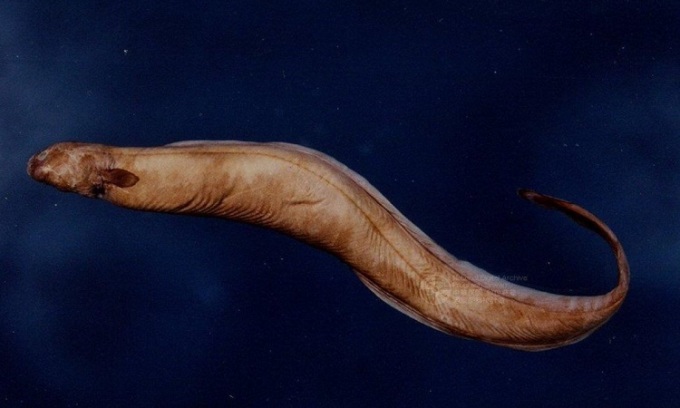
Snub-nosed eels typically live at depths of 500-1,800 meters. Photo: Weird Animals
Inside the hearts and internal organs of sharks, scientists occasionally encounter a rare parasite: the snub-nosed eel ( Simenchelys parasitica ). In a 1997 case, two eels nested in the heart of a large shortfin mako shark ( Isurus oxyrinchus ) and digested the shark's blood. Ten years later, in 2007, snub-nosed eels were found in the heart, body cavity, and muscles of a small-toothed sand shark ( Odontaspis ferox ), according to Science Alert . In fact, snub-nosed eels don't necessarily need to be parasites. They can live comfortably underwater, feeding on carcasses on the seabed. But snub-nosed eels prefer to burrow through the skin and flesh of larger fish.
Researchers were unaware of eel parasitism in sharks until they collected the carcass of a male shortfin mako shark from the North Atlantic seabed in June 1992 and brought it ashore in Montauk, New York. The shark, weighing 395 kg, was entangled in fishing lines and was already dead by the time it was brought aboard. Its pale coloration indicated it had been at the muddy seabed for some time. The mako shark carcass was placed in a cold room for researchers to carefully examine it to determine the cause of death.
The following day, when biologists Janine Caira of the University of Connecticut and Nancy Kohler of the Northeast Fisheries Science Center dissected the shark, they discovered two nearly mature female snub-nosed eels, 21 and 24 cm long, nested in its heart. Both had died from being brought out of the sea and refrigerated, but had previously appeared healthy. Furthermore, there was evidence the eels had been hiding in the shark's heart for some time. According to the research team led by Caira, the stomachs of both eels were full of blood, indicating they had been inside the shark's body long enough to feed. The shark's heart also showed damage that the six other shortfin mako sharks that were not parasitized did not.
However, scientists couldn't find evidence of how the eels burrowed into the shark's heart from the outside. They speculated that the eels found the shark injured or dead from being hooked and took advantage of the situation to feed. Before or after the animal died, the two eels burrowed into the gills or throat. Then, they entered the circulatory system via the efferent or aortic artery and traveled to the heart. Throughout this process, they digested the blood to survive.
In 2007, researchers found the carcass of a 3.7-meter-long female sand tiger shark floating in the sea near Fuerteventura in the Canary Islands. Inside its body were several snub-nosed eels in its heart and dorsal muscle tissue. The shark was mature but had completely lost its ovaries, possibly eaten by the eels or due to natural degeneration, according to the research team led by biologist Ian Fergusson. The eels may have contributed to the shark's death, as no external or internal injuries were detected. Both cases reflect the survival strategy of the snub-nosed eel: facultative parasitism.
An Khang (According to Science Alert )
Source link

![[Photo] Prime Minister Pham Minh Chinh receives the Governor of Tochigi Province (Japan)](/_next/image?url=https%3A%2F%2Fvphoto.vietnam.vn%2Fthumb%2F1200x675%2Fvietnam%2Fresource%2FIMAGE%2F2025%2F12%2F16%2F1765892133176_dsc-8082-6425-jpg.webp&w=3840&q=75)
![[Live] 2025 Community Action Awards Gala](/_next/image?url=https%3A%2F%2Fvphoto.vietnam.vn%2Fthumb%2F1200x675%2Fvietnam%2Fresource%2FIMAGE%2F2025%2F12%2F16%2F1765899631650_ndo_tr_z7334013144784-9f9fe10a6d63584c85aff40f2957c250-jpg.webp&w=3840&q=75)

![[Image] Leaked images ahead of the 2025 Community Action Awards gala.](/_next/image?url=https%3A%2F%2Fvphoto.vietnam.vn%2Fthumb%2F1200x675%2Fvietnam%2Fresource%2FIMAGE%2F2025%2F12%2F16%2F1765882828720_ndo_br_thiet-ke-chua-co-ten-45-png.webp&w=3840&q=75)
![[Photo] Prime Minister Pham Minh Chinh receives Lao Minister of Education and Sports Thongsalith Mangnormek](/_next/image?url=https%3A%2F%2Fvphoto.vietnam.vn%2Fthumb%2F1200x675%2Fvietnam%2Fresource%2FIMAGE%2F2025%2F12%2F16%2F1765876834721_dsc-7519-jpg.webp&w=3840&q=75)




















































































Comment (0)