

On the afternoon of May 12th, the Ho Chi Minh City People's Committee organized a workshop on the research project for the construction of the Can Gio International Transshipment Port.

Opening the workshop, Vice Chairman of the Ho Chi Minh City People's Committee Bui Xuan Cuong assessed that the more than 300-year history of Saigon - Ho Chi Minh City is closely linked to the development of seaports and maritime transport.
To date, Ho Chi Minh City's seaports have been fundamentally developed according to the plan. The ports are modern, equipped with new technologies, and efficiently operated, making a significant contribution to the socio -economic development of the city and the region, especially Cat Lai port with a throughput of 5 million TEU/year, ranking among the top 22 largest ports in the world.
According to the leaders of the Ho Chi Minh City People's Committee, Resolution 24 on socio-economic development and ensuring national defense and security in the Southeast region until 2023, with a vision to 2045, and Resolution 31 on the direction and tasks for the development of Ho Chi Minh City until 2030, with a vision to 2045, issued by the Politburo , both identify one of the main tasks and solutions as researching and promoting investment in the construction of the Can Gio International Transshipment Port in the period 2021-2030.
Therefore, the workshop was organized to gather feedback and ideas from experts, scientists , and relevant units on successful deep-water port and seaport models around the world, and to identify difficulties and challenges facing the Can Gio International Transshipment Port.
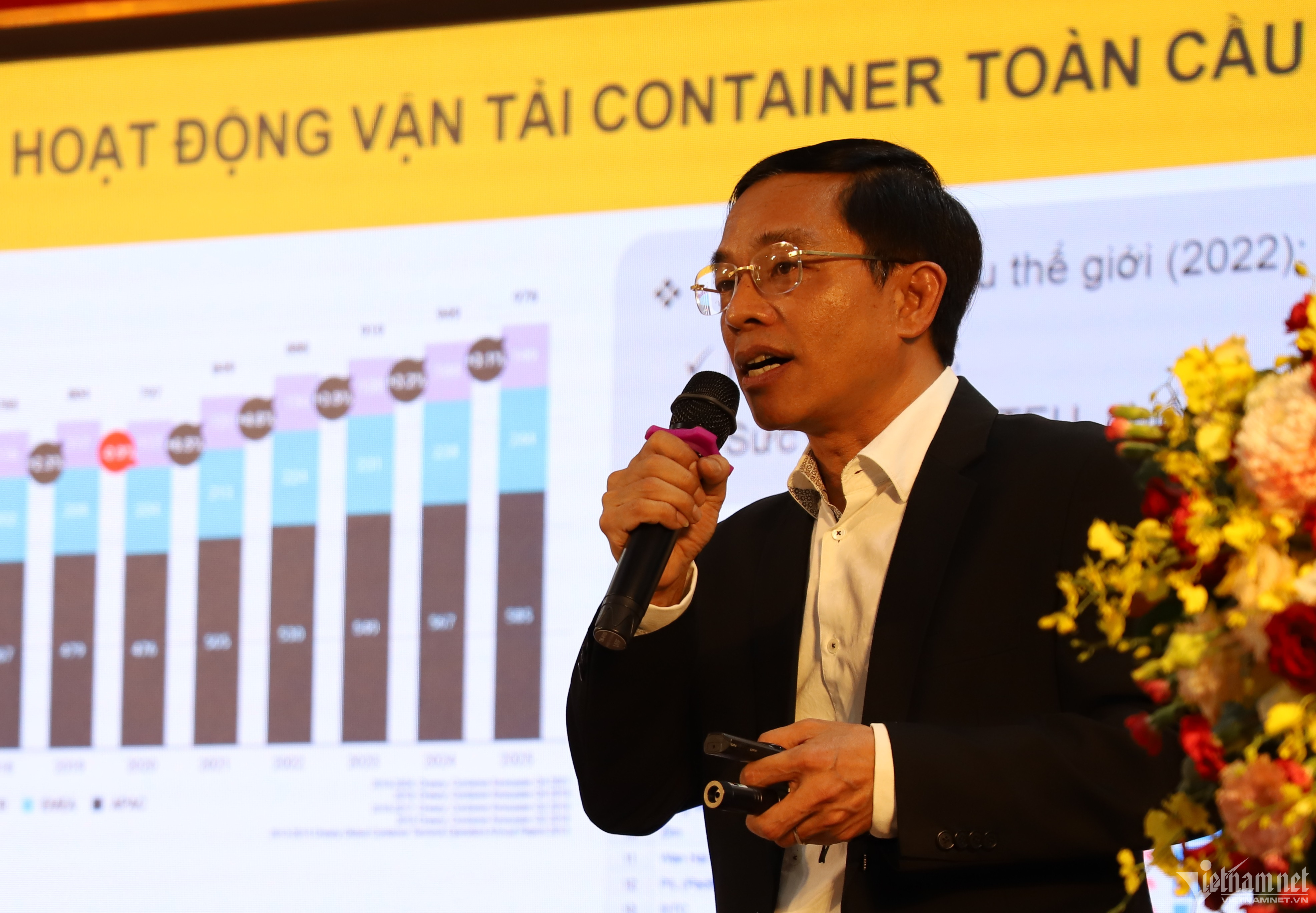
Reporting at the workshop, Mr. Pham Anh Tuan, General Director of Vietnam Port and Marine Engineering Consulting Joint Stock Company, stated that the planned location for the Can Gio International Transshipment Port is in the Phu Loi Island area (Thanh An commune, Can Gio district). This area has over 93 hectares of protected forest, including more than 82 hectares of forested land, and is surrounded by the Thi Vai and Theu rivers.
The investor has committed to bringing technology and expertise to apply green port technology, reduce emissions and waste, and develop a plan for rational use and exploitation, preventing environmental incidents. For the more than 82 hectares of forest affected, relevant units will carry out reforestation.
According to Mr. Tuan, currently about 70-80% of import and export goods transported to and from the Cai Mep - Thi Vai port area on the opposite bank are transported by waterway. Therefore, the Can Gio International Transshipment Port will focus entirely on sea transport before 2030; after 2030, road transport will be studied, connecting the port to the Rung Sac road.
The estimated cost for the Can Gio International Transshipment Port project is nearly 129,000 billion VND (over 5 billion USD). The total cargo throughput is expected to reach 4.8 million TEU by 2030, gradually increasing to 16.9 million TEU when the project operates at full capacity (expected in 2047).
Act early to avoid missing out on opportunities.
At the seminar, Dr. Tran Du Lich, a member of the National Financial and Monetary Policy Advisory Council, expressed his agreement with the construction of the Can Gio International Transshipment Port. He cited the extremely favorable location and, more importantly, the fact that the investor is a leading global maritime transport company.
"The success of a seaport project depends on whether the desires of the investor and the management agencies align. Where the state's planning and the investor's intentions meet, that's where success will come. If our planning doesn't align with the investor's desired location, it will be very difficult," Dr. Tran Du Lich expressed.

The expert also stated that the establishment of the Can Gio International Transshipment Port is a large-scale project, requiring extensive preparation and involvement from Ho Chi Minh City and relevant parties. The challenge for this mega-port is how to create a large-scale project while preserving the environment and transforming Can Gio's coastal area into a major development hub.
"I propose that we shouldn't consider Cai Mep-Thi Vai as belonging to Ba Ria-Vung Tau province, or Can Gio as belonging to Ho Chi Minh City. We must consider both of these port systems as belonging to the entire Southeast region and the whole nation."
Therefore, the Southeast Region Coordination Board must coordinate from the outset, forgetting localistic thinking, and viewing these as two components of a whole international transshipment port system that can compete with countries around the world,” the expert suggested.

Contributing further to the workshop, Director of the Ho Chi Minh City Customs Department, Dinh Ngoc Thang, stated that the Can Gio International Transshipment Port construction project is a long-awaited aspiration of many generations. This project has immense significance for the maritime industry and the economic development not only of Ho Chi Minh City but also of the entire Southeast region.
"Currently, Ho Chi Minh City only has two ports, Tan Cang and Hiep Phuoc, but they are small in scale, like small markets. Building the Can Gio International Transshipment Port is extremely important; if we don't do it now, we will fall behind. This port will be a large market, a central hub, so I hope the leaders of the Ho Chi Minh City People's Committee and the association will be determined to do it as soon as possible," Mr. Thang expressed his opinion.

Source


![[Photo] Prime Minister Pham Minh Chinh presides over the fourth session on private economic development.](/_next/image?url=https%3A%2F%2Fvphoto.vietnam.vn%2Fthumb%2F1200x675%2Fvietnam%2Fresource%2FIMAGE%2F2026%2F01%2F31%2F1769835553414_ndo_br_dsc-7213-jpg.webp&w=3840&q=75)

![[Photo] General Secretary To Lam attends the Inauguration Ceremony of the Ho Chi Minh Memorial House at the E2 Hill historical site.](/_next/image?url=https%3A%2F%2Fvphoto.vietnam.vn%2Fthumb%2F1200x675%2Fvietnam%2Fresource%2FIMAGE%2F2026%2F01%2F31%2F1769831648495_vna-potal-tong-bi-thu-to-lam-du-le-khanh-thanh-nha-tuong-niem-chu-tich-ho-chi-minh-tai-di-tich-doi-e2-8564287-1-2231-jpg.webp&w=3840&q=75)


![OCOP during Tet season: [Part 3] Ultra-thin rice paper takes off.](/_next/image?url=https%3A%2F%2Fvphoto.vietnam.vn%2Fthumb%2F402x226%2Fvietnam%2Fresource%2FIMAGE%2F2026%2F01%2F28%2F1769562783429_004-194121_651-081010.jpeg&w=3840&q=75)


![OCOP during Tet season: [Part 2] Hoa Thanh incense village glows red.](/_next/image?url=https%3A%2F%2Fvphoto.vietnam.vn%2Fthumb%2F402x226%2Fvietnam%2Fresource%2FIMAGE%2F2026%2F01%2F27%2F1769480573807_505139049_683408031333867_2820052735775418136_n-180643_808-092229.jpeg&w=3840&q=75)


Comment (0)