

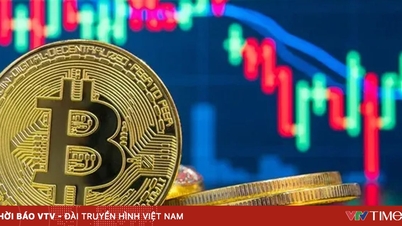
The Russian lower house of parliament has passed a bill paving the way for the use of cryptocurrencies in international payments, aiming to circumvent Western sanctions. According to observers, the battle on the cryptocurrency "front" to thwart Russia's economic efforts is sure to be fierce.
Used in international payments.
The bill allows the Russian Central Bank (BOR) to establish a pilot project to promote the use of cryptocurrencies in international payments – something that has been prohibited until now. The bill will also strictly regulate the production of virtual currencies, stipulating that only state-authorized enterprises will be allowed to produce cryptocurrencies on a large scale. After being approved by the lower house of parliament, the bill will await passage from the upper house and presidential ratification before officially taking effect.
In the field of cryptocurrencies, in addition to those produced by businesses such as Bitcoin, according to Russian news agencies, the Bank of Russia (BOR) will move from a pilot program to the widespread deployment of the digital ruble from July 2025. The BOR has been conducting a pilot project with the digital ruble since August 2023. Reuters quoted economist Anatoly Aksakov, Chairman of the Finance Committee of the Russian State Duma, as saying that Moscow is making a historic decision in the financial sector.
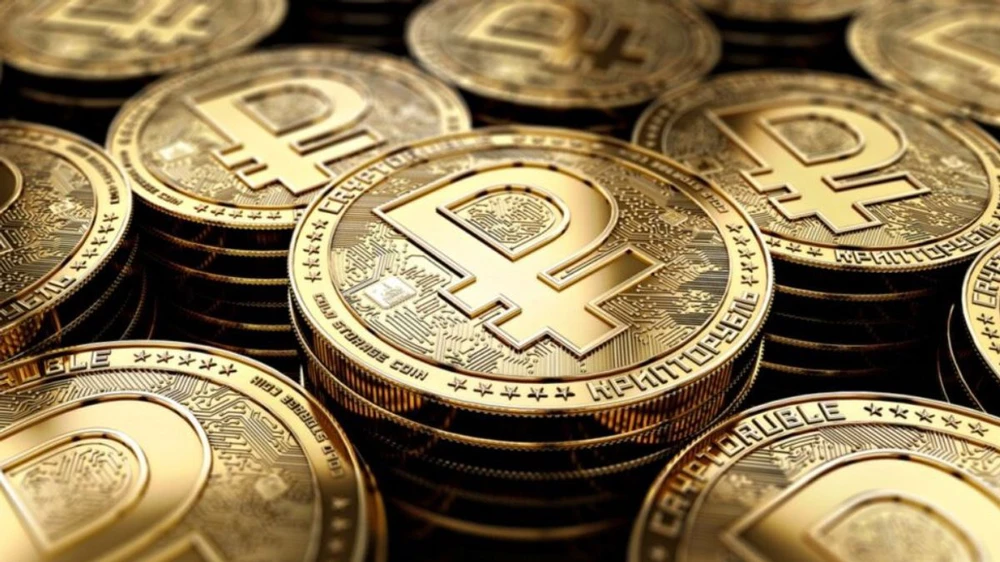
According to some analysts, Moscow hopes that the use of cryptocurrencies in general will be harder for Western regulators to detect. This would make it easier for Russia to purchase goods on the international market that are banned from sale to Russia.
Mati Greenspan, CEO of Quantum Economics (a company specializing in cryptocurrency market research), emphasized that Russia believes transactions, such as with bitcoin, will not be blocked by any government or bank. According to BOR Governor Elvira Nabiullina, cryptocurrency payments will begin before the end of this year.
Accelerate the adoption of cryptocurrencies.
Could cryptocurrencies help countries circumvent sanctions? According to expert Greenspan, using cryptocurrencies in international payments could help Russia in this regard. The expert from Quantum Economics cites several examples, such as North Korea being repeatedly accused of raising millions of dollars in cryptocurrencies for various Pyongyang programs, or Iran being accused of using cryptocurrencies to bypass international trade barriers.
According to Elvira Nabiullina, it will take 5-7 years for the digital ruble to be widely adopted in society. Moscow is accelerating the deployment of virtual currency, partly due to the rapid advancements in cryptocurrency technology which are making it increasingly popular. On the other hand, the tightening Western sanctions are forcing Russia to seek an escape route.
The BOR governor emphasized that "secondary sanctions" have made it more difficult to pay for imports and have led to an 8% decrease in imports into Russia this year.
The digital ruble is stored in an electronic wallet. Transactions using this currency are monitored by the Federal Security Service of Russia. During the trial, users of the digital ruble were able to make payments at 30 points of sale in 11 Russian cities.
According to BOR, these transactions are free for individuals, while businesses only have to pay a very small fee. VTB, Russia's second-largest bank, said it has successfully tested transactions using the digital ruble in its mobile application.
Compiled by MINH CHÂU
Source: https://www.sggp.org.vn/lach-trung-phat-bang-tien-dien-tu-post752457.html

![[Photo] Prime Minister Pham Minh Chinh receives the Chinese Ambassador to Vietnam](https://vphoto.vietnam.vn/thumb/1200x675/vietnam/resource/IMAGE/2026/04/05/1775397481797_ndo_br_dsc-5512-jpg.webp)
































































































Comment (0)