

This draft law is not only anticipated by the business community but also receives attention from state agencies at all levels, due to expectations of perfecting the legal system for water resource management in the context of strengthening water security, overcoming shortcomings and existing problems in water resource management, and meeting the requirements of international integration.
Mobilizing the dedication and expertise of specialists in amending the Law.
According to Mr. Chau Tran Vinh, Director of the Department of Water Resources Management, during the drafting process of the amended Law on Water Resources, the Department of Water Resources Management, in its role as the drafting agency, organized many working sessions and directly exchanged views with international experts from organizations such as the World Bank, AFD, KOICA, IUCN, JICA, etc., to gain a deeper understanding of management models, regulatory contexts, development levels, and practical implementation of policies in advanced countries around the world , as well as countries with similar conditions to Vietnam.
Specifically, the drafting agency studied the experience of state management of water resources in countries around the world with the support of international experts such as Australian experts on scarcity and regulation and allocation of water resources; Dutch experts on water storage, water source protection corridors and groundwater; World Bank experts on water economics ; French experts on integrated river basin management; Korean experts on river restoration and rehabilitation, information and data; American experts related to the protection of riverbeds, banks and floodplains; Italian experts related to the operation and management of water reservoirs; Finnish experts related to groundwater, etc. At the same time, numerous working sessions and workshops were organized with domestic and international experts, and the Vietnam Federation of Commerce and Industry provided feedback on each content of the Draft Law.
In addition, the draft Law on Water Resources (amended) has been sent by the Ministry of Natural Resources and Environment to ministries, sectors, and localities for comments; it has also been publicly posted on the Government's electronic portal and the Ministry's website to gather broad feedback from citizens and businesses in accordance with regulations. Based on this, the Ministry of Natural Resources and Environment has received 94 documents and comments (20 comments from ministries and ministerial-level agencies, 63 comments from provincial-level agencies, 10 comments from associations and large water-using enterprises, and 1 comment from the Government's electronic portal).
Minister of Natural Resources and Environment Dang Quoc Khanh particularly emphasized: The drafting of the amended Water Resources Law is an important political task, aiming to institutionalize the new views, policies, and guidelines of the Party and State on the management and protection of water resources and ensuring national water security. Therefore, the Minister requested the drafting agency to study the opinions of National Assembly deputies to finalize the draft amended Water Resources Law. The draft amended Water Resources Law will address practical difficulties and overlaps between the Water Resources Law and other laws, unifying the investigation, management, exploitation, and use of water resources from the central to local levels, and unifying water resource management.
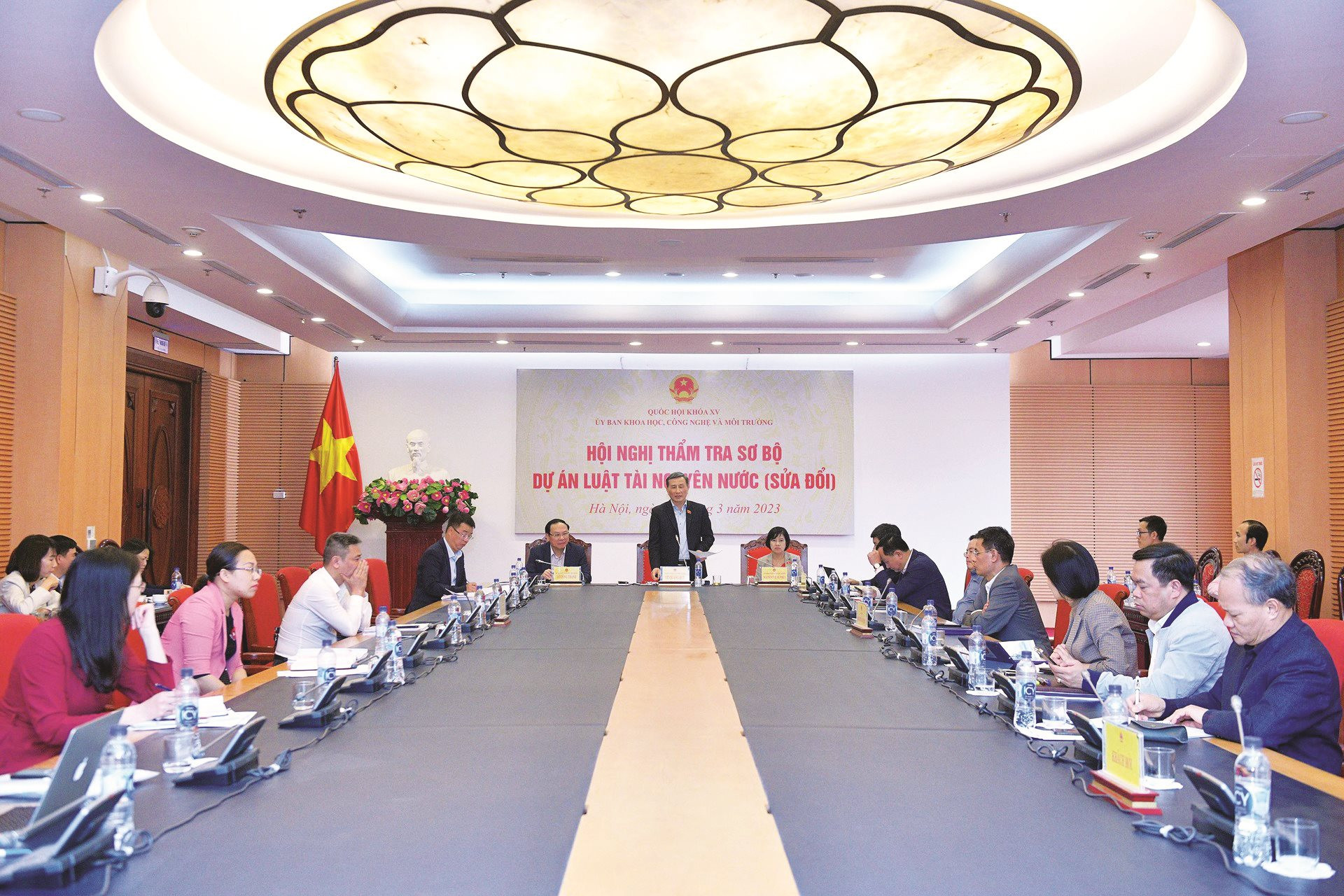
Specifically, to facilitate the review process, the Standing Committee of the National Assembly's Committee on Science, Technology and Environment organized numerous field surveys in localities related to the operation of hydropower plants and water treatment plants – areas directly affected by water resource utilization; organized workshops in the North, Central, and South regions; and held many consultation seminars with experts and scientists to mobilize and promote the role and intellect of those with practical experience in the field of water resources to contribute opinions to improve the draft Law; and organized widespread consultations with relevant agencies, organizations, the National Assembly's Ethnic Council, and other National Assembly committees on the content of the draft Law.
This is perhaps not a completely new approach, because when drafting any important law, ministries and the Standing Committee of the National Assembly will conduct surveys and gather opinions from organizations, businesses, and the public, especially since the field of water resources is vast, has a profound and direct impact on the rights and interests of every citizen and business, because water is a particularly important resource, an essential component of life and the environment, and determines the existence and sustainable development of the country.
In particular, given the current rapid socio-economic development, coupled with the ever-increasing water usage activities and the severe impacts of climate change, many challenges are being posed in the management and sustainable protection of national water resources.
The scope of soliciting feedback needs to be further expanded.
Following extensive consultations with experts, scientists, managers, citizens, and businesses through various direct and online methods, voters and National Assembly representatives once again had the opportunity to contribute their opinions on the draft Law on Water Resources (amended) in the National Assembly forum. The ongoing 5th session of the 15th National Assembly has devoted considerable time to this draft. On June 5th, 19 groups with nearly 500 National Assembly representatives submitted hundreds of compiled opinions and suggestions on the draft law.
Deputy Minister of Natural Resources and Environment Le Cong Thanh affirmed: The perspective in drafting the amended Water Resources Law is to institutionalize the view that water resources are public assets owned by the entire people and managed uniformly by the State. Water resources must be the core in the development of economic and social development plans, population plans, and plans for various sectors and fields. At the same time, it inherits the provisions of the 2012 Water Resources Law that are currently effective; abolishes inadequate provisions; and updates, amends, and supplements existing regulations to ensure their suitability.
The draft Law on Water Resources (amended) consists of 88 articles and is structured into 10 chapters. Compared to the 2012 Law, the draft Law does not increase the number of chapters (10 articles remain unchanged; 62 articles are amended or supplemented; and 16 new articles are added) and 8 articles are repealed.
On June 22nd, the draft law will be presented to the National Assembly for comprehensive feedback. The drafting committee and the government will also have the opportunity to clarify issues where there are still many differing opinions and concerns, such as: the scope of the draft law; basic investigation, strategy, and planning of water resources; protection of water resources and restoration of water sources; regulation, distribution, exploitation, and use of water resources; prevention, control, and remediation of harmful consequences caused by water; economic tools, policies, and resources for water resources…
Immediately following the June 5th consultation sessions in 19 groups on the draft Law on Water Resources (amended), the Department of Water Resources Management promptly compiled the opinions of National Assembly deputies according to thematic groups, and at the same time seriously considered and explained many important issues raised by the National Assembly deputies.
However, with a law that profoundly impacts social life like the Water Resources Law, it is crucial that the Government and the drafting agencies pay more attention to promoting policy communication and, at the same time, soliciting broader opinions from all segments of the population to gather more insightful, intelligent, and comprehensive feedback in order to thoroughly address the remaining obstacles in practical management. Because if land resources are considered the "value of life," then water resources are the "quality of life." Whether the quality of life is ensured depends on whether water resources are managed and allocated rationally and scientifically.
Although all comparisons are flawed, given the importance of water resources in social life, especially under the profound impact of climate change which is causing precious water resources to become increasingly depleted and difficult to restore, the voices and heartfelt contributions of all sectors of society are even more necessary. When the Law is enacted, it will create a truly important resource to improve the quality of life for all citizens.
Source













































































Comment (0)