

Some common causes of fires include: overloaded electrical equipment, open circuits causing short circuits, carelessly discarding cigarette butts, candles left on, negligence during cooking, and malfunctions in gas valves or lines. Therefore, everyone needs to equip themselves with the necessary skills to handle fires in order to ensure their own safety and the safety of those around them.
5 THINGS YOU NEED TO EQUIP YOURSELF WITH
1. Know the emergency exits: Always make it a habit to check the emergency exits when entering any place: your workplace, places you visit, meetings, events, shopping malls, movie theaters, schools, etc. For example, parents taking their children to supermarkets, movie theaters, or indoor playgrounds should make it a habit to take them on a walk around to find the emergency exits, the location of mini fire extinguishers, the condition of the emergency stairwells, and the assembly area before proceeding with play or shopping. This helps create a habit for both parents and children, so that when the children grow up, they will also learn this habit from their parents. This is the first thing to know in case of any unfortunate incident.
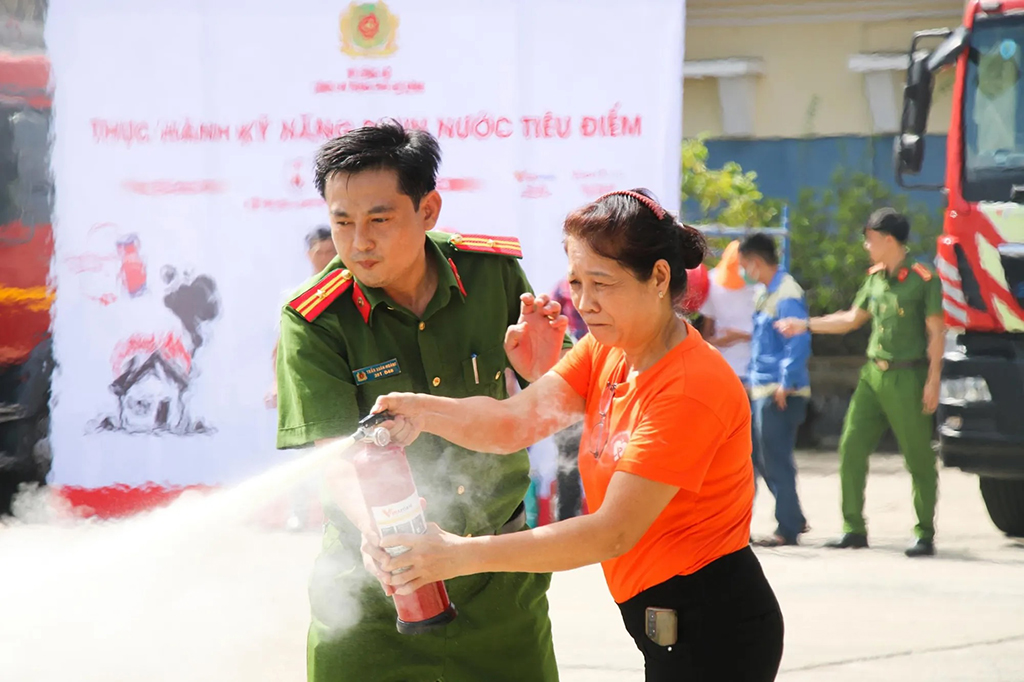
Residents practice using fire extinguishers at a fire safety training session organized by the Da Nang City Police on October 7th, as part of the National Fire Prevention and Control Action Month program (October).
Additionally, it's advisable to draw an escape plan for your home, always identifying at least two escape routes and ensuring all family members participate in the process, as well as agreeing on a safe gathering point suitable for each situation. Practice the escape plan with family members several times to make adjustments as needed.
2. Fire safety knowledge: The whole family, or at least one family member, should participate in a "Fire Safety" course organized periodically by professional organizations.
3. First Aid Skills: The entire family, or at least one adult, should take a "Basic First Aid Skills" course to know how to handle health-related problems, accidents, etc.
4. Inspection and Cleaning: Regularly check the condition of electrical systems and appliances in your home, as well as fire and smoke detectors (if any). Periodically clean and remove flammable materials from your home, especially in the kitchen, living room, and bedrooms. Ensure that emergency exits have an automatic opening and closing function: they should always open when needed and automatically close when someone opens them. Ensure that emergency exits are not left open due to obstructions and that the escape routes are not used for storing items. When leaving the house, always check and ensure that the gas is turned off and all cooking appliances are switched off.
5. Fire safety equipment: The factory can be equipped with fire and smoke detectors, fire extinguishing and escape aids such as mini fire extinguishers, fire blankets, thick ropes with specialized hooks, escape hammers, etc.
5 THINGS TO DO IN CASE OF A FIRE
1. If you discover a fire, shout out the specific location of the fire to help those around you make the most appropriate decisions in that situation. At the same time, press the fire alarm button on the building's fire alarm system and immediately call 114.
2. When a fire starts to grow, after 2 minutes, toxic fumes begin to spread and affect respiration. Try to remain calm and deal with the fire using a small fire extinguisher if the fire is still small. If the fire on other floors has spread, you need to assess the situation to make the most appropriate decision. The general rule is to go down to the ground floor because toxic fumes are lighter and rise, but in some cases, if the stairwell is filled with toxic fumes, you should go to a higher floor. Absolutely do not use the elevator.
3. Don't worry about finding documents or belongings to take with you; prioritize escaping according to the decision made beforehand. Note that decisions should be made continuously depending on the progress of the fire. Remember that smoke is very dangerous; you need to crouch low to the ground and crawl out. If you have enough time, find a towel or cloth, dampen it with water, and cover your mouth and nose to limit the amount of toxic fumes entering your respiratory system.
4. Use the back of your hand to check the main door. If it feels hot, absolutely do not open it. A hot door means there is a fire burning outside, and if you open it, the fire will rush in. At this time, you need to find a secondary escape route such as a balcony or window. If you cannot find any escape route, stay inside the room and use wet clothes, towels, or blankets to seal any gaps to prevent smoke from entering. If you catch fire, immediately lie down on the ground and roll around.
5. Cooperate with rescue forces. Remain calm and follow the instructions of the rescue team and police. This is especially important; do not let panic prevent you from having a chance of safety in extremely urgent situations.
Source link
![[Image] Leaked images ahead of the 2025 Community Action Awards gala.](/_next/image?url=https%3A%2F%2Fvphoto.vietnam.vn%2Fthumb%2F1200x675%2Fvietnam%2Fresource%2FIMAGE%2F2025%2F12%2F16%2F1765882828720_ndo_br_thiet-ke-chua-co-ten-45-png.webp&w=3840&q=75)
![[Image] The tenacious fighting spirit of Vietnamese women's football](/_next/image?url=https%3A%2F%2Fvphoto.vietnam.vn%2Fthumb%2F1200x675%2Fvietnam%2Fresource%2FIMAGE%2F2025%2F12%2F17%2F1765990260956_ndo_br_4224760955870434771-copy-jpg.webp&w=3840&q=75)
![[Photo] Prime Minister Pham Minh Chinh receives the Governor of Tochigi Province (Japan)](/_next/image?url=https%3A%2F%2Fvphoto.vietnam.vn%2Fthumb%2F1200x675%2Fvietnam%2Fresource%2FIMAGE%2F2025%2F12%2F16%2F1765892133176_dsc-8082-6425-jpg.webp&w=3840&q=75)
![[Live] 2025 Community Action Awards Gala](/_next/image?url=https%3A%2F%2Fvphoto.vietnam.vn%2Fthumb%2F1200x675%2Fvietnam%2Fresource%2FIMAGE%2F2025%2F12%2F16%2F1765899631650_ndo_tr_z7334013144784-9f9fe10a6d63584c85aff40f2957c250-jpg.webp&w=3840&q=75)

![[Photo] Prime Minister Pham Minh Chinh receives Lao Minister of Education and Sports Thongsalith Mangnormek](/_next/image?url=https%3A%2F%2Fvphoto.vietnam.vn%2Fthumb%2F1200x675%2Fvietnam%2Fresource%2FIMAGE%2F2025%2F12%2F16%2F1765876834721_dsc-7519-jpg.webp&w=3840&q=75)


























































![[Live] Closing Ceremony and Award Presentation for the "Impressive Vietnam Tourism" Video/Clip Creation Contest 2025](https://vphoto.vietnam.vn/thumb/402x226/vietnam/resource/IMAGE/2025/12/17/1765974650260_z7273498850699-00d2fd6b0972cb39494cfa2559bf85ac-1765959338756946072104-627-0-1338-1138-crop-1765959347256801551121.jpeg)


















Comment (0)