


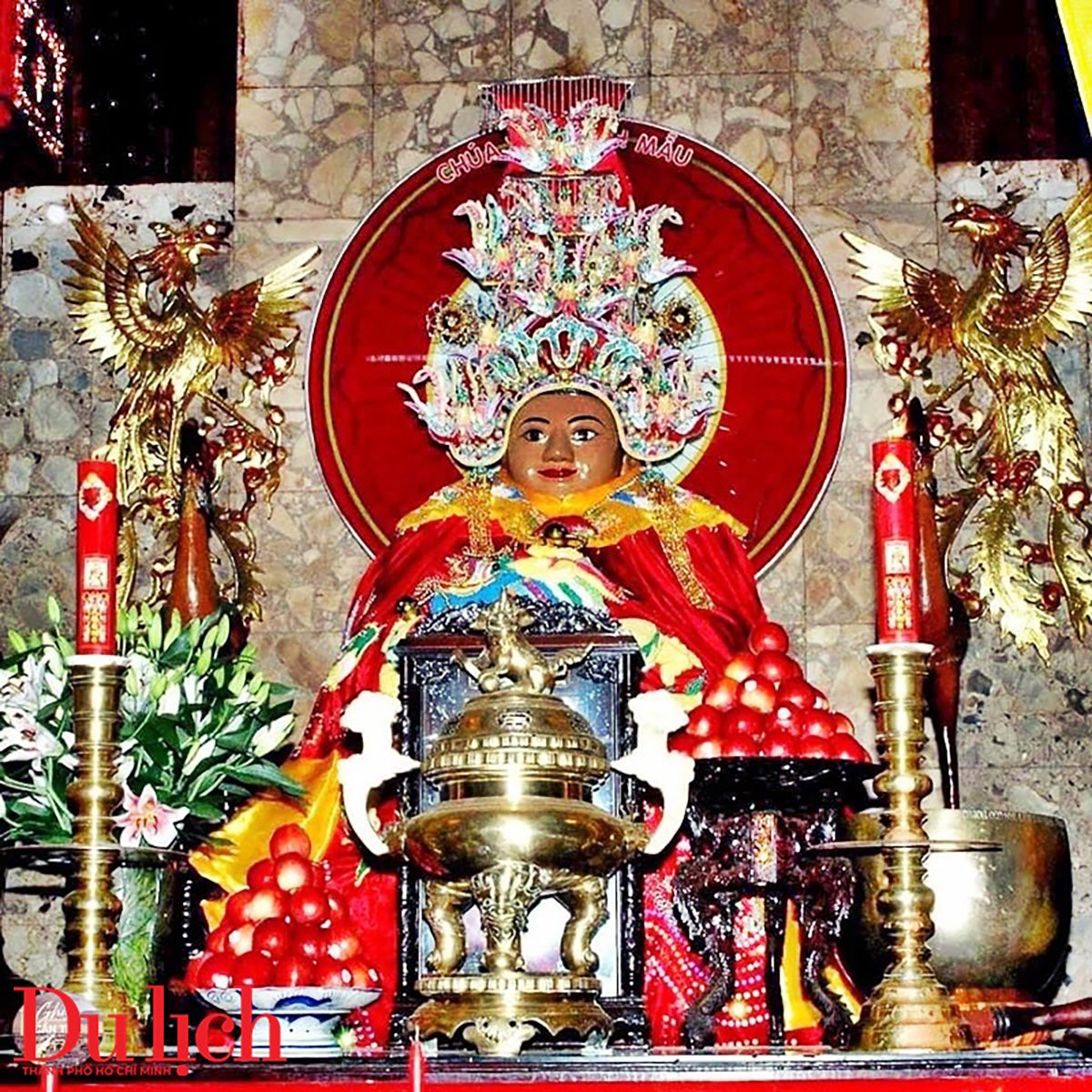
Historical records and legends of the inhabitants of Vinh Te village all acknowledge that the statue of the Lady of the Land, whose origin is unknown, has long resided halfway up Mount Sam (Hoc Lanh Son). It may be a product of the Oc Eo culture during the Funan Kingdom period from the 1st to 7th centuries, or even earlier. Believing in the sacredness of the statue, local people often come to burn incense and pray for protection from wild animals, for favorable weather, for a warm and happy family life, and for their wishes to be granted. From then on, the 1.65m tall statue became a spiritual anchor for the people, known as the Lady of the Land, even though it was only known to be made of stone and whether it depicted a man or a woman was unclear.
Two centuries have passed, yet the "residence" of the Lady of Sam Mountain, as well as the origin of the statue and the legends surrounding its relocation, along with many related events, remain a mystery. But above all, the statue is highly sacred and revered by the people. From the 23rd to the 27th of April in the lunar calendar each year, an average of millions of people from all over, both domestically and internationally, come to worship, pay their respects, and pray for blessings, good fortune, and divine intervention.
Moving the statue of Lady of the Land
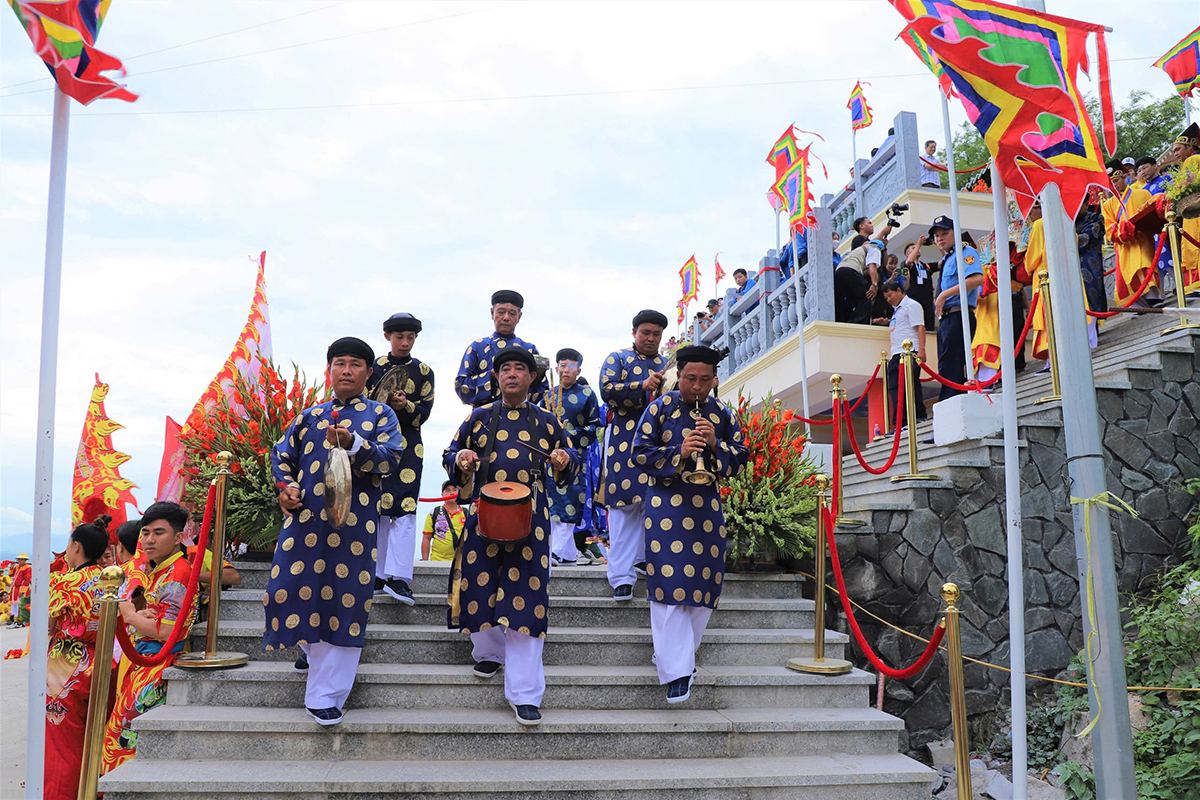
Wishing to worship the Goddess of the Land in a convenient and solemn manner, the elders of that time discussed moving the statue down the mountainside to build a shrine for her (currently located in Vinh Tay 1 hamlet, Nui Sam ward, Chau Doc city). After the prayers, nine strong young men were tasked with carrying the statue, but despite their best efforts, the statue wouldn't budge. At that moment, the "girl whom the Goddess had touched" announced that nine virgin girls, having bathed and cleansed themselves, had to go up the mountainside to perform a ceremony to bring the statue down before she would allow it to descend. After following the instructions, the nine girls carried the statue easily, but upon reaching the current shrine site, the statue suddenly became heavy and immobile. The elders believe that the Goddess wished to rest her back against the mountainside and watch the villagers go about their lives. That was the wish of the Goddess of the Land.
Regarding the statue of the Goddess, there is a legend that during the 1820s, when Siamese soldiers frequently raided and plundered the Sam mountain region, they encountered the statue. One day, they tied it to a rope and carried it down the mountain to take it back to their country. After carrying it a short distance, the statue suddenly became too heavy to lift. An enraged soldier struck the statue and was immediately punished by the Goddess, while the remaining soldiers fled in fear. The main hall of the Goddess's temple also has a couplet: "Prayers are always answered, offerings are always miraculous, omens revealed in dreams / The Siamese are terrified, the Qing are revered, beyond comprehension."
Speaking to the media about the statue of the Goddess, Dr. Lam Quang Lang, Vice Chairman of the Provincial Historical Science Association, said, "The Vietnamese people's religious custom is to worship goddesses, and it is possible that the statue of the Goddess of the Land was erected at the intention of Mr. Thoai Ngoc Hau. Faced with the raging epidemic and the harsh mountain climate eroding the people's strength and causing unrest, Mr. Thoai Ngoc Hau had the statue brought down from the mountain and established a temple to worship the Goddess so that the people would believe in a supernatural force protecting and guiding them, giving them the strength to overcome difficulties and build a life in this 'borderland' of the country."
According to another version of the story, it is said that 80,000 laborers were mobilized to dig the Vinh Te Canal, but during the work, they continuously encountered illness, attacks by wild animals, and deaths from accidents. Hearing from the villagers about the sacredness of the Lady of the Land, Mrs. Chau Thi Te, the wife of Thoai Ngoc Hau, went to Mount Sam to pray to the sacred statue. Indeed, after the ceremony, the canal digging proceeded smoothly. Believing and giving thanks, Thoai Ngoc Hau decided to build a temple dedicated to the Lady of the Land so that the people could worship her solemnly and conveniently.
The origin of the statue of Lady of the Land
According to French archaeologist Malleret, who studied the site in 1941, the statue of the Lady of Sam Mountain originated in India, belonging to the category of statues of the god Vishnu (male deity), one of the three supreme gods in Brahmanism. The statue, 1.65m tall and made of sandstone (also known as red stone), is of high artistic value, depicting a pensive, noble figure. It dates back to around the late 6th century and may be one of the surviving ancient artifacts of the Oc Eo culture. Previously, the statue was placed on a stone pedestal in the southeast of Sam Mountain. The pedestal is 1.6m wide, 0.3m thick, with a square hole in the center measuring 0.34m on each side. It is made of dark green, fine-grained sedimentary rock. Research indicates this type of rock is not found locally.
In his work "The Mekong Delta - Ancient Way of Life," the late writer Son Nam asserted that the statue of the Lady of the Land was a male Buddha statue of the Khmer people, and that this statue had been forgotten for a long time on the summit of Mount Sam. Vietnamese people migrating from the North brought the statue into the temple, painted it, dressed it in silk robes, added a necklace, and transformed the male statue into a female one. Mr. Tran Van Dung, author of the book "History of the Exploitation of Chau Doc Land 1757 - 1857," also confirmed that the statue of the Lady of the Land is a male statue, seated in a regal posture. The head of the statue is not original but was later crafted from a different type of stone than the body.
Regarding the temple and statue of Lady of the Land
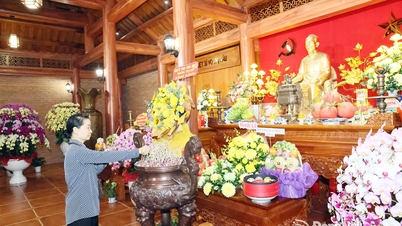
Initially, the temple was simply constructed of bamboo and leaves, situated in a low-lying area northwest of Mount Sam, with its back against the mountain and the main hall overlooking the road and fields of the old Vinh Te village. In 1870, the temple was rebuilt with brick and mortar. In 1962, it was renovated with stone slabs and covered with yin-yang tiles. In 1965, the temple's benefactors expanded the guesthouse and built a fence around the main hall. In 1972, the temple underwent a major reconstruction, completed in 1976, giving it its current appearance. The architects were Huynh Kim Mang and Nguyen Ba Lang.
To this day, the origin of the statue of the Goddess of Sam Mountain, as well as the history of the Goddess of Sam Mountain, remains a mystery and a legend. These anecdotes continue to be passed down to future generations. However, regardless of whether the statue depicts a male or female deity and its origin, in the minds of not only the people of Southern Vietnam, the Goddess of Sam Mountain remains a spiritual anchor. People visit her with reverence and worship, believing her to be a powerful goddess who blesses the country with peace , secure borders, unity among the people to overcome difficulties, prosperity in business, and a comfortable and flourishing life. With this aspiration, millions of visitors from all over the world gather annually to pay their respects, worship, and give thanks to her.
With its historical development and current grandeur, the Ba Chua Xu Temple on Sam Mountain was recognized by the Vietnam Book of Records Center as the largest temple in Vietnam on May 25, 2008, with a spacious area of approximately 3,000 m² . In 2009, the statue of the Goddess was recorded in the An Giang Book of Records as the oldest sandstone statue in Vietnam and the one with the most offerings of robes. The statue of the Goddess is recognized by the Vietnam Book of Records Center as the oldest and largest sandstone statue of the Goddess in Vietnam...
Source: https://baoangiang.com.vn/an-giang-24-gio/thoi-su/ky-bi-ve-ba-chua-xu-nui-sam-a417216.html








































![[Photo] Coc Ly market bustling on the eve of Tet](https://vphoto.vietnam.vn/thumb/402x226/vietnam/resource/IMAGE/2026/02/14/1771062261424_baolaocai-br_img-6457-jpg.webp)


Comment (0)