

Like many provinces and cities nationwide, Phu Tho province's population work is facing difficulties and challenges as the gender imbalance at birth remains high. In light of predictions about the consequences of this gender imbalance, various levels of government and localities in the province have been implementing numerous solutions to mitigate this situation.
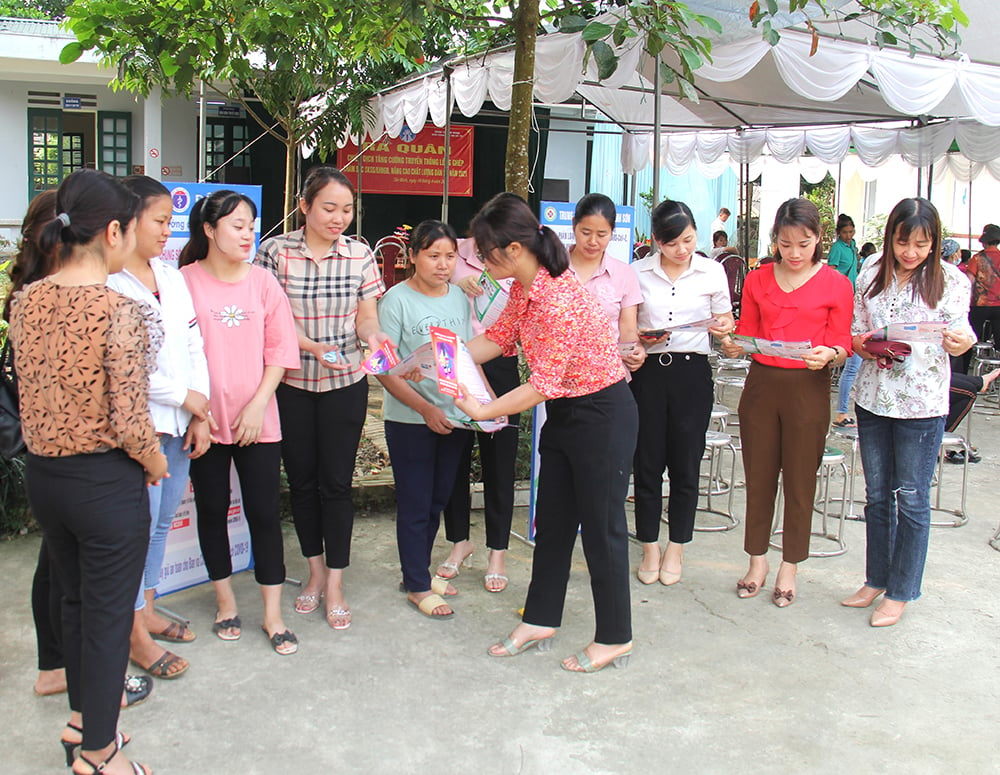
Distributing informational leaflets as part of an integrated communication campaign with the provision of reproductive health/family planning services in Tan Minh commune, Thanh Son district.
Gender imbalance at birth has emerged in Vietnam since the early 21st century, manifested through the sex ratio at birth (SRB). The SRB is calculated as the number of boys compared to the number of girls born alive within the same timeframe, usually a year. A ratio between 103 and 106 boys per 100 girls (103-106/100) is considered balanced or the natural biological level. Any sex ratio outside this range (higher or lower) is considered gender imbalance at birth.
In Phu Tho province, the gender imbalance at birth first appeared in 2006, with a ratio of 111.3/100 (SRB), and increased to 116.7/100 in 2009. The causes include the strong influence of Confucian ideology, the preference for male children among many individuals and couples; easy access to and misuse of technological advancements and modern medical progress in assisting with fetal sex selection; and inadequate social security for the elderly, leading people to rely on their sons in old age.
To control the gender imbalance at birth, the Phu Tho Provincial Party Committee issued Resolution 26-NQ/TU dated June 5, 2009, on continuing to promote the implementation of population and family planning work in the period 2009-2015; Plan No. 47-KH/TU dated December 22, 2017, implementing Resolution No. 21-NQ/TW of the Central Committee of the 12th Party Congress on population work in the new situation; the Provincial People's Committee issued the Project to reduce gender imbalance at birth in the period 2011-2015, the Plan to implement the Project to control gender imbalance at birth in the periods 2016-2020, 2021-2025...; the guiding documents for implementation have been concretized in 100% of districts, cities, towns, and communes, wards, and townships.
Intervention activities are implemented synchronously and appropriately to the actual situation of each locality, such as: Building support models to enhance the status of women and girls; establishing and maintaining clubs for women who do not have a third child or more, adolescent/youth clubs, pre-marital clubs, and exemplary girls' clubs in junior and senior high schools; organizing communication campaigns on gender imbalance at birth, disseminating the Law on Gender Equality, the Ordinance on Population, the Government Decree prohibiting sex selection of fetuses in all forms, and regulations on administrative penalties for violations of gender equality...
Thanh Son district is home to 32 ethnic groups living together, with the Muong ethnic group accounting for over 56% of the total population. Economic conditions and transportation are still challenging, and the level of awareness among the people is uneven.
Comrade Ha Quoc Viet - Head of the Population and Health Education Communication Department (Thanh Son District Health Center) said: “To improve the effectiveness of communication on population in general, and gender imbalance at birth in particular, the Center has implemented many measures, focusing on promoting the role of the population collaborator network in direct communication activities in the community. In addition, models for reducing gender imbalance at birth in 23 communes and towns and 10 secondary and high schools are regularly maintained and effective; at the same time, meetings are integrated with the dissemination and thorough understanding of regulations strictly prohibiting the provision of information and services related to fetal sex selection in any form to health officials and health facilities in the area.”
With the decisive leadership of Party committees and authorities at all levels; the close coordination of relevant departments, organizations, agencies, and units; the great efforts of the Health and Population system; and the support of the whole society, after 15 years of active implementation, Phu Tho has controlled the rate of increase in SRB and gradually reduced the SRB gap between male and female children, such as: SRB decreased from 117.4/100 (2010) to 114.15/100 (2023).
Currently, Phu Tho is not among the six provinces with the highest sex ratio imbalance at birth in the country, but it still has a high rate of gender imbalance at birth. It is estimated that by 2026 onwards, when children born after 2006 reach marriageable age, Phu Tho will experience a surplus of approximately 10% in males compared to females of the same age.
To address the gender imbalance at birth, it is necessary to continue prioritizing the implementation and promulgation of policies that encourage women and girls, enhancing the status of women in the family and in society; effectively addressing social security for the elderly; strengthening communication for high-risk groups (those who have given birth to one or two daughters); paying particular attention to improving the effectiveness of enforcing legal regulations on controlling gender imbalance at birth as stipulated in laws, ordinances, and decrees; coordinating inter-sectoral efforts in implementing inspection, examination, and handling of businesses, publications, and medical services that violate population policies regarding the selection of fetal sex; and prioritizing resources for addressing the goals of gender imbalance at birth.
Red Army
Source: https://baophutho.vn/kiem-soat-tinh-trang-mat-can-bang-gioi-tinh-khi-sinh-222433.htm


![[Photo] General Secretary and President To Lam and the President of the Philippines hold talks.](https://vphoto.vietnam.vn/thumb/1200x675/vietnam/resource/IMAGE/2026/06/01/1780286997787_anh-man-hinh-2026-06-01-luc-11-09-43.png)


![[Photo] Reception to welcome General Secretary and President To Lam and his wife on their State visit to the Philippines](https://vphoto.vietnam.vn/thumb/1200x675/vietnam/resource/IMAGE/2026/06/01/1780295488620_vna-potal-chieu-dai-chao-mung-tong-bi-thu-chu-tich-nuoc-to-lam-va-phu-nhan-tham-cap-nha-nuoc-toi-philippines-8798060-7855-jpg.webp)














































































Comment (0)