

Why is it so difficult to replace the 1982 United Nations Convention on the Law of the Sea (UNCLOS)? If UNCLOS were renegotiated using a new formula, could a more detailed outcome be achieved?
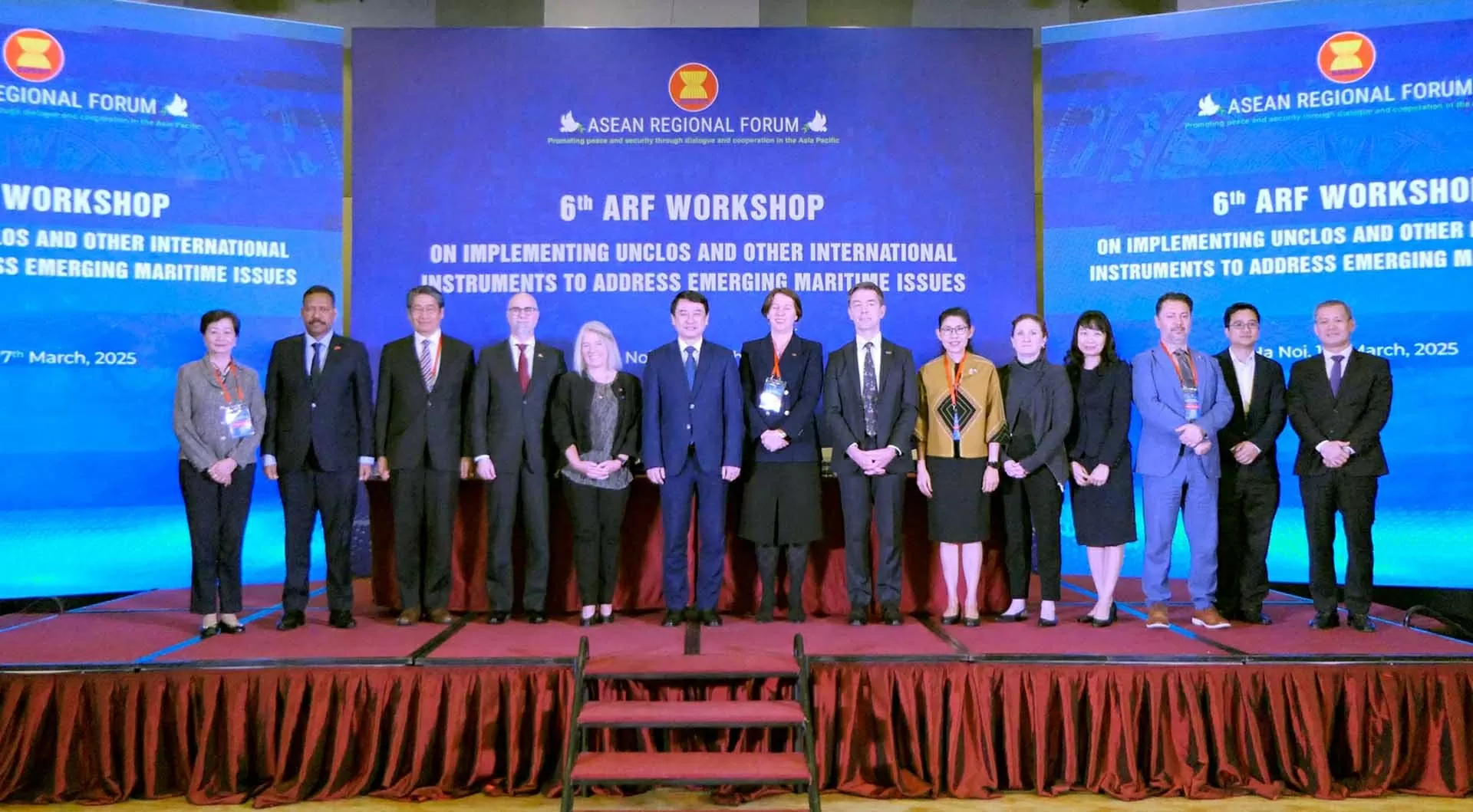 |
| The sixth workshop of the ASEAN Regional Forum (ARF) on the application of the 1982 United Nations Convention on the Law of the Sea (UNCLOS) and other international legal instruments in responding to emerging challenges at sea was organized by the Ministry of Foreign Affairs on March 17 in Hanoi. (Photo: Thanh Long) |
In an interview with TG&VN , Associate Professor Dr. Nguyen Thi Lan Anh, Director of the East Sea Institute, Diplomatic Academy of Vietnam, affirmed that it is difficult to have a treaty that is broader and attracts more participants than the United Nations Convention on the Law of the Sea (UNCLOS) (with 169 members). The provisions of UNCLOS serve as both a legal framework and remain relevant over time.
This year marks the 31st anniversary of the UNCLOS's entry into force. How do you assess the importance of UNCLOS in promoting peace and stability in the seas and oceans in general?
It can be said that UNCLOS is a very important international treaty because its main subject matter is the seas and oceans (which cover up to 70% of the Earth's surface). All provisions of the Convention are aimed at peaceful and sustainable governance of the seas.
Therefore, if the parties comply with the provisions of UNCLOS in establishing an order of rights and obligations, the Convention will indirectly create a rules-based order at sea. This will harmonize the rights and interests of the parties, ensuring they are consistent with the peaceful use of the sea on the one hand, and with sustainable, future-oriented governance on the other.
UNCLOS is a fairly comprehensive treaty with over 300 articles. It took a very long time, more than 11 years, for the parties to negotiate and reach an agreement on UNCLOS. Some have criticized the provisions of UNCLOS for not being very specific, or even being outdated, given that it was completed in 1982.
| In the context of the international community facing numerous unconventional and unprecedented challenges, UNCLOS remains the "Constitution of the Oceans"—a comprehensive legal framework regulating all activities in the seas and oceans. At the same time, UNCLOS ensures flexibility and adaptability to address emerging urgent issues. After a long process of formation and development, UNCLOS has become one of the most important legal documents of the international community. The Convention serves as a foundation for countries to promote cooperation in the conservation of the marine environment, biodiversity, and marine ecosystems. Deputy Minister of Foreign Affairs Le Anh Tuan made this statement at the Sixth ASEAN Regional Forum (ARF) Workshop on the Application of UNCLOS. |
But in reality, achieving a broader agreement that attracts more participants is very difficult. Currently, UNCLOS has 168 members. Or, even if UNCLOS were renegotiated using a new formula, it's not certain that a more detailed outcome could be produced.
The provisions of UNCLOS serve both as a legal framework and remain relevant over time. UNCLOS contains provisions that allow for the extension of its interpretation to related treaties, provided that the objectives and purposes are consistent with the peaceful and sustainable use of the sea. As long as international law is interpreted consistently, without contradiction or opposition, UNCLOS retains its validity after 31 years.
UNCLOS is often referred to as the "Constitution of the Oceans," helping parties harmonize and reconcile their interests to achieve common global benefits.
To address doubts about UNCLOS, countries are now making great efforts to promote the "extended arms" of UNCLOS, including the Agreement on the Conservation and Sustainable Use of Biodiversity in the Sea Beyond National Jurisdiction (BBNJ), which is actively participated in by many countries. What is your assessment of the UNCLOS member states' continued efforts to promote the important mission of the Convention?
The BBNJ is an enforcement agreement of UNCLOS. This is not the first time UNCLOS has had an enforcement agreement. In 1994, UNCLOS had an enforcement agreement concerning the international seabed. In 1995, countries signed an enforcement agreement of UNCLOS relating to fish migration flows.
Last year, countries signed the BBNJ Agreement to regulate maritime zones outside national jurisdiction with the goal of protecting biodiversity in those zones. Once again, it is seen that the BBNJ will help UNCLOS as a living document.
Because, whenever UNCLOS member states feel there is still a gap, an opportunity to further improve the legal framework of UNCLOS, they can continue to sit down together and negotiate to sign implementing agreements.
BBNJ's noble goal is to supplement UNCLOS in order to protect marine biodiversity. Marine genetic resources and the diversity of marine life in areas beyond national jurisdiction are also becoming extremely important in the context of today's advanced science and technology.
Marine genetic resources not only play a role in biodiversity conservation but also contribute to many industries in beauty and healthcare. How can these genetic resources be used sustainably? How can the benefits of these genetic resources be distributed equitably among countries and preserved for future generations? That is BBNJ's mission.
Therefore, UNCLOS offers hope that the BBNJ will not be the final document, but rather an "extension," an implementing agreement. New implementing agreements may emerge in the future if countries feel the need to supplement the legal framework to further refine UNCLOS.
 |
| Associate Professor Dr. Nguyen Thi Lan Anh, Director of the East Sea Institute, Diplomatic Academy of Vietnam. |
Vietnam was a party to and ratified UNCLOS very early on. How do you assess Vietnam's efforts in maintaining the vitality of UNCLOS over the past 30 years?
Vietnam is one of the founding members of UNCLOS, participating in negotiations for the Convention since 1977, and was one of the member states that ratified the Convention before it came into effect in 1994.
Throughout the past 31 years, Vietnam has consistently complied with and fully implemented UNCLOS in good faith. In fact, Vietnam has enacted laws to internalize its obligations and commitments under UNCLOS. Vietnam's maritime claims are also formulated in accordance with UNCLOS.
At the same time, Vietnam has been, is, and will continue to strive to resolve maritime disputes based on the provisions of UNCLOS. To date, Vietnam is very proud to say that, based on UNCLOS provisions, it has delimited the sea with China in the Gulf of Tonkin, and with Thailand and Indonesia; Vietnam cooperates with Malaysia to establish a joint oil and gas exploration area, and has made joint submissions on the extended continental shelf to the United Nations Commission on the Limits of the Continental Shelf.
All these results were achieved based on the spirit of Vietnam as a member of UNCLOS, always complying in good faith, effectively and actively with all commitments within the framework of UNCLOS.
| New Zealand Ambassador to ASEAN Joanna Jane Anderson: Maritime prosperity and security depend on maintaining stability and respecting international maritime law as reflected in UNCLOS. New Zealand is ready to cooperate with countries to strengthen the universality and consistency of UNCLOS. |
Vietnam is an active and proactive member of ASEAN. Currently, ASEAN is also making great efforts to promote UNCLOS. In your opinion, what is the significance of such a concerted effort to maintain the mission of the Convention?
It can be said that ASEAN is a very progressive region, considering the overall context of countries worldwide . Nine out of ten ASEAN countries are members of UNCLOS; only one country is not currently a member, but I understand that this country is also actively considering joining UNCLOS.
In fact, disputes and overlapping maritime areas between ASEAN countries have been and are being resolved within the framework of UNCLOS. ASEAN countries are also very active in using dispute resolution mechanisms within the UNCLOS framework to resolve disagreements with each other.
Within the framework of UNCLOS, there are provisions that are very important for ASEAN, for example, the framework for cooperation in semi-enclosed seas. The South China Sea is also considered one of these semi-enclosed seas. Currently, ASEAN members are committed to jointly fulfilling the cooperative obligations stipulated in UNCLOS.
Beyond cooperation in marine environmental protection and marine scientific research, ASEAN members are also committed to actively promoting activities such as the development of a blue economy.
Most recently, in December 2023, ASEAN Foreign Ministers jointly issued the ASEAN Foreign Ministers' Statement on Maintaining and Promoting Maritime Stability in Southeast Asia. This is an extremely important move, demonstrating on the one hand the determination of ASEAN nations to maintain peace and stability in the seas of Southeast Asia. On the other hand, it also shows that ASEAN nations recognize the role of the sea in connectivity, economic development, and promoting sustainable development.
 | UNCLOS 1982 creates an environment for Vietnam to protect its sovereignty in the South China Sea. UNCLOS 1982 creates a peaceful environment for Vietnam to develop its maritime economy, build and protect its maritime potential... |
 | Vietnam accurately applies the provisions of the United Nations Convention on the Law of the Sea. The 1982 United Nations Convention on the Law of the Sea (UNCLOS) is proving its value in practice, helping Vietnam and other coastal countries... |
 | Permanent Deputy Minister of Foreign Affairs Nguyen Minh Vu attends the 8th Indian Ocean Conference in Oman. Permanent Deputy Minister Nguyen Minh Vu affirmed that the connection of seas and oceans is a fundamental pillar for harmony... |
 | Vietnam was unanimously nominated by the Asia-Pacific Group to chair the 35th session of SPLOS. This will be the first time Vietnam has assumed the chairmanship of SPLOS since becoming a member of the UN Convention... |
 | UNCLOS 1982: An 'anchor' for maritime prosperity and security. On March 17th, in Hanoi, the Ministry of Foreign Affairs coordinated with the Embassies of Canada, Australia, New Zealand, and the European Union... |
Source: https://baoquocte.vn/unclos-1982-khung-phap-ly-bien-toan-dien-song-voi-thoi-gian-308218.html















![[Image] Hanoi's urban life under the challenge of a "scorching hot" environment](https://vphoto.vietnam.vn/thumb/1200x675/vietnam/resource/IMAGE/2026/05/25/1779706979265_nang-nong-t5-2026-minh-duy-7-4636-jpg.webp)

































































Comment (0)