

 |
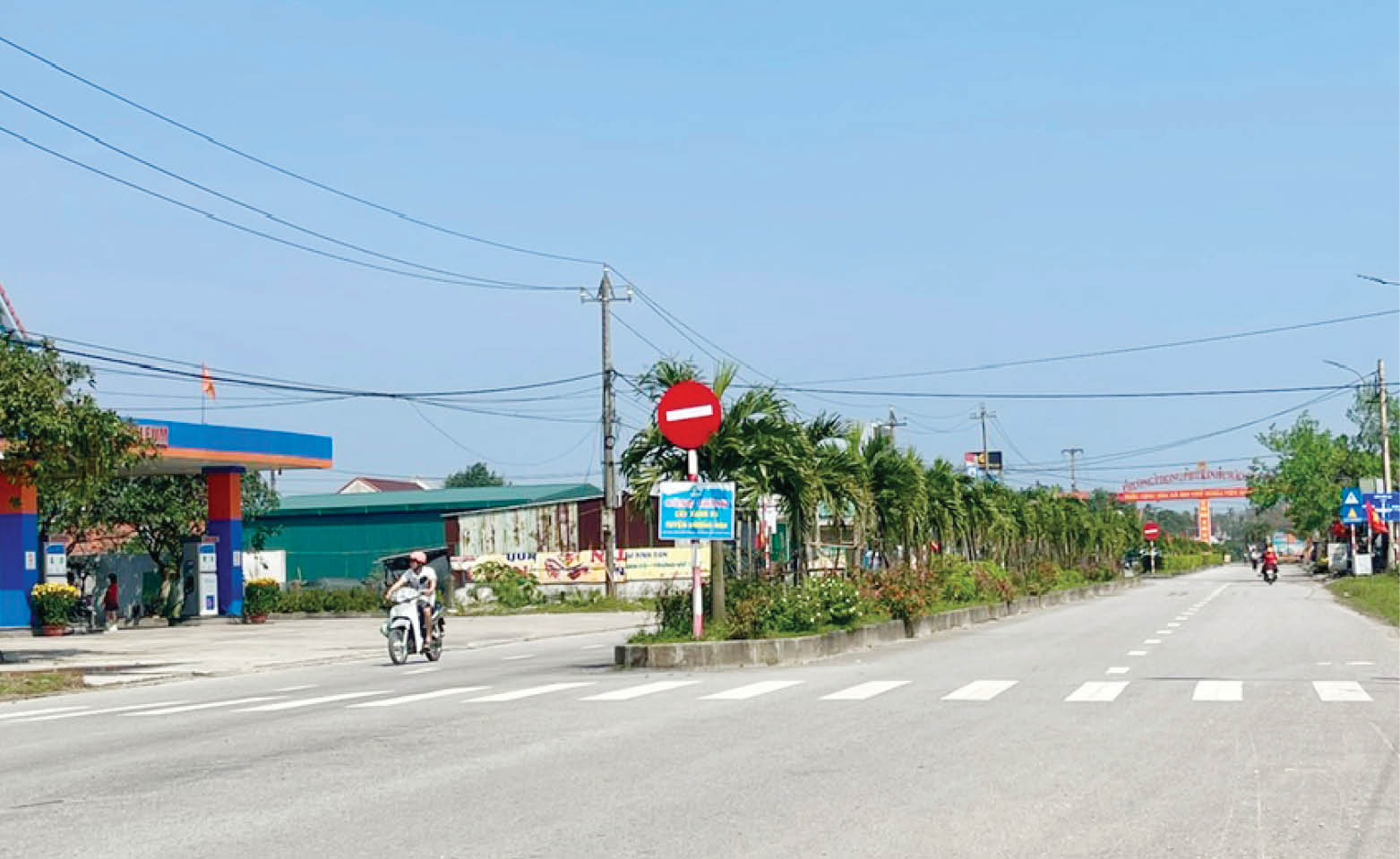
| Improved transportation infrastructure is a crucial factor in connecting regions. |
Expectations from practice
Throughout history, the administrative map of Hue has undergone many changes. Before becoming a centrally governed city, the old city of Hue expanded south of the Perfume River, extending beyond the Citadel to integrate into the surrounding areas or reach out to the sea – a move reflecting an aspiration for "outward orientation." These adjustments, while seemingly administrative divisions and mergers, were in reality actions to create new spaces for development.
In 2025, along with other provinces and cities nationwide, Hue will continue to implement a major policy of the Party and State: reorganizing commune-level administrative units. “The reorganization of commune-level administrative units is in line with current practical requirements, contributing to the reform and streamlining of the political system's organizational structure for effective and efficient operation; creating favorable conditions for socio-economic development and improving the material and spiritual lives of the people. At the same time, it will overcome limitations, obstacles, and inadequacies, and facilitate better state management at the local level,” said Nguyen Van Manh, Director of the Department of Internal Affairs.
The issue of administrative boundaries is no longer simply about dividing and managing. In the era of urbanization, the digital economy , and regional connectivity, "boundaries" are now the framework for development, the design of development. A fragmented commune or a small ward will lead to localized planning, fragmented infrastructure, overlapping governance, and a lack of connectivity.
By merging small communes into larger wards and communes, Hue promises to create sufficiently strong and extensive development entities to facilitate synchronized urban planning, industrial development, service development, and technical infrastructure development.
Ms. Nguyen Thi Thanh, a retired official in An Dong ward, Thuan Hoa district, shared: “We are used to mergers. This time, people were asked for their opinions specifically, given clear explanations, and more importantly, we see the practical benefits from more convenient management, faster procedures, and officials being closer to the people.”
The new spatial layout also brings specific expectations for businesses. Areas that were previously sandwiched between communes have now been merged into a single unit, simplifying investment procedures. Inter-commune roads have become unified development axes, facilitating the planning of industrial clusters, logistics services, and e-commerce.
Mr. Hoang Tan Phuc, director of a construction materials manufacturing company, observed: "We need stability and uniformity. A wide development space and a unified administrative government help save both time and costs."
Restructuring for sustainable development
On May 9th, the Government issued Resolution No. 126/NQ-CP approving 34 dossiers on the plan for reorganizing commune-level administrative units in 2025 nationwide.
Previously, according to Report No. 2174 dated May 8, 2025, on the rearrangement of commune-level administrative units in 2025, signed by Minister of Home Affairs Pham Thi Thanh Tra and submitted to the Government, Hue City developed a plan to rearrange 132 commune-level administrative units (78 communes, 47 wards, and 7 towns) to form 39 new commune-level administrative units (19 communes and 20 wards), reducing the number by 93 units. This is not only a turning point in organizational structure but also a comprehensive reconstruction of the geographical boundaries. Eliminating the district level and bringing the government to a two-tier model means shortening the administrative chain, increasing autonomy, and reducing intermediate levels. However, this comes with significant challenges: commune-level officials must adapt quickly, administrative offices need to be relocated, and public assets need to be used rationally to avoid waste.
At the recent 23rd Special Session of the City People's Council, the City People's Committee provided very specific information on the post-merger management plan, ranging from headquarters planning, staff training, and digital technology application to maintaining the morale of grassroots officials and citizens.
“The merger of commune-level administrative units will promote the resolution of issues arising in the process of managing administrative boundaries, socio-economic development, building urban infrastructure systems, and improving the quality and efficiency of public service delivery. The reorganization of small-scale commune-level administrative units to create larger, more reasonable-sized grassroots administrative units will facilitate the concentration of land and population resources for planning and investment in expanding production towards modernization, effectively utilizing the potential and strengths of natural resources and minerals for development,” said Mr. Nguyen Van Manh, Director of the Department of Internal Affairs.
There have been many opinions suggesting that Hue is hesitant to change. But reality shows the opposite. And after this streamlining, Hue will have new spaces, new opportunities, and a new stature.
Source: https://huengaynay.vn/chinh-polit-xa-hoi/theo-dong-thoi-su/khong-gian-moi-co-hoi-phat-trien-moi-154138.html
![[Photo] The General Secretary attends the groundbreaking ceremony for the construction of the Truong Ha Primary and Secondary Boarding School.](/_next/image?url=https%3A%2F%2Fvphoto.vietnam.vn%2Fthumb%2F1200x675%2Fvietnam%2Fresource%2FIMAGE%2F2026%2F01%2F28%2F1769604498277_vna-potal-tong-bi-thu-du-le-khoi-cong-xay-dung-cong-trinh-truong-pho-thong-noi-tru-tieu-hoc-va-trung-hoc-co-so-truong-ha-8556822-jpg.webp&w=3840&q=75)
![[Photo] Commemorating the unwavering friendship between Vietnam and Laos](/_next/image?url=https%3A%2F%2Fvphoto.vietnam.vn%2Fthumb%2F1200x675%2Fvietnam%2Fresource%2FIMAGE%2F2026%2F01%2F27%2F1769518372051_ndo_br_1-jpg.webp&w=3840&q=75)


![[Photo] National Assembly Chairman Tran Thanh Man meets with former leaders of the National Assembly from various periods.](/_next/image?url=https%3A%2F%2Fvphoto.vietnam.vn%2Fthumb%2F402x226%2Fvietnam%2Fresource%2FIMAGE%2F2026%2F01%2F28%2F1769601014034_anh-man-hinh-2026-01-28-luc-18-50-04.png&w=3840&q=75)


![OCOP during Tet season: [Part 3] Ultra-thin rice paper takes off.](/_next/image?url=https%3A%2F%2Fvphoto.vietnam.vn%2Fthumb%2F402x226%2Fvietnam%2Fresource%2FIMAGE%2F2026%2F01%2F28%2F1769562783429_004-194121_651-081010.jpeg&w=3840&q=75)


![OCOP during Tet season: [Part 2] Hoa Thanh incense village glows red.](/_next/image?url=https%3A%2F%2Fvphoto.vietnam.vn%2Fthumb%2F402x226%2Fvietnam%2Fresource%2FIMAGE%2F2026%2F01%2F27%2F1769480573807_505139049_683408031333867_2820052735775418136_n-180643_808-092229.jpeg&w=3840&q=75)
![OCOP during Tet season: [Part 1] Ba Den custard apples in their 'golden season'](/_next/image?url=https%3A%2F%2Fvphoto.vietnam.vn%2Fthumb%2F402x226%2Fvietnam%2Fresource%2FIMAGE%2F2026%2F01%2F26%2F1769417540049_03-174213_554-154843.jpeg&w=3840&q=75)


Comment (0)