

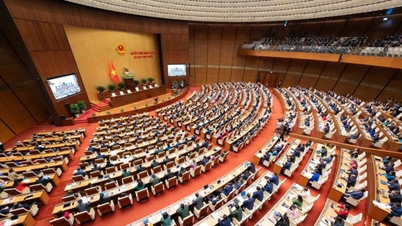
During the National Assembly 's plenary session on the morning of November 24th, many delegates suggested reviewing the contents of the draft Road Law to avoid overlap with the Law on Road Traffic Order and Safety.
Do not let a vehicle be governed by two laws.
Representative Nguyen Hai Dung (from Nam Dinh province) supported the development of two separate laws: the Law on Road Transport and the Law on Road Traffic Safety and Order. However, Representative Dung noted that during the drafting process, several issues need to be clearly distinguished to determine whether they should be combined into one law or kept as two separate laws.
He cited the example of school buses, where one person acts as the driver and another as the student supervisor. Article 72, Clause 2 of the draft Road Law stipulates that drivers must have at least two years of passenger transport experience, but the draft Law on Road Traffic Safety only specifies the supervisor for vehicles transporting primary and preschool students; vehicles with more than 24 seats must have two or more supervisors.
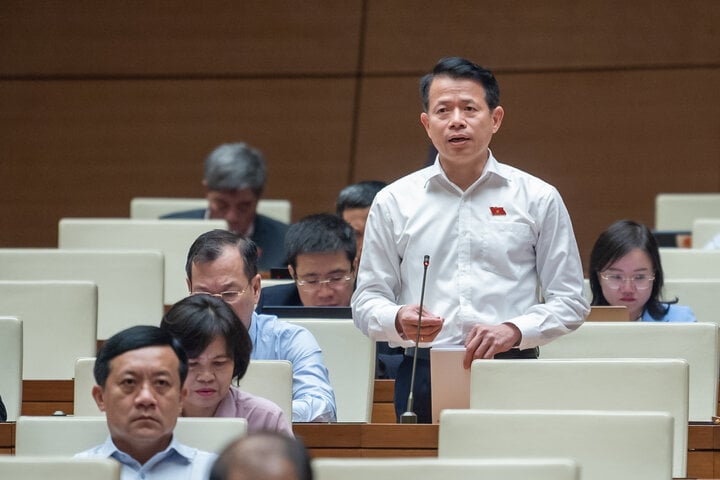
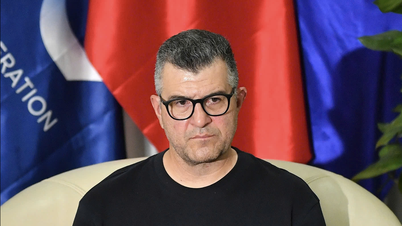
Delegate Nguyen Hai Dung. (Photo: Quochoi.vn).
"A school bus is regulated by two laws. In practice, this would be troublesome and difficult for transportation businesses, schools, and enforcement agencies. Therefore, the regulation regarding the seniority of school bus drivers should be included in the Road Traffic Safety Law," Representative Dung stated.
Sharing the same view, delegate Nguyen Thi Mai Thoa (from Hai Duong province) argued that separating the Road Law to focus on regulating issues related to road transport infrastructure and road transport is necessary. The drafting agency has tried to reasonably delineate the contents falling within the scope of this law and the Law on Road Traffic Safety and Order.
However, according to Ms. Thoa, some regulations are currently stipulated in both laws simultaneously, causing inconvenience for citizens in the process of applying and enforcing the laws. The representative suggested that the drafting agency continue to review the regulations to ensure that no provisions are omitted, but also that there is no duplication and that they are easy to apply.
Regarding the issue of school transportation, Ms. Thoa argued that some regulations are still unreasonable. She cited the example of classifying school-organized student transportation as internal transport, arguing that Article 61, Clause 13 of the draft law stipulates that internal transport by car is a non-commercial activity for transporting people and goods on public roads.
"Meanwhile, schools are required to collect fees for organizing student transportation. In many cases, it's difficult to distinguish whether this constitutes a business activity or not. Therefore, I propose that regulations clearly stipulate that for student transportation services, the school is the entity responsible for organizing the contract and bearing the responsibility, avoiding the situation where it is delegated to the parent committee," Representative Thoa said.
A toll station should not collect fees for services in one location but for services in another.
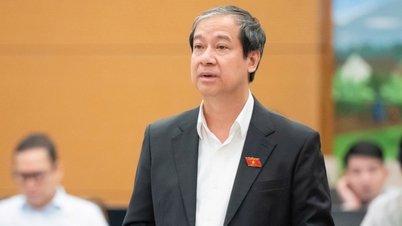
Representative Nguyen Quang Huan (Binh Duong) acknowledged that the draft law was meticulously and comprehensively prepared, with efforts made to separate one law into two, however, there are still some overlapping provisions between the draft Law on Roads and the draft Law on Road Traffic Order and Safety.
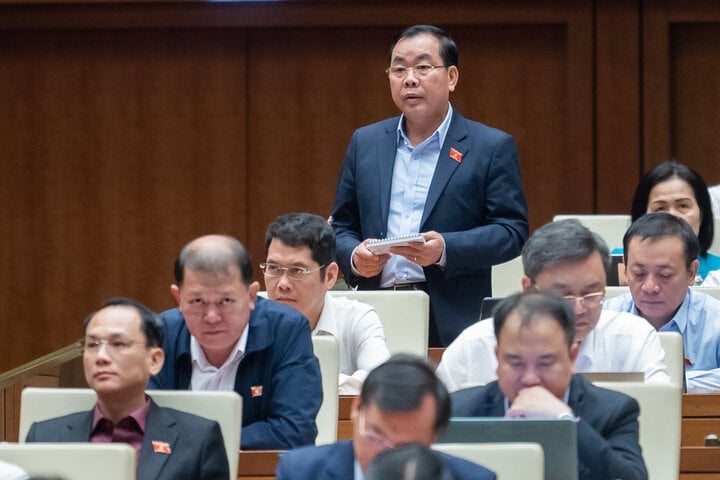
Delegate Nguyen Quang Huan. (Photo: Quochoi.vn).
The delegate from Binh Duong province argued that the road development policy is still quite general and suggested that Article 5 of the draft Law be reviewed and improved.
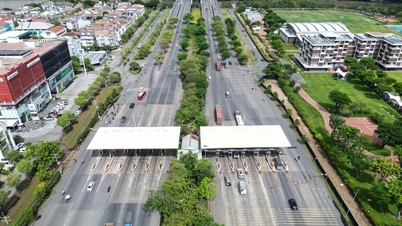
Regarding road toll stations, delegate Nguyen Quang Huan suggested clearly defining the locations of these stations to avoid situations where a station is located in one place but collects tolls for a different road.
Regarding prohibited behaviors, delegates suggested reviewing and redefining the definition to avoid excessive specificity and ensure greater universality. On the other hand, delegates also argued that some of these behaviors are governed by ethics, and therefore cultural institutions could be empowered to speak out on these issues.
Representative Nguyen Quang Huan suggested that Article 24 on the construction and exploitation of technical infrastructure works, Article 32 on investment in road construction projects, and regulations on expressways… should incorporate provisions on adaptation to climate change.
Regarding Article 50, specifically Clause 7, which addresses compensation and resettlement support during highway construction, Representative Huân stated that this content is already very specifically regulated in the Land Law and therefore should not be included in the Road Law.
expeditiously finalize the draft law's documentation.
Responding to, explaining, and clarifying the opinions raised by National Assembly deputies during the discussion session, Minister of Transport Nguyen Van Thang stated that he would incorporate the contributions of the National Assembly deputies.
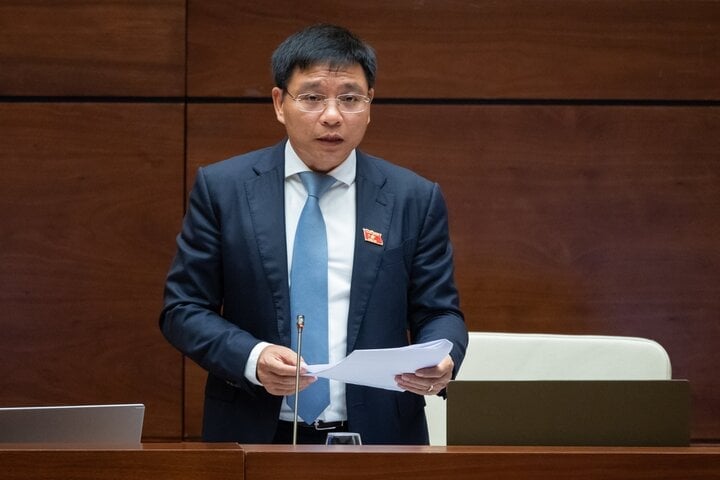
Minister of Transport Nguyen Van Thang. (Photo: Quochoi.vn).
Regarding the financial resources for investing in the construction, management, operation, and maintenance of road infrastructure, there is a suggestion to assess the necessity of adding highway usage fees alongside the road usage fee based on vehicle type.
Minister Nguyen Van Thang stated that, in implementing the National Assembly's policy in the resolutions approving investment in expressways, the Ministry of Transport has conducted research on toll collection options on state-invested expressways, considering and analyzing the impact of both toll collection and non-toll collection on these state-invested expressways.
To ensure a balance between the contribution fee and the quality of service received by users, based on the principle that users of higher-quality services should pay higher costs and have the right to choose parallel routes, the draft Law has added this provision.
Toll rates will be determined for each expressway, ensuring they are appropriate to the operating conditions of each area, commensurate with the quality of service, but do not exceed the benefits obtained and the ability of expressway users to pay, ensuring a balance of interests between the people and the state.
Based on the opinions of National Assembly deputies discussed in the working group, the drafting committee has submitted a preliminary report on the feedback and explanations. Simultaneously, following discussions in the plenary session, the Minister of Transport will seriously consider the valid opinions to revise and finalize the draft law and submit it to the National Assembly at the next session.
PHAM DUY
Source
![[Photo] National Assembly Chairman Tran Thanh Man attends the groundbreaking ceremony for the National Highway 1A spatial axis project.](https://vphoto.vietnam.vn/thumb/1200x675/vietnam/resource/IMAGE/2026/05/19/1779161360398_ndo_br_bnd-1412-jpg.webp)
![[Photo] Capturing the moment the tide recedes at Yen Binh Son rapids - a million-year-old scenic spot in Quang Ngai.](https://vphoto.vietnam.vn/thumb/1200x675/vietnam/resource/IMAGE/2026/05/19/1779175463885_yen9-1199-jpg.webp)
![[Photo] General Secretary and President To Lam presides over a meeting on the implementation of Directive No. 34-CT/TW of the Party Central Committee.](https://vphoto.vietnam.vn/thumb/1200x675/vietnam/resource/IMAGE/2026/05/19/1779187768672_a1-bnd-2350-631-jpg.webp)












































![[Photo] General Secretary and President To Lam receives Indian Defense Minister Rajnath Singh](https://vphoto.vietnam.vn/thumb/402x226/vietnam/resource/IMAGE/2026/05/19/1779184046302_anh-man-hinh-2026-05-19-luc-16-46-58.png)





















Comment (0)