

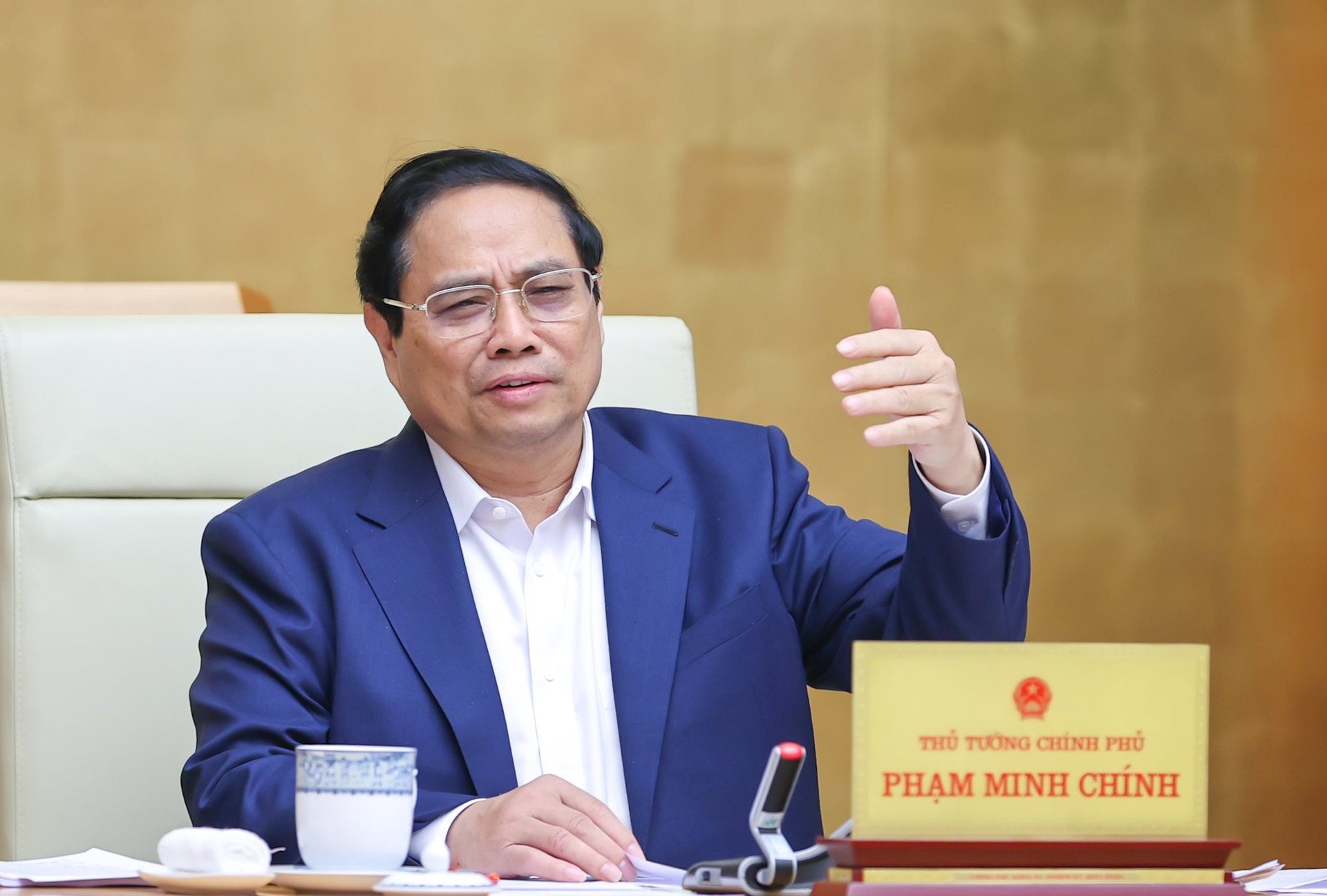
With a high sense of responsibility and lively discussion, the Government considered and commented on two important issues. Firstly, the draft Law on Value Added Tax (amended) needs to be decided upon so that it can be submitted to the National Assembly for consideration and comments at the 7th session. Secondly, the plan for using increased revenue and reduced expenditure in 2023 needs to be submitted to the Standing Committee of the National Assembly for consideration and decision on allocation and use to serve socio -economic development.
Concluding the session, regarding the draft Law on Value Added Tax (amended), the Prime Minister emphasized the need to adhere closely to the Party's guidelines and policies, stay close to reality, and address the challenges arising from practical situations. Tax instruments should protect domestic production, encourage priority sectors, but be reasonable, appropriate to the situation, and flexible; harmonize the interests of the State, businesses, and the people; promote digital transformation, cashless payments, and prevent corruption, negative practices, losses, and smuggling.
The Prime Minister stated that it is necessary to encourage innovation, technology transfer, and investment in emerging fields such as digital transformation and green transformation, and to promote exports…; for essential goods that affect macroeconomic stability, such as energy, food, and foodstuffs, very careful calculations must be made.
Regarding the plan for using increased revenue and reduced expenditure in 2023, the Prime Minister noted that it is necessary to strictly adhere to the Budget Law, prioritize projects, ensure transparency, harmony, and balance across regions and sectors, but with a focus on key areas, concentrating on implementing the tasks and objectives set forth in the Resolution of the 13th National Congress, projects that have completed procedures, and priority areas such as strategic infrastructure and transportation, including urgent projects such as some sections of expressways that currently only have 2 lanes…
Along with the specific contents of the meeting, the Prime Minister emphasized three key tasks regarding the development and improvement of institutions in the coming period.
Firstly, the Prime Minister requested active preparation for the 7th session of the 15th National Assembly. The number of draft laws the Government will submit to the National Assembly at this session is very large (approximately 18 draft laws), making the task very challenging. The Prime Minister requested that ministers and heads of ministerial-level agencies focus resources, leadership, and guidance on completing the draft laws in accordance with the Law on the Promulgation of Legal Documents; be responsible for the content and quality of the draft laws, and prevent the inclusion of provisions that benefit specific groups or local interests. They should coordinate closely and effectively with the National Assembly's agencies in submitting, reviewing, reporting on the acceptance and explanation of opinions from the National Assembly and its deputies; and report to the Government and the Prime Minister on the acceptance and revision of draft laws as prescribed.
Secondly, the Prime Minister requested the urgent drafting, submission, and promulgation of detailed regulations and guidelines for the implementation of laws and ordinances passed by the National Assembly. Ministers and heads of ministerial-level agencies are directed to focus on leading and directing the acceleration of the drafting, submission, and promulgation of detailed regulations for laws and ordinances that came into effect on January 1, 2024 (5 decrees and 2 decisions of the Prime Minister); and to urgently finalize and submit to the Government and the Prime Minister for consideration and promulgation detailed regulations for the Land Law, the Law on Credit Institutions, the Housing Law, and the Law on Real Estate Business (before May 15, 2024). The Minister of Justice is to monitor, urge, and inspect the promulgation of detailed regulations by ministries and ministerial-level agencies; and report and recommend to the Prime Minister for consideration and handling of responsibility in cases of delays or backlogs in the promulgation of detailed regulations.
Thirdly, the Prime Minister requested continued investment in the development and improvement of institutions, removing bottlenecks, and unlocking all resources to serve socio-economic development. Accordingly, the role of leaders at all levels, including ministerial and local leaders, should be promoted to directly lead the work of institutional development and improvement. Resources should be concentrated, and qualified, capable, and dedicated personnel should be assigned to this work; investment should be made in infrastructure and favorable working conditions, along with appropriate policies and regulations for this staff. The process of amending and supplementing legal documents should be further shortened to meet practical requirements; group interests and policy corruption should be prevented and strictly dealt with during the process of drafting and promulgating legal documents. Policy responsiveness should be strengthened, and timely amendments should be made to immediately address difficulties, obstacles, and inadequacies, especially in the production and business sectors. Promoting decentralization and delegation of power, coupled with appropriate resource allocation, enhancing the implementation capacity of lower levels, and strengthening supervision and inspection; reforming, reducing, and simplifying administrative procedures and business conditions, and reducing compliance costs for citizens and businesses right from the law-making process; unlocking all resources for socio-economic development. Researching and proposing the development of new legal regulations to adapt to the fourth industrial revolution, especially to promote science and technology, innovation, entrepreneurship, renewing traditional growth drivers and promoting new development drivers such as the development of the digital economy, green economy, circular economy, and emerging industries and sectors.
The Prime Minister requested enhanced coordination among ministries and agencies in the process of drafting, reviewing, and finalizing draft laws and ordinances. He emphasized listening to the opinions of experts, scientists, practitioners, and stakeholders, incorporating feedback from businesses and citizens, and promoting the "three together" spirit (listening together, understanding together; sharing a vision for action together; working together, benefiting together, winning together, and developing together). He also stressed the need to continue drawing on international experience and incorporating content suitable to Vietnam's conditions. Furthermore, he called for strengthened policy communication, especially during the law-making and promulgation process, to foster consensus and effectiveness in the development, promulgation, and implementation of legislation.
Source
![[Image] Nearly 125,000 Hanoi students completed the Literature exam for the 10th grade entrance exam.](https://vphoto.vietnam.vn/thumb/1200x675/vietnam/resource/IMAGE/2026/05/30/1780117233041_ndo_br_thiet-ke-chua-co-ten-2-png.webp)
























































































Comment (0)