

Building a happy classroom must begin with understanding, and it starts with the teachers themselves changing.
I remember a class almost a decade ago, a bright-faced, intelligent-eyed female student suddenly stood up and spoke at length: "Why do you make things so difficult for us? I can still do the assignments, I still understand the material, that's all that matters. Your tests are good, but please let the students be self-motivated and take responsibility for their own work. You're too concerned; it puts a lot of pressure on us, and the class is already tense. Do you think that after graduation, without you, the students will be self-motivated? If they don't learn to study independently, it's your fault because you didn't teach them how to take responsibility; you only supervised them."
The girl spoke non-stop, leaving me stunned, my face flushed. Trying to control myself, I asked, "Are you finished? If so, please sit down." Then, I continued checking the other students' papers.

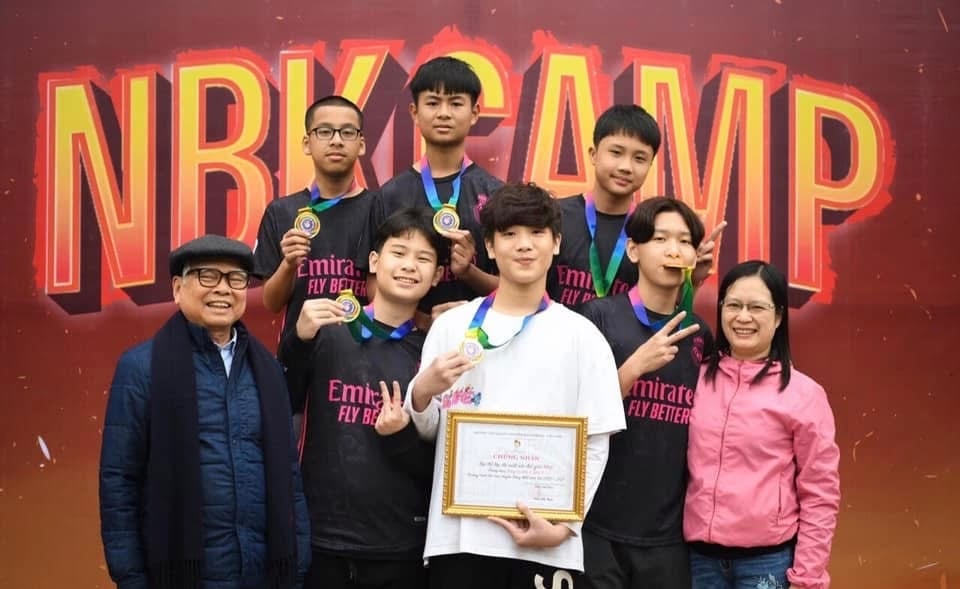
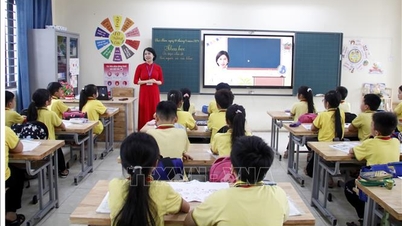
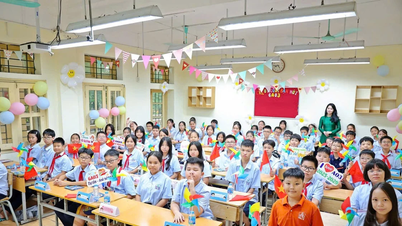
Ms. Vu Thi Tuyet Nga with her students.
Back home, I put down my bag, left my clothes on, and sat at my desk, thinking about that student. My daughter's words, the images of the student in class, all came flooding back.
Back then, I was a young teacher full of enthusiasm, but I harbored a fear – a fear of not having authority over my students. Therefore, I often imposed strict rules regarding classroom discipline and homework checks. I hesitated to offer praise, fearing that it would discourage them from trying harder or being more diligent. I always entered the classroom with a cold and stern expression. Unintentionally, this robbed the children and myself of the joy of coming to class. I regretted realizing that my daily presence had created a suffocating atmosphere, not only failing to inspire the children to learn and be creative, but also causing them to withdraw into anxiety, worry, and even fear.
In the following days in class, I chose a different approach. I still closely monitored each student, but I guided them to check and correct each other's work. I noticed they smiled more and were more relaxed. The high-achieving students became more passionate and confident; the lower-ranking students were less fearful and more enthusiastic about striving for improvement; and I myself felt more cheerful. By changing my approach, I changed myself.
Inspiring others is hard work, and teaching in an inspiring way is even harder. I realized that simply changing methods isn't enough to inspire children, because no matter how good the method is, inspiration can't be felt between people who are still at odds with each other.
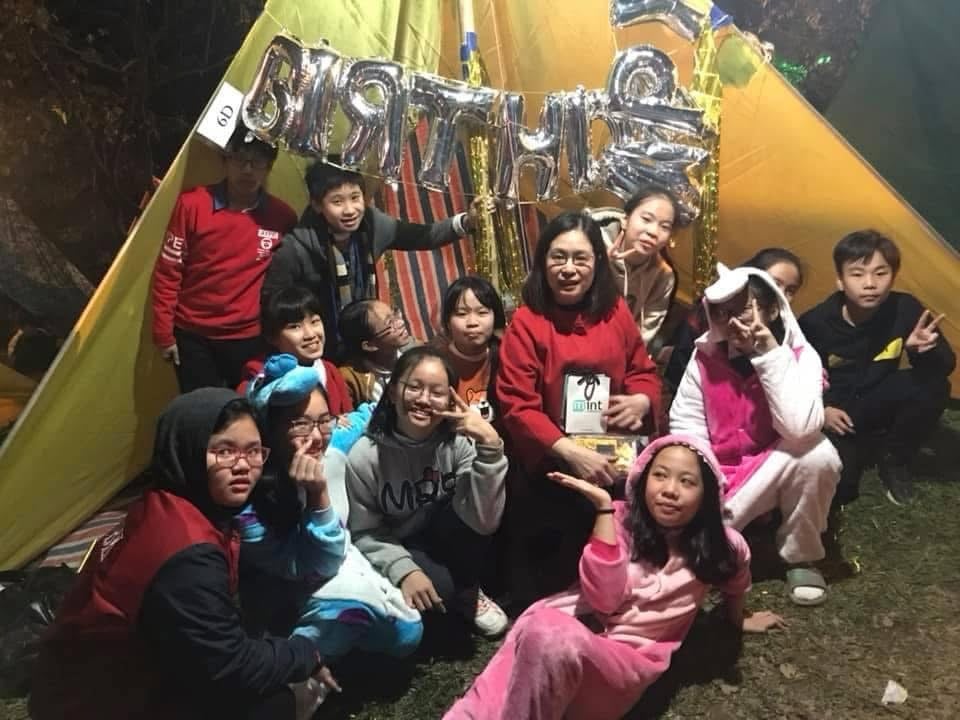
Education based on love requires patience, but yields more lasting results.
I thought about bridging that gap by changing my style when entering the classroom. I shed my cold "mask," maintaining a cheerful expression and a friendly smile as I greeted the children upon entering.
In particular, I reminded myself to smile more, trying to respond to all students with greetings and compliments instead of the dry "yes" or cold nod. Occasionally, I created humorous situations, told short funny stories, or shared a social issue to foster a friendly atmosphere, encourage the children to open up, and make the classroom more lively.
As time passed, many things changed in my classroom, but what my children and I felt most strongly was the happiness we felt coming to class every day. Then, that little girl who used to talk so much placed a postcard on my desk with the words: "Thank you for bridging the gap between us."
I realized that teachers don't necessarily need to bring a stern look to the classroom. Education with love requires more patience, it may be slower, but the results are more sustainable. Building a happy classroom must begin with understanding, and it starts with the teachers themselves changing.
Ms. Vu Thi Tuyet Nga is an excellent teacher at the district level and an excellent homeroom teacher at the district level. She was awarded the Gold Badge, Class A, by Nguyen Binh Khiem Secondary and High School for her teaching achievements, her ability to understand students' psychology well, and her role in helping them change and improve themselves.
She was also awarded the "Dedicated and Creative Teacher" award at the district level in 2024.
Source: https://thanhnien.vn/khoi-nguon-cua-lop-hoc-hanh-phuc-185250307175931734.htm

![[Photo] Prime Minister Pham Minh Chinh receives Lao Minister of Education and Sports Thongsalith Mangnormek](/_next/image?url=https%3A%2F%2Fvphoto.vietnam.vn%2Fthumb%2F1200x675%2Fvietnam%2Fresource%2FIMAGE%2F2025%2F12%2F16%2F1765876834721_dsc-7519-jpg.webp&w=3840&q=75)
![[Image] Leaked images ahead of the 2025 Community Action Awards gala.](/_next/image?url=https%3A%2F%2Fvphoto.vietnam.vn%2Fthumb%2F1200x675%2Fvietnam%2Fresource%2FIMAGE%2F2025%2F12%2F16%2F1765882828720_ndo_br_thiet-ke-chua-co-ten-45-png.webp&w=3840&q=75)
![[Live] 2025 Community Action Awards Gala](/_next/image?url=https%3A%2F%2Fvphoto.vietnam.vn%2Fthumb%2F1200x675%2Fvietnam%2Fresource%2FIMAGE%2F2025%2F12%2F16%2F1765899631650_ndo_tr_z7334013144784-9f9fe10a6d63584c85aff40f2957c250-jpg.webp&w=3840&q=75)
![[Photo] Prime Minister Pham Minh Chinh receives the Governor of Tochigi Province (Japan)](/_next/image?url=https%3A%2F%2Fvphoto.vietnam.vn%2Fthumb%2F1200x675%2Fvietnam%2Fresource%2FIMAGE%2F2025%2F12%2F16%2F1765892133176_dsc-8082-6425-jpg.webp&w=3840&q=75)
![[Image] The tenacious fighting spirit of Vietnamese women's football](/_next/image?url=https%3A%2F%2Fvphoto.vietnam.vn%2Fthumb%2F1200x675%2Fvietnam%2Fresource%2FIMAGE%2F2025%2F12%2F17%2F1765990260956_ndo_br_4224760955870434771-copy-jpg.webp&w=3840&q=75)
















































![[Live] Closing Ceremony and Award Presentation for the "Impressive Vietnam Tourism" Video/Clip Creation Contest 2025](https://vphoto.vietnam.vn/thumb/402x226/vietnam/resource/IMAGE/2025/12/17/1765974650260_z7273498850699-00d2fd6b0972cb39494cfa2559bf85ac-1765959338756946072104-627-0-1338-1138-crop-1765959347256801551121.jpeg)
















Comment (0)