

Researchers estimate that Earth's atmosphere weighs approximately 5.15 x 10^18 kg, nearly a billion times heavier than the Great Pyramid of Giza.
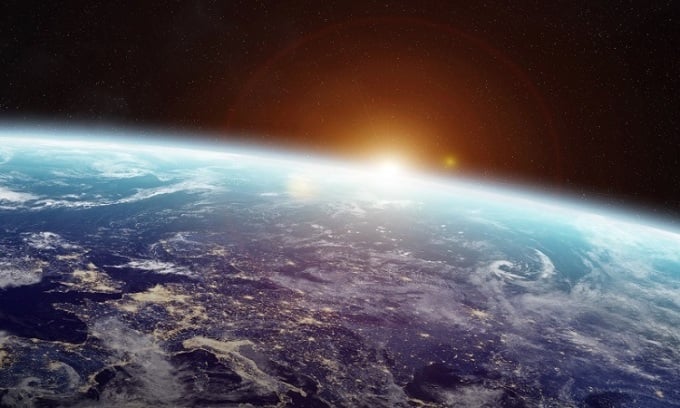
The Earth's atmosphere consists of many layers with varying temperatures and densities. (Image: Wordpress)
Before understanding the weight of the atmosphere, we need to grasp the concept of atmospheric pressure. At sea level, the atmosphere exerts a pressure of approximately 101,325 pascals. This pressure is the result of the weight of gas molecules being pressed down by gravity, according to Sci Tech Daily . Based on atmospheric pressure across the entire surface of the Earth, scientists estimate the total weight of the atmosphere to be 5.15 x 10^18 kg, nearly a billion times heavier than the Great Pyramid of Giza in Egypt. The Earth's atmosphere is equivalent in weight to a vast ocean 10 meters deep covering the entire surface of the planet.
The Earth's atmosphere is not homogeneous but is divided into several layers based on temperature variations. These layers include the troposphere, stratosphere, mesosphere, thermosphere, and exosphere. Each layer has a different density and composition. The densest layer is the troposphere, which is closest to the Earth's surface. Approximately 78% of the atmosphere is nitrogen, 21% is oxygen, and the remaining 1% consists of argon, CO2, and small amounts of other gases.
Although the total mass of the atmosphere is relatively stable (with very little seasonal variation, mainly due to changes in water vapor), its distribution can vary due to several factors. First is altitude; as you ascend, atmospheric pressure decreases because there is less air above you. This is also why breathing becomes more difficult at high altitudes.
The second factor is temperature. On warm days, the air expands and rises, becoming less dense. This redistribution of air leads to a decrease in atmospheric pressure at ground level due to less weight pressing down. Conversely, on cold days, the air contracts and sinks, resulting in increased pressure near the ground.
The final factor is humidity; humid air is less dense than dry air. This is because water molecules are not as heavy as air molecules. As humidity increases, this can affect the atmospheric weight distribution, although the effect is less pronounced than with temperature.
By understanding these factors, we can assess the nature of atmospheric movement and how its weight is distributed at different altitudes and under varying conditions. Atmospheric weight plays a vital role in sustaining life on Earth. It allows humans to breathe air, protects humanity from harmful solar radiation, and regulates the planet's temperature. Without atmospheric weight and pressure, water would evaporate into space, and life could not exist. Therefore, the weight of Earth's atmosphere is evidence of the balance that sustains life on the planet.
An Khang (According to Sci Tech Daily )
Source link

![[Image] The tenacious fighting spirit of Vietnamese women's football](/_next/image?url=https%3A%2F%2Fvphoto.vietnam.vn%2Fthumb%2F1200x675%2Fvietnam%2Fresource%2FIMAGE%2F2025%2F12%2F17%2F1765990260956_ndo_br_4224760955870434771-copy-jpg.webp&w=3840&q=75)
![[Photo] Prime Minister Pham Minh Chinh receives the Governor of Tochigi Province (Japan)](/_next/image?url=https%3A%2F%2Fvphoto.vietnam.vn%2Fthumb%2F1200x675%2Fvietnam%2Fresource%2FIMAGE%2F2025%2F12%2F16%2F1765892133176_dsc-8082-6425-jpg.webp&w=3840&q=75)
![[Live] 2025 Community Action Awards Gala](/_next/image?url=https%3A%2F%2Fvphoto.vietnam.vn%2Fthumb%2F1200x675%2Fvietnam%2Fresource%2FIMAGE%2F2025%2F12%2F16%2F1765899631650_ndo_tr_z7334013144784-9f9fe10a6d63584c85aff40f2957c250-jpg.webp&w=3840&q=75)
![[Image] Leaked images ahead of the 2025 Community Action Awards gala.](/_next/image?url=https%3A%2F%2Fvphoto.vietnam.vn%2Fthumb%2F1200x675%2Fvietnam%2Fresource%2FIMAGE%2F2025%2F12%2F16%2F1765882828720_ndo_br_thiet-ke-chua-co-ten-45-png.webp&w=3840&q=75)
![[Photo] Prime Minister Pham Minh Chinh receives Lao Minister of Education and Sports Thongsalith Mangnormek](/_next/image?url=https%3A%2F%2Fvphoto.vietnam.vn%2Fthumb%2F1200x675%2Fvietnam%2Fresource%2FIMAGE%2F2025%2F12%2F16%2F1765876834721_dsc-7519-jpg.webp&w=3840&q=75)



























































![[Live] Closing Ceremony and Award Presentation for the "Impressive Vietnam Tourism" Video/Clip Creation Contest 2025](https://vphoto.vietnam.vn/thumb/402x226/vietnam/resource/IMAGE/2025/12/17/1765974650260_z7273498850699-00d2fd6b0972cb39494cfa2559bf85ac-1765959338756946072104-627-0-1338-1138-crop-1765959347256801551121.jpeg)















Comment (0)