

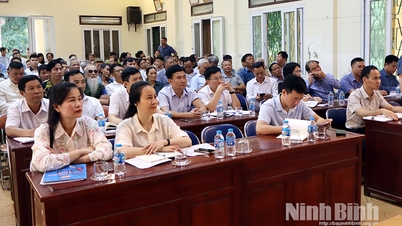
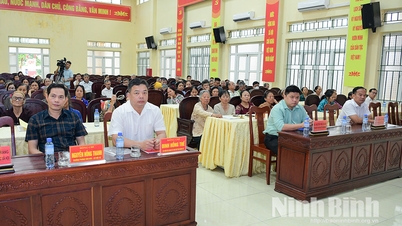
The seminar, chaired by the Central Propaganda Department and organized in coordination with the Central Organization Department, the Central Theoretical Council, and the Ho Chi Minh National Political Academy, recently took place in Hanoi .
"The fundamental foundation" and the responsibility of cadres and Party members to preserve it.
At the aforementioned seminar, Professor Nguyen Xuan Thang clearly stated: We need to face the truth that there is still a segment of cadres and Party members, including those at high levels, who are degenerating in terms of political ideology, morality, and lifestyle, exhibiting signs of "self-evolution" and "self-transformation," causing dissatisfaction, anxiety, and a decline in the people's trust in the Party, the State, and the socialist regime. Practical experience shows that when cadres and Party members do not regularly study, cultivate, and refine their qualities, they will gradually lose themselves, lose the "fundamental foundation" of revolutionary morality, leading to ideological and political degeneration; and that is a short, extremely dangerous step leading to "self-evolution" and "self-transformation"...
The assessment of the Chairman of the Central Theoretical Council is a concretization and clarification of the content and implications of the dangers of "self-evolution" and "self-transformation" that our Party has clearly pointed out in its resolutions, focusing on Resolution 4 of the 12th Central Committee. Revolutionary ethical standards are the "fundamental foundation" of cadres and Party members, a constituent element of the Party's ideological foundation, and the culture and morality within the Party. In other words, revolutionary ethics in each cadre and Party member are the "stem cells" that constitute the strength, effectiveness, and efficiency of the Party's leadership; they play a core role and are decisive to the survival of the socialist regime in our country. Losing this "fundamental foundation" is like uprooting a tree. This "gradual death" is the process of ideological and political decline, moral decay, and lifestyle degradation, leading to "self-evolution" and "self-transformation." When Party members and officials, especially high-ranking officials, experience ideological, moral, and lifestyle degradation, and their morals and lifestyles deteriorate to the point of "self-transformation," the impact on the Party's prestige and the people's trust is immense. When Party members and officials lose their "fundamental foundation," it creates gaps and cracks in the Party's ideological foundation. These are the pretexts and loopholes that hostile and reactionary forces use to carry out propaganda campaigns, incite unrest, and undermine the Party and the country.
The fact that a series of high-ranking officials, including many under the management of the Politburo and the Central Committee, heading several ministries, sectors, and localities playing strategic roles in the country, have been disciplined by the Party and prosecuted criminally in recent times is a typical example. The practical experience of Party building and rectification, and the fight against corruption and negative phenomena with perseverance, determination, and without exception, has left cadres and Party members with many "bitter" lessons about the responsibility and duty to preserve the "fundamental foundation" of revolutionary ethics in the new situation.
At the aforementioned seminar, leaders, managers, and experts acknowledged that building the Party's ethics and cultivating revolutionary ethics among cadres and Party members is a very important issue. This is one of the key tasks in Party building and rectification, and one of the fundamental contents of Ho Chi Minh's thought. Throughout the process of establishing, educating, and training our Party, President Ho Chi Minh always identified revolutionary ethics as the core content of the Party, ethics as the "root" of a revolutionary. He emphasized: A revolutionary must have ethics; without ethics, no matter how talented, they cannot lead the people...
Reiterating and emphasizing the Party's fundamental principles helps to better understand, deepen, and broaden the importance of revitalizing culture and ethics within the Party; strengthening the "foundation" in each cadre and Party member, especially the exemplary role of key cadres and leaders. The higher the level of the cadre, the more exemplary their example must be. This crucial issue has been deeply and thoroughly understood by our Party. In principle, the Party has "armed" all cadres, Party members, and Party organizations at all levels with a system of contents, viewpoints, goals, and solutions... creating an environment for cadres and Party members to study, cultivate, train, contribute, push back against negative manifestations and degeneration, and prevent "self-evolution" and "self-transformation". The 27 manifestations of degradation, "self-evolution," and "self-transformation" summarized and clearly outlined by the Party in Resolution No. 4 of the 12th Central Committee are the basis for cadres, Party members, and Party organizations at all levels to build and rectify themselves. The deeper we delve into implementation, the clearer we see the importance of early and proactive preventive measures to limit, repel, and ultimately eliminate the proliferation and development of these issues.
Emphasize the importance of self-education and self-cultivation.
Establishing revolutionary ethical standards for cadres and Party members in the new era is a scientific issue, reflecting the Party's strategic vision. We are continuing to research and define these standards based on theoretical foundations, traditional values, practical experience, and the goals and requirements of Party building and rectification, as well as national construction and defense in the new situation. Alongside the universal and core contents of revolutionary ethics that have been built and developed from the history of the nation, the history of the Communist Party of Vietnam, the practical experience of Party building and rectification, and the development trends of the country and the times, new requirements arise that necessitate our additions, developments, and refinements.
Looking back at recent years, we see that: After 7 years of implementing Resolution No. 4 of the 12th Central Committee, alongside the very important achievements, manifestations of ideological and political degradation, moral character, and lifestyle deterioration, seriously affecting the "fundamental foundation" in a segment of cadres and Party members, continue to be complex. The conclusion of the Fourth Plenum of the 13th Central Committee of the Party clearly stated: A segment of cadres and Party members, including leading and managerial cadres, have not fully understood the nature and importance of Party building and rectification work; They have failed to uphold a sense of responsibility, lacked exemplary conduct, their ideals have faded, their willpower has diminished, they have fallen into individualism, their words do not match their actions, they have violated Party discipline, and they have violated the law... The main cause of these limitations and shortcomings is that some Party committees, Party organizations, and leading and managing cadres, especially those at the top, have not fully recognized the extent of degradation, "self-evolution," and "self-transformation" in their localities, agencies, and units...
One of the fundamental issues in strengthening the "foundation," preventing it from being attacked, eroded, or lost, is changing the perception of cadres and Party members regarding the importance and severity of internal degeneration. Resolution No. 4 of the 12th Central Committee clearly states: The deep-seated and primary cause of degeneration among a segment of cadres and Party members is primarily due to their own lack of self-cultivation and training; their unstable ideological stance; their confusion and wavering in the face of external influences; and their descent into individualism...
Thus, the revolutionary ethical standards for cadres and Party members in the new era not only set high goals and requirements for "construction" but also link them to the courage, duty, and responsibility of "combating." Cadres and Party members need to deeply understand the dangers and correctly identify the manifestations of ideological and political degradation, moral decay, and lifestyle deviations, as well as "self-evolution" and "self-transformation" within themselves and within their Party organizations, in order to have effective preventive and combative measures.
Among the various solutions proposed by researchers to uphold the "fundamental foundation" of revolutionary ethics among cadres and Party members, self-help solutions (self-education, self-cultivation, self-training) play a crucial and decisive role. Moral qualities and lifestyles are factors formed from within the individual cadre or Party member. External forms and solutions only serve as supplementary elements.
Cadres and Party members, especially those holding important positions and responsibilities in the current political system at all levels, have a great advantage: a learning environment and opportunities to study and conduct fundamental research on political theory. The higher the position held, the more opportunities they have for in-depth study and research. Their theoretical knowledge and the process of learning, working, and practical activities form the environment for transforming the educational process into self-education, self-cultivation, and self-improvement. The degeneration of a segment of cadres and Party members, including many high-ranking officials, leading to the complete loss of their "fundamental foundation," stems entirely from subjective causes: a lack of self-cultivation and a disregard for, or suppression of, the process of self-education and self-improvement.
For the "fundamental foundation" to become an endogenous resource that governs people's thinking, actions, and deeds, cadres and Party members must prioritize self-help solutions more than ever. If they themselves lose this "fundamental foundation," leading to disciplinary and legal violations, they should only blame themselves, not their agencies or organizations...
LU NGAN (qdnd.vn)
Source link



![[Image] National Assembly discusses the implementation of the socio-economic development plan.](https://vphoto.vietnam.vn/thumb/1200x675/vietnam/resource/IMAGE/2026/04/20/1776696707422_ndo_br_img-20260420-185419-jpg.webp)
![[Photo] General Secretary and President To Lam meets with National Assembly delegates from ethnic minorities.](https://vphoto.vietnam.vn/thumb/1200x675/vietnam/resource/IMAGE/2026/04/20/1776696701056_a1-bnd-8331-3342-jpg.webp)



















































































Comment (0)