

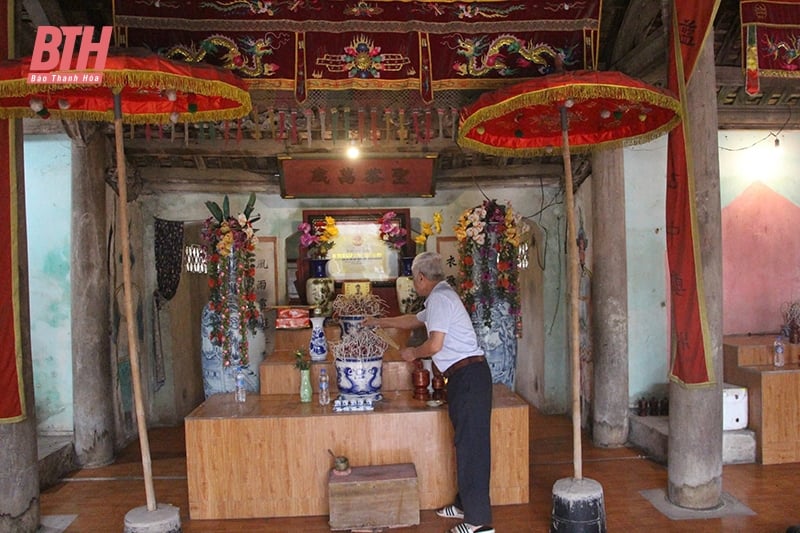
Grand Tutor and Duke Le Kha Lang is revered by the people of Huong Nhuong village as the village's guardian deity. Photo: CHI ANH
According to Professor Phan Huy Le, "Le Loi - Lam Son, the name of the person and the name of the place are inextricably linked and have long entered history and the hearts of the people as a heroic symbol of Thanh Hoa province and of our entire country and nation."
During the 10-year journey of hardship and struggle, alongside King Le Loi of Binh Dinh were generals from the Kinh ethnic group to ethnic minorities, from the mountainous regions of the Ma and Chu rivers to the plains, all united under the banner of rebellion.
Located on the right bank of the Chu River, Tho Hai is a flat plain with no mountains or hills, fertile land, and a favorable geographical position, making life relatively easy for its people. It is the birthplace of Le Van Linh, a founding national hero of the early 15th century, and the place of worship for Le Kha Lang, another founding national hero. Around Tho Hai, within an area of approximately 10 square kilometers, the villages along both banks of the Chu River are also the birthplaces of many founding national heroes and generals associated with the Lam Son Uprising, such as Le Nhu Lam (Xuan Lap), Le Van An, Vu Uy (from Muc Son, now Xuan Bai commune); Le Ngan (from Dam Di commune in Lam Son, now Xuan Thien commune)...
These national heroes not only held important positions and made immense contributions to the defense and development of the country, but their prestige also profoundly impacted their homeland, contributing to the protection and building of the Great Viet nation through the ups and downs of history.
The village chronicle of Huong Nhuong, Tho Hai commune, records that the village's patron deity was Grand Marshal Tu Quoc Cong Le Kha Lang. Originally from Dao Xa village, Lam Son commune, Thuy Nguyen district, Thieu Thien prefecture, Thanh Hoa province, he once joined the Tran dynasty's army to fight against the Ming invaders. However, the Tran dynasty's cause was unsuccessful, and he returned to his hometown.
Le Kha Lang had five sons, all of whom contributed to the pacification of the Ngo Dynasty and the founding of the nation. Two of them held the highest rank of Duke, and were even granted the title of Great King. Historical records state that in 1418, Le Kha Lang, along with his two eldest sons, Le Dinh Ngang (Le Ngang) and Le Liet, participated in the Lam Son Uprising against the Ming invaders under the command of Binh Dinh King Le Loi. After enduring years of hardship and suffering, Le Kha Lang gained Le Loi's trust and proved his worth and capabilities, subsequently receiving continuous rewards and titles.
On April 15, 1428, after the country was free from invaders, in accordance with the will of Heaven and the wishes of the people, Le Loi ascended the throne as Emperor, taking the reign name Thuan Thien and naming the country Dai Viet. Le Kha Lang was rewarded for his services and was granted the title of Thai Bao, the rank of Tu Quan Cong, and the position of co-general of Thuong Nam Sach, and was bestowed the title of Thai Pho Tu Quan Cong.
In 1429, he was promoted to the rank of Marquis. Le Kha Lang died on January 25th, 1442 (the year of the Water Dog), and was deified and worshipped in many places. Besides the ancestral temple in Trung Hoa village, Gia Van commune, Gia Vien district ( Ninh Binh province), Le Kha Lang is primarily worshipped at the communal temple in Huong Nhuong village, Tho Hai commune (Tho Xuan). In 1484, King Le Thanh Tong posthumously bestowed upon him the titles of Grand Tutor, Duke of Tu Quoc, Inspector of the Imperial Court, Minister of War, and Grand Marshal, Left Holy King.
Compared to many other founding heroes of the Later Le Dynasty, documentation about General Le Kha Lang is very scarce. The main information is found in the village's genealogical records and two royal decrees currently preserved at the ancestral temple in Trung Hoa village.
Regarding Huong Nhuong, an ancient village located on the right bank of the Chu River, it was an important transportation hub during Le Loi's rebellion against the Ming invaders. Proudly introducing it to us, Mr. Nguyen Trung Thanh, deputy head of the relic management board, said: "Huong Nhuong communal house is a place to honor and worship Le Kha Lang, a founding meritorious official of the Le Dynasty and Grand Tu Quoc Cong. This is a wooden sculpture from the Nguyen Dynasty, rebuilt in the 19th century. Initially, the communal house was made of bamboo and thatch right on the banks of the Chu River; later, the villagers moved it to the center of the village, building it on a large, high, and flat piece of land."
The temple grounds are vast. With its T-shaped architecture, the temple is built of ironwood, divided into a front hall and a rear sanctuary. Looking at the decorative details and carvings of the four mythical creatures, the four auspicious symbols, intertwined with clouds, flowers, and leaves... one can appreciate the skill of the ancient carpenters as well as the thoughts and feelings that the villagers have poured into it.
Although the current communal house is only a little over 100 years old, the people of Huong Nhuong village, from generation to generation, are very proud of their village and of Grand Tutor and Duke Le Kha Lang.
"In remembrance of the contributions of the founding national hero, according to the plan, the village communal house will be restored and renovated by the Department of Culture, Sports and Tourism in the near future," added Mr. Nguyen Trung Thanh, deputy head of the relic management board.
CHI ANH
Source: https://baothanhhoa.vn/khai-quoc-cong-than-nbsp-le-kha-lang-243820.htm


![[Infographics] - Traditional Tet program in ancient villages, Spring of the Year of the Horse 2026](/_next/image?url=https%3A%2F%2Fvphoto.vietnam.vn%2Fthumb%2F402x226%2Fvietnam%2Fresource%2FIMAGE%2F2026%2F02%2F02%2F1770024604982_infographics-ch-w1200t0-di2605d199d1155458t11358l1-chuong-trinh-te7.webp&w=3840&q=75)


![OCOP during Tet season: [Part 3] Ultra-thin rice paper takes off.](/_next/image?url=https%3A%2F%2Fvphoto.vietnam.vn%2Fthumb%2F402x226%2Fvietnam%2Fresource%2FIMAGE%2F2026%2F01%2F28%2F1769562783429_004-194121_651-081010.jpeg&w=3840&q=75)




Comment (0)