

Mitigating the impact of rain on rice crops.
Monday, May 20, 2024 | 15:03:32
193 views
Currently, the spring rice crop has basically finished flowering, the early-season crop is in the ripening stage, and some areas are preparing for harvest; the main crop is in the milky to green ripening stage.
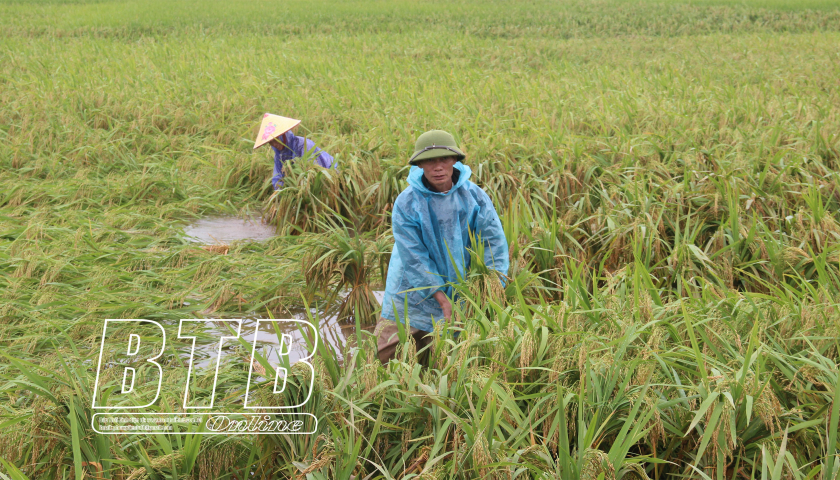
For rice fields where the plants have flattened, after draining excess water, it is necessary to prop up the plants and tie them together at their natural angle. (illustrative image)
On May 19th, the province experienced moderate to heavy rain, with some areas receiving very heavy rainfall. Rainfall amounts generally ranged from 30-50mm, with some areas like Vu Hoa commune (Kien Xuong district) recording 88.8mm. This caused some areas of spring rice crops to tilt or fall over, mainly those that had headed in late April.
The agricultural sector advises localities to urgently drain excess water from rice fields, but not immediately. A shallow layer of water should be maintained to support the rice plants, especially those in the heading to ripening stage. For areas where rice plants are slightly tilted, they can recover on their own. For areas where rice plants are completely flattened, after draining the water, the plants should be propped up and tied along their tilt. Under no circumstances should they be propped up against the direction of the fall, as this will break the roots and significantly affect grain filling. Regular checks for rice planthoppers and brown spot disease are necessary to proactively apply timely control measures.
For rice fields with 70% or more of the grains ripened, if the rice has been flattened, after draining the water and once the weather clears, harvest immediately and dry the rice to prevent the grains from becoming too wet and reducing rice quality. For rice fields with slight or no lodging, harvest when the grains are 80-85% ripe, following the principle of "better to harvest while still green than to let it ripen too much in the field." For rice fields that are heading or have just finished heading, proactively spray to prevent rice blast disease on susceptible varieties such as BC15, TBR225, TBR1, various glutinous rice varieties, etc., and combine this with prevention of grain discoloration and blight on other rice varieties when the weather clears.
Ngan Huyen
Source


![OCOP during Tet season: [Part 3] Ultra-thin rice paper takes off.](/_next/image?url=https%3A%2F%2Fvphoto.vietnam.vn%2Fthumb%2F402x226%2Fvietnam%2Fresource%2FIMAGE%2F2026%2F01%2F28%2F1769562783429_004-194121_651-081010.jpeg&w=3840&q=75)



Comment (0)