

The conference was held in a hybrid format, combining in-person and online participation, with the main venue in Hanoi and 63 other venues in provinces and cities.
Prime Minister Pham Minh Chinh; Minister of Education and Training Nguyen Kim Son, Deputy Minister Nguyen Van Phuc, Deputy Minister Pham Ngoc Thuong, Deputy Minister Hoang Minh Son, and Deputy Minister Nguyen Thi Kim Chi chaired the conference.
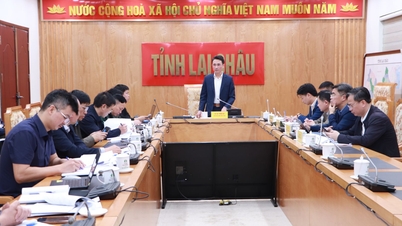
At the Lao Cai provincial venue, Ms. Giang Thi Dung, Vice Chairman of the Provincial People's Committee, attended the conference.

The report presented at the conference assessed: Under the close guidance of the Government and the Prime Minister, along with the effective coordination of central ministries and agencies, local Party committees and authorities; the support of the broad masses of the people and parents; and especially with the determination and responsibility of the teaching staff and education management officials, and the efforts of students and trainees, the entire education sector has completed the 2023-2024 school year plan, with many positive results. The universalization of preschool, primary, and lower secondary education, and literacy programs continue to receive attention. The 2018 general education program, with many new features, has been implemented comprehensively across all subjects and educational activities in all grades nationwide. The quality of mass and advanced education continues to improve. The Ministry of Education and Training successfully organized the 2024 High School Graduation Examination. Higher education autonomy is gradually becoming more substantive.
Besides the achievements mentioned above, the implementation of the 2023-2024 school year plan still faces some shortcomings and limitations. The shortage of teachers remains widespread in most localities; recruitment in many areas is slow, failing to fill all allocated positions, affecting the assurance and improvement of educational quality. The distribution of preschool and general education facilities is still uneven in some areas, with a shortage of schools and classrooms in large cities, industrial zones, densely populated areas, and mountainous regions. Ensuring the safety of preschool children in independent and private preschools, especially in urban areas, industrial zones, and export processing zones, remains inadequate. The quality of higher education does not yet meet the human resource requirements for new economic sectors and high-tech industries.

Speaking at the conference, Minister of Education and Training Nguyen Kim Son affirmed: With the theme "Discipline, responsibility, continuous innovation, and quality improvement," the 2024-2025 school year marks the end of the term implementing the Resolution of the 13th National Congress of the Communist Party of Vietnam. This is also the year the 2018 General Education Program will be implemented in all grades from 1 to 12; and the first year the High School Graduation Examination will be held according to the 2018 General Education Program. Therefore, the education and training sector will focus on several key tasks: Implementing Conclusion No. 91-KL/TW, dated August 12, 2024, of the Politburo, continuing to implement Resolution 29-NQ/TW; ensuring... ensuring equitable access to education for all; ensuring To ensure that the nurturing, care, and education of children meet the requirements of the Preschool Education Program; to develop Develop a sufficient and high-quality team of teachers, lecturers, and educational administrators; effectively utilize state budgets and mobilize investment resources for education; strengthen the education of revolutionary ideals, political ideology, ethics, and lifestyle for administrators, teachers, lecturers, staff, students, and trainees; improve the quality of human resource training, especially high-quality human resources linked to scientific research and innovation; strengthen international integration in education; promote digital transformation and administrative reform throughout the sector; strengthen inspection, supervision, and handling of violations in the field of education and training; and strengthen educational communication.


At the conference, delegates from central ministries and agencies exchanged and shared experiences from their localities. Based on this, they contributed solutions for effectively implementing the tasks of the 2024-2025 school year and other key responsibilities assigned to the education sector by the Party and the State.
Clearly outlining the causes and lessons learned, analyzing the context, tasks, and key solutions for the 2024-2025 school year and beyond, Prime Minister Pham Minh Chinh directed the Ministry of Education and Training, other ministries, sectors, and localities to prioritize resource allocation, upgrade facilities, and ensure hygiene, security, and safety in schools; and to continue reviewing and planning the network of preschool, general education, continuing education, special education, higher education, and teacher training colleges. The Ministry of Education and Training, other ministries, sectors, and localities should pay attention to planning and ensuring suitable land for the construction of schools and classrooms to meet learning needs in line with urbanization and population shifts.
The Prime Minister also requested the promotion of autonomy coupled with improving the quality of university education in a substantive, in-depth manner, linked to accountability, openness, and transparency; continuing to create a favorable environment to attract investment resources for the development of education and training, ensuring fairness and equality between the public and private sectors; promoting public-private partnerships; and promoting non-profit higher education and training. At the same time, he called for the development, review, amendment, and supplementation of policies and remuneration schemes for teachers to ensure suitability; the recruitment and restructuring of teachers according to the allocated staffing quotas, addressing the surplus and shortage of teachers in educational institutions, ensuring the principle of "where there are students, there must be teachers in the classroom" and aligning with reality.
On the eve of the new academic year 2024-2025, Prime Minister Pham Minh Chinh wished all management staff, teachers, and educators to always uphold their sense of responsibility and enthusiasm for the profession, overcome all difficulties and challenges, and persevere in the goal of fundamental and comprehensive reform of education and training, meeting the expectations of the Party, the State, and the People.
For Lao Cai province, the overall quality of education continued to show significant improvements in the 2023-2024 school year. Currently, the province has 403 schools meeting the required standards. In the national-level excellent student competition, 63 out of 99 contestants won awards; in the national-level scientific research competition, the province won 2 out of 2 awards (1 second prize and 1 third prize); in the high school graduation exam, the pass rate reached 99.68%, ranking 4th out of 14 provinces in the northern midland and mountainous region (after Phu Tho, Tuyen Quang, and Bac Giang); maintaining its first position among the 7 northern mountainous provinces in the emulation group.
For the 2024-2025 academic year, the education and training sector of Lao Cai province will continue to steadfastly and resolutely implement the theme of the academic year: "For our beloved students; building disciplined, responsible, and happy schools; innovation and integration." The entire sector will continue to focus on breakthrough areas, namely: promoting digital transformation in education; improving the quality of foreign language teaching and learning - international integration in education and training; building national standard schools; and identifying and nurturing gifted and talented students.
Source

![[Photo] Prime Minister Pham Minh Chinh receives Lao Minister of Education and Sports Thongsalith Mangnormek](/_next/image?url=https%3A%2F%2Fvphoto.vietnam.vn%2Fthumb%2F1200x675%2Fvietnam%2Fresource%2FIMAGE%2F2025%2F12%2F16%2F1765876834721_dsc-7519-jpg.webp&w=3840&q=75)
![[Image] Leaked images ahead of the 2025 Community Action Awards gala.](/_next/image?url=https%3A%2F%2Fvphoto.vietnam.vn%2Fthumb%2F1200x675%2Fvietnam%2Fresource%2FIMAGE%2F2025%2F12%2F16%2F1765882828720_ndo_br_thiet-ke-chua-co-ten-45-png.webp&w=3840&q=75)

![[Live] 2025 Community Action Awards Gala](/_next/image?url=https%3A%2F%2Fvphoto.vietnam.vn%2Fthumb%2F1200x675%2Fvietnam%2Fresource%2FIMAGE%2F2025%2F12%2F16%2F1765899631650_ndo_tr_z7334013144784-9f9fe10a6d63584c85aff40f2957c250-jpg.webp&w=3840&q=75)
![[Photo] Prime Minister Pham Minh Chinh receives the Governor of Tochigi Province (Japan)](/_next/image?url=https%3A%2F%2Fvphoto.vietnam.vn%2Fthumb%2F1200x675%2Fvietnam%2Fresource%2FIMAGE%2F2025%2F12%2F16%2F1765892133176_dsc-8082-6425-jpg.webp&w=3840&q=75)






























![[Photo] Prime Minister Pham Minh Chinh attends the Vietnam Economic Forum 2025](https://vphoto.vietnam.vn/thumb/402x226/vietnam/resource/IMAGE/2025/12/16/1765893035503_ndo_br_dsc-8043-jpg.webp)


















Comment (0)