

Perhaps the idea of 'Teaching AI to first graders' is about introducing children to the applications of artificial intelligence, not about training AI experts from the first grade.
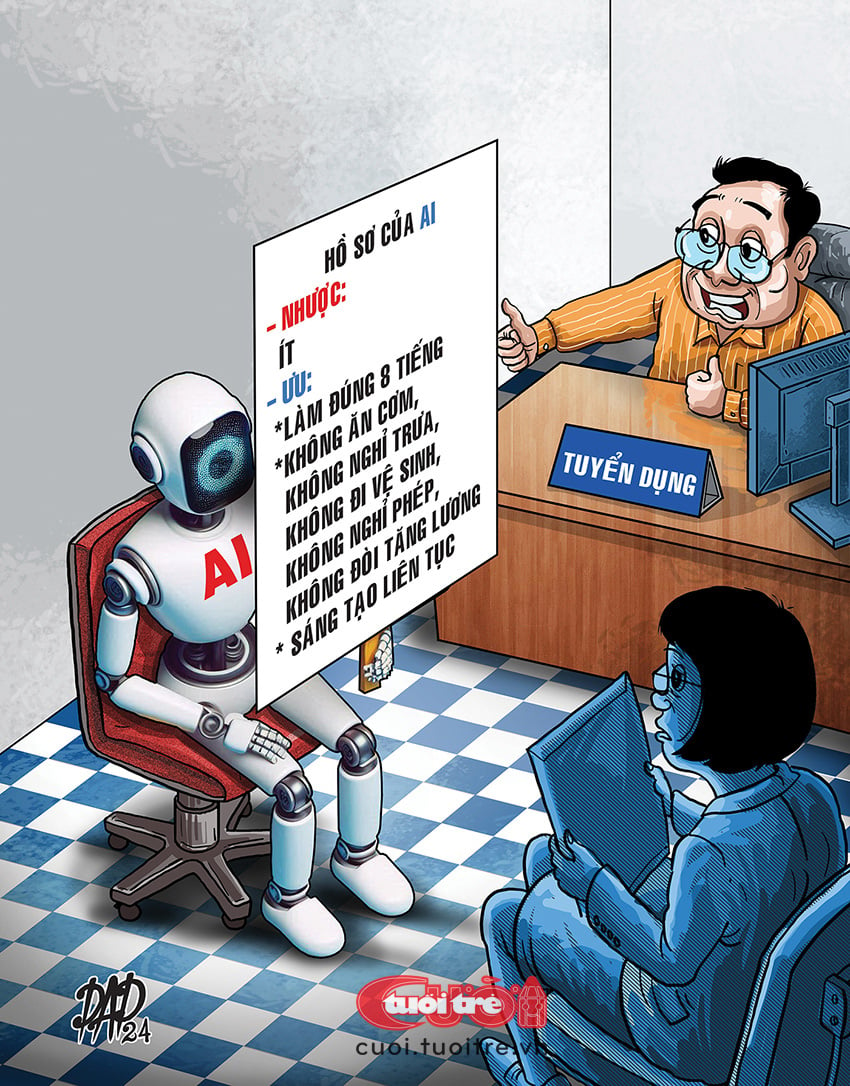
Illustration photo: Tuoi Tre Cuoi (Youth Laughs)
Yesterday, I read in the newspaper about an opinion from a tech company executive who proposed the idea of teaching artificial intelligence (AI) to children as early as first grade. The article included support from one parent, and of course, there were also dissenting opinions from other parents.
I think teaching AI to first-grade students is an early approach. Perhaps this statement is just a side note rather than a full study of the potential impact of AI on young children. This is an age where any educational proposal requires very thorough research into its effects.

Introducing artificial intelligence to elementary school students requires extreme caution - Image created by AI.
What are the implications of exposing children to AI at an early age?
Impact on children's creativity
Children aged 6-12 are in a period of rapid development of creative thinking.
If children are exposed to technology too early, especially AI, which can automate many thinking processes, they may become dependent on technology instead of developing creativity and independent thinking skills.
Young children are not yet mature enough to understand AI.
AI is a complex technology, and users are required to possess critical thinking skills.
At a young age, children lack the foundation to understand how AI works, making them more likely to passively and unverifiedly accept information.
Impact on the development of social communication skills.
Early exposure to technology can diminish children's social interaction skills. At this age, children need to be encouraged to develop communication skills, teamwork, and real-world experiences, rather than spending too much time in front of screens and passively using technology.
At what age can children be trained to use AI?
Today, children already possess basic computer skills at a relatively young age. The appropriate age to begin training children to access AI applications should start from 12 years old.
We can start with foundational skills like logical thinking and problem-solving before delving deeper into AI.
On the other hand, AI training should be coupled with an education program on "Technological Ethics." Children need to be taught how to use AI responsibly, avoiding cheating or misusing AI for malicious purposes.
The goal is to use AI as a supportive tool, rather than allowing children to become passively dependent on technology.
Teaching AI to young children requires a scientific and responsible approach.
We are not against AI, but we need to ensure that AI education for young children truly serves the best interests of an entire future generation.
Source: https://tuoitre.vn/hoc-sinh-tieu-hoc-dang-phat-trien-tu-duy-sang-tao-co-nen-cho-hoc-ve-ai-20250214081929173.htm

![[Photo] Prime Minister Pham Minh Chinh receives the Governor of Tochigi Province (Japan)](/_next/image?url=https%3A%2F%2Fvphoto.vietnam.vn%2Fthumb%2F1200x675%2Fvietnam%2Fresource%2FIMAGE%2F2025%2F12%2F16%2F1765892133176_dsc-8082-6425-jpg.webp&w=3840&q=75)
![[Live] 2025 Community Action Awards Gala](/_next/image?url=https%3A%2F%2Fvphoto.vietnam.vn%2Fthumb%2F1200x675%2Fvietnam%2Fresource%2FIMAGE%2F2025%2F12%2F16%2F1765899631650_ndo_tr_z7334013144784-9f9fe10a6d63584c85aff40f2957c250-jpg.webp&w=3840&q=75)

![[Photo] Prime Minister Pham Minh Chinh receives Lao Minister of Education and Sports Thongsalith Mangnormek](/_next/image?url=https%3A%2F%2Fvphoto.vietnam.vn%2Fthumb%2F1200x675%2Fvietnam%2Fresource%2FIMAGE%2F2025%2F12%2F16%2F1765876834721_dsc-7519-jpg.webp&w=3840&q=75)
![[Image] Leaked images ahead of the 2025 Community Action Awards gala.](/_next/image?url=https%3A%2F%2Fvphoto.vietnam.vn%2Fthumb%2F1200x675%2Fvietnam%2Fresource%2FIMAGE%2F2025%2F12%2F16%2F1765882828720_ndo_br_thiet-ke-chua-co-ten-45-png.webp&w=3840&q=75)





































































































Comment (0)