

Leading the pack is Joseph Inguimberty's (1896-1971) painting *Le retour du marché * ( Returning from the Market ), which fetched a hammer price of HKD 12.47 million (VND 41.52 billion). Following closely behind are Jos Henri Ponchin's (1897-1981) *Marché au Tonkin * ( Market in Tonkin ) at HKD 3.52 million (VND 11.74 billion), Victor Tardieu's (1870-1937) * La paysanne * ( The Peasant Woman ) at HKD 3.15 million (VND 10.48 billion), and Alix Aymé's (1894-1989) * La jeune femme et le fleuve* ( The Young Woman by the River ) at HKD 504,000 (VND 1.67 billion)...
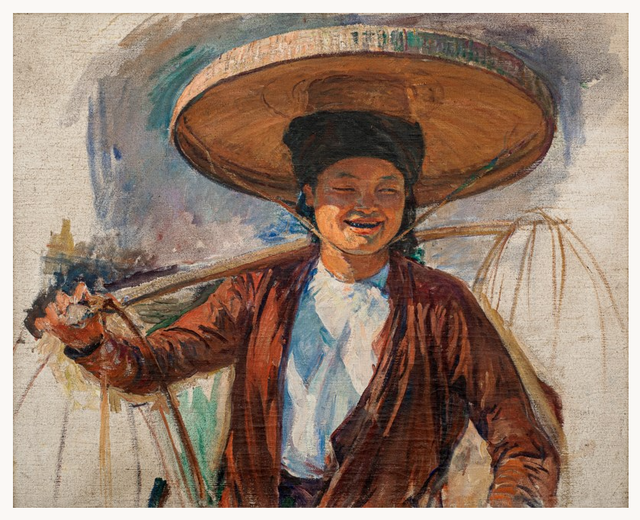
Victor Tardieu's work La paysanne (The Peasant Woman)
On March 30, Sotheby's auction house announced that Alix Aymé's painting *Annonce Faite à Marie * ( Blessing Marie ) sold for HK$190,000 (VND 632 million). On April 10, at Drouot auction house (Paris), Joseph Inguimberty's * Scène de famille dans un parc* ( Family Scene in a Park ) sold for EUR 117,000 (VND 3.44 billion).
"I feel a strong connection to this country."
Victor Tardieu was born in Lyon, France, and studied at the Lyon School of Fine Arts from 1887 to 1889. In 1920, he won the Prix de l'Indochine, the prize of which was a one-year trip to Indochina.
On February 2, 1921, Victor Tardieu arrived in Saigon and then traveled to Hanoi . On October 27, 1924, Tardieu founded the Indochina School of Fine Arts with the collaboration of painter Nam Son. On November 24, 1924, Victor Tardieu became the first principal of this school, which trained many famous painters such as Le Pho, Vu Cao Dam, Mai Trung Thu, To Ngoc Van, Nguyen Gia Tri, Le Thi Luu, Pham Hau, Bui Xuan Phai… Victor Tardieu passed away on June 12, 1937 in Hanoi.
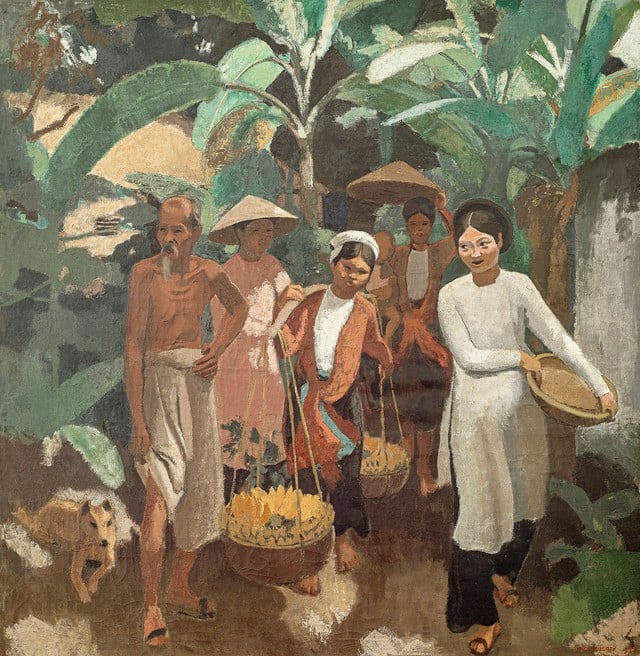
Joseph Inguimberty's work , *Le retour du marché* (Returning from the Market).
Alix Aymé was born in Marseille, France, and studied art and music at the Toulouse Conservatory. She married Professor Paul de Fautereau-Vassel in 1920, moved to Shanghai, China, and then to Hanoi to live with her husband. In the 1920s, she taught drawing at the Albert Sarraut School in Hanoi. In 1922, after her first visit to Vietnam, she wrote to her teacher, Maurice Denis, which included the following passage: "I find this country very interesting, especially its colors and flat terrain with lush green rice fields stretching to the horizon, and beautiful trees like the banyan and fig trees with their roots growing from the branches to the ground, or the kapok trees now ablaze with red blossoms… I feel attached to this country because I have come to understand and love it more. I think I will be able to create many beautiful works here."
Alix Aymé spent nearly 25 years living, painting, and teaching in Vietnam, achieving remarkable success in innovating traditional Vietnamese lacquer painting, transforming it into a new means of expression in modern art. In 1945, she returned to France. Although she left Indochina, the region remained deeply ingrained in her heart. Themes of the land and people of Indochina were ever-present in her paintings until the end of her life.
Joseph Inguimberty was also born in the port city of Marseille. He entered art school in 1910, studying architecture. He won the Prix Blumenthal in 1922 and the Grand National Prize for Painting in 1924.
In 1925, Joseph Inguimberty accepted Victor Tardieu's offer to teach decorative arts at L'École Supérieure des Beaux-Arts de L'Indochine (Indochina School of Fine Arts) in Hanoi. He and the school's co-founder (the painter Nam Son) built the foundation for art education and taught there for over 20 years. Joseph Inguimberty always encouraged his students to create paintings that strongly reflected the cultural identity of their homeland.
In 1929, Joseph Inguimberty held his first solo exhibition in Hanoi, where the Governor-General of Indochina purchased several of his artworks. Joseph Inguimberty's works all depicted the people and life of Vietnam in a realistic and vivid way.
Jos Henri Ponchin belonged to the third generation of the renowned Ponchin family, with many painters bearing the Ponchin surname whose works are preserved in numerous museums in France. In the mid-1920s, the young artist followed his father, Antoine Ponchin, who had just been appointed to an important official position in the government, to Asia, taking up a teaching position at a French high school in Hanoi until his return to France in 1931. Jos participated in decorating the Albert Sarraut High School and the Indochina Governor-General's Palace with his father, and for a time taught drawing to French students at a high school in Saigon. He was also famous for his propaganda paintings promoting Indochina.
3 main reasons why paintings by French artists are becoming increasingly valuable.
Art researcher Ngo Kim Khoi (grandson of painter Nam Son) believes that the auction figures for paintings by French artists reflect a growing interest in Indochinese art. Their painting techniques clearly follow Western styles, from the use of light, shadow, and color to express emotions or space. They know how to combine these techniques with the distinctive features of Vietnamese culture, landscapes, and people, creating a very unique artistic style.
"Overall, these French artists create a connection between the two cultures, reflecting the differences while also highlighting the values and beauty of Indochina. The success of these works at auctions also reflects the growing interest and appreciation for Indochinese art, opening up a new perspective on the past," Mr. Khoi commented.
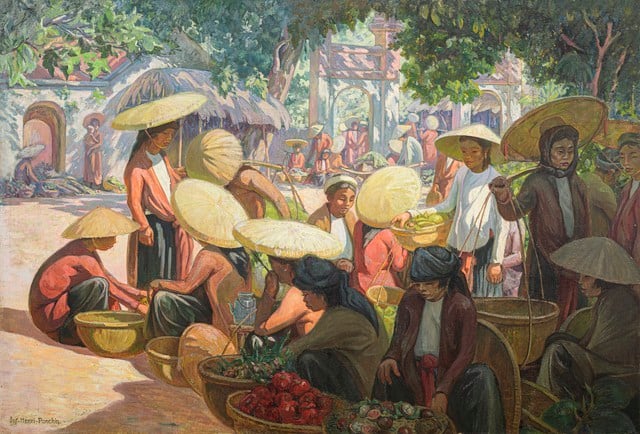
Jos Henri Ponchin's work , Marché au Tonkin (Market in Tonkin).
PHOTO: CHRISTIE'S
Curator Ly Doi added: "There were quite a few Western artists (mainly French) who painted landscapes and portraits of Vietnam during the Indochina period, perhaps over 40 in total. In Christie's auction on March 29th alone, out of 51 lots, more than 15 French artists painted landscapes and portraits of Vietnam during the Indochina period, with over 25 paintings."
"There are three main reasons why paintings by French artists are increasingly valuable. Firstly, Vietnamese paintings from the Indochina art period are now very difficult to find and very expensive, so many collectors are expanding their collections to include paintings by French artists from the same period, directly related to Indochina, which is a logical choice. Secondly, as the Indochina School of Fine Arts approaches its 100th anniversary, French artists and lecturers who were associated with the school are attracting more attention from collectors. Thirdly, collections like that of Philippe Damas have already been an important selection channel, and now that they are being acquired, the price is naturally high," curator Ly Doi commented.
A vast heritage
Ace Lê, CEO of Sotheby's Vietnam, commented: "The 100th anniversary of the Indochina School of Fine Arts is a fitting occasion to reflect on the contributions of French artists to Indochina, not only in establishing an academy, but also in creating an entire art movement with a rich legacy. Their artistic journey carried within it the ambitions, dreams, and perspectives of each individual and group, demonstrating the influence of the West on the flow of Vietnamese art and vice versa."
Source: https://thanhnien.vn/hoa-si-phap-va-tinh-yeu-danh-cho-dat-viet-185250415225522514.htm
![[Image] 20 islands in the Spratly Islands special administrative region hold early elections.](https://vphoto.vietnam.vn/thumb/1200x675/vietnam/resource/IMAGE/2026/03/08/1772949669607_img-20260308-112026-90-jpg.webp)


































Comment (0)