

Satellite images reveal that Lake Urmia, a salt lake, was flooded in September 2020, but by September of this year, the lake had almost turned into a giant salt flat.
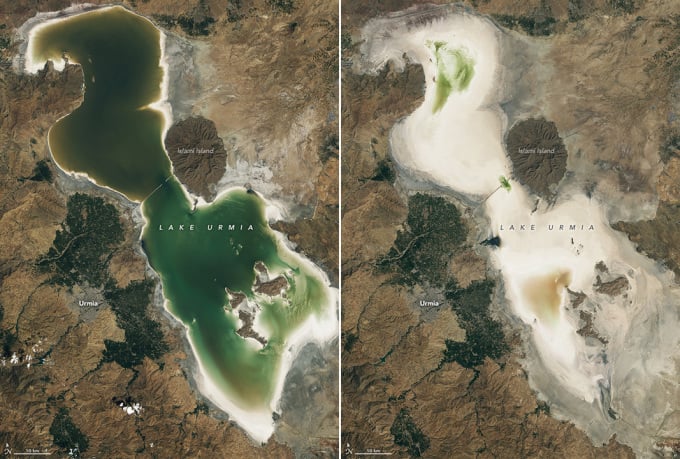
Lake Urmia in satellite images from September 2020 (left) and September 2023 (right). Photo: NASA
With an area of approximately 5,200 square kilometers, Lake Urmia in northwestern Iran was once the largest lake in the Middle East and one of the largest hypersaline lakes on Earth at its peak. However, this body of water has now almost completely transformed into a vast salt flat, SciTechDaily reported on October 15. The change is clearly visible in images taken by Landsat 8 in September 2020 and Landsat 9 in September 2023.
In 2020, most of the lakebed was flooded, and salt was only present around the lake's edge. This was because, prior to that, the area had received above-average rainfall, causing freshwater to inundate the lake and expand its water surface. However, since then, drought conditions have caused the water level to drop.
Urmia's long-term trend is gradual drying up. In 1995, Lake Urmia had a high water level, but over the next two decades, the lake's water level dropped by more than 7 meters and it lost approximately 90% of its area. Repeated droughts, agricultural water use, and dam construction on rivers supplying the lake have contributed to this decline.
The shrinking Lake Urmia is causing numerous impacts on the ecosystem and human health. The lake, its islands, and the surrounding wetlands form a valuable natural habitat and are recognized as a UNESCO Biosphere Reserve, a Ramsar site (a wetland of international importance under the Ramsar Convention), and a national park. It is a breeding ground for waterbirds such as flamingos, pelicans, and white-headed ducks, and a stopover point for migratory species. However, with lower water levels, the remaining water in the lake is becoming more saline, affecting shrimp populations and other food sources for larger animals.
The drying up of the lake also increases the risk of dust from the lakebed being blown up by the wind, leading to a decline in air quality. Recent studies have shown that low water levels in Lake Urmia affect the respiratory health of local residents.
The impacts of climate, water use, and dams on Lake Urmia's water levels remain controversial. The lake has shown some recovery during a 10-year restoration program launched in 2013. However, the true effectiveness of the program is difficult to assess because heavy rainfall also occurred during that period. Some studies conclude that new climatic factors played a key role in the recovery.
Thu Thao (According to SciTechDaily )
Source link
![[Photo] Standing Committee member of the Party Central Committee Tran Cam Tu working with the Central Inspection Committee](https://vphoto.vietnam.vn/thumb/1200x675/vietnam/resource/IMAGE/2026/05/28/1779969579668_ndo_br_bnd-2495-jpg.webp)



















![[GALLERY] A "billion-dollar" game that hasn't even been released yet is already driving gamers crazy.](https://vphoto.vietnam.vn/thumb/402x226/vietnam/resource/IMAGE/2026/05/28/1779977371733_goi-3-png.webp)












































































Comment (0)