

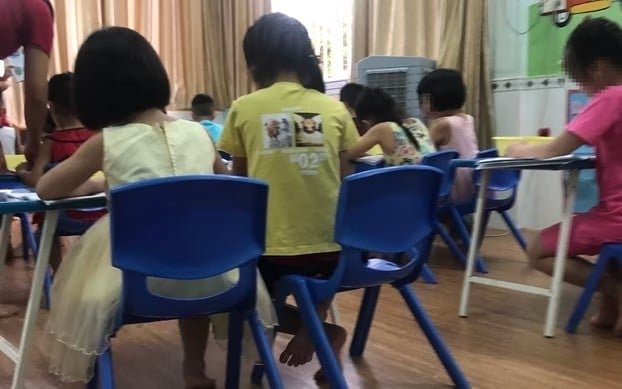
Inside a preschool literacy and math class before entering first grade in Ho Chi Minh City.
What is the "broken windows effect"?
In 1969, Stanford University psychologist Philip Zimbardo conducted an experiment. He left two broken-down, unregistered cars in a low-income neighborhood in the Bronx, New York City, and a wealthy neighborhood in Palo Alto, California, respectively.
In just 24 hours, the car in the Bronx had its windows smashed and parts stolen. In contrast, the car in Palo Alto remained untouched for over a week. Only after Mr. Zimbardo smashed the car with a sledgehammer did some people join in. Most of the vandals in both cities were described as "well-dressed and presentable."
But what happened next was really interesting.
Many years after Zimbardo's experiment, the above results were reiterated in an article published in The Atlantic by social scientist George Kelling in 1982. For the first time, Kelling mentioned the "broken window effect" theory. If someone breaks a window in a building and it's not repaired promptly, more windows will break. This is because, upon seeing broken windows, vandals tend to break other windows to commit crimes.
This theory is actually very easy to understand. For example, a hallway might be perfectly clean, but if someone throws a bag of trash into a corner and it's not cleaned up promptly, a few bags of trash will soon become a large garbage dump. Over time, the hallway will become a dumping ground and become smelly and dirty. This is the "broken window effect." Initially, it's a small problem, but if not addressed in time, the problem will grow larger and the consequences will become serious.
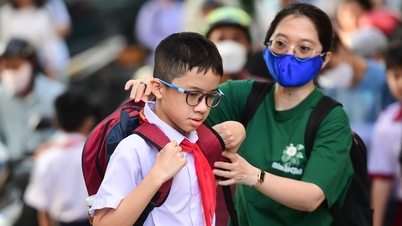
Regarding pre-first grade learning, no parent wants their child to fall behind others when they first start first grade. Falling behind in early years can affect a child's self-confidence and this can persist into later years.
From the "broken windows effect," we can see that if just one child learns ahead of the curriculum and excels more than the others, it will lead to the whole class following suit. This also applies to the current problem of extra tutoring and supplementary classes.
Peer pressure
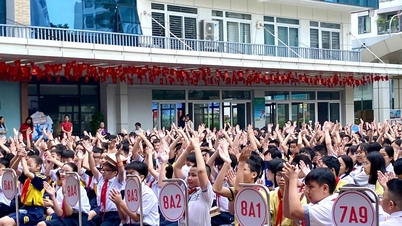
Competition in schools and peer pressure are the root causes of these phenomena. As long as parents and schools place too much emphasis on grades and a race for achievement to evaluate students, the widespread practice of extra tutoring and learning ahead of the first-grade curriculum will continue.
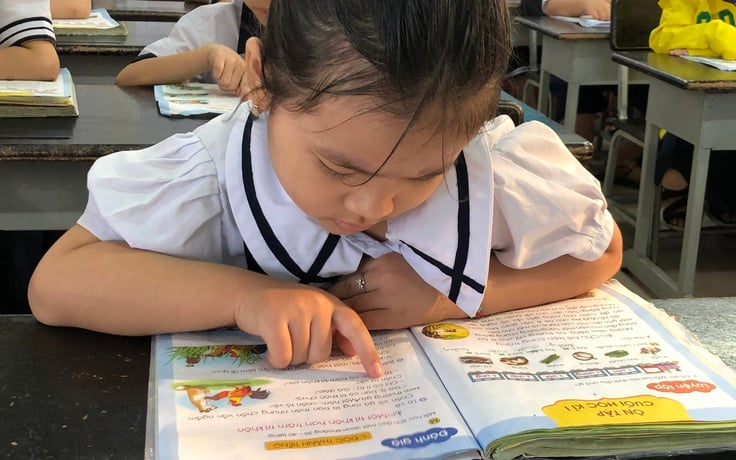
First-grade students during their Vietnamese language lesson.
In Western management theory, there's a well-known concept, "You get what you measure," which can be used to describe a gap in human perception. If we focus our attention on only certain aspects, we will overlook many others (cognitive blind spots).
Education administrators need to review student assessment criteria, especially at the primary school level, learning from Western education systems. They don't overemphasize grades, but focus on student development. Reducing the pressure of academic achievement will help alleviate stress for students, parents, and teachers; and minimize the need for extra tutoring or learning ahead of the curriculum.
Currently, academic pressure in many Asian countries, such as Vietnam, China, and South Korea, remains very high, with academic success and a place at university considered the deciding factors in a student's success.
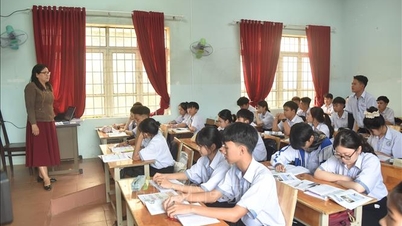
Another objective factor to consider is the reality of overcrowded schools in major cities in Vietnam. Newly built schools cannot keep up with the increase in the migrant population; class sizes are quite large, sometimes reaching nearly 50 students per class.
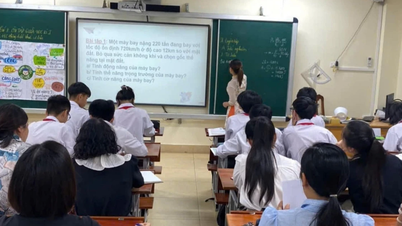
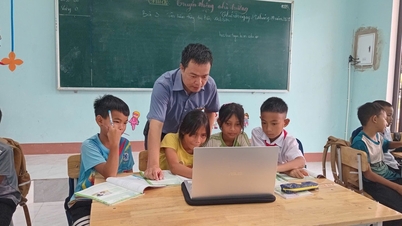
In primary school, and especially in first grade, teachers need to closely monitor and support young children in adapting to the school environment, guiding them in handwriting practice. With limited time and large class sizes, the work of primary school teachers is more demanding. Having children learn the first-grade curriculum in advance will lessen the burden on teachers.
In the story of children attending extra classes and learning ahead of the first-grade curriculum, we need to look at the issue from multiple perspectives: peer pressure, the pressure of the grading system, overcrowded classrooms in primary schools, and many shortcomings in the current primary school curriculum.
Source link


![[Photo] General Secretary To Lam visits the exhibition space showcasing books, photo exhibitions, and achievements of digital transformation in journalism.](/_next/image?url=https%3A%2F%2Fvphoto.vietnam.vn%2Fthumb%2F1200x675%2Fvietnam%2Fresource%2FIMAGE%2F2025%2F12%2F19%2F1766110879215_1766110240024-jpg.webp&w=3840&q=75)
![[Photo] Enchanting ancient rose garden on the mountainside in Nghe An](/_next/image?url=https%3A%2F%2Fvphoto.vietnam.vn%2Fthumb%2F1200x675%2Fvietnam%2Fresource%2FIMAGE%2F2025%2F12%2F19%2F1766109900916_vuon-hong-chin-do-thu-hut-du-khach-toi-check-in-o-ha-noi-3-20162778-1671624890024-1671624890104198100259.jpeg&w=3840&q=75)

















































































Comment (0)