Utilizing his family's 1.5 hectares of rubber trees, Mr. Ho Van Giang in Hamlet 1, Dong No Commune, Hon Quan District, raises 6,000 Grimaud ducklings. This is a lean duck breed that grows very quickly, requiring a shorter rearing time than other breeds. After about 42-45 days of rearing, the ducks reach a weight of 3.3-3.5 kg/each and can be sold. "I've been raising ducks for 5 years now and I find the economic efficiency very good. I raise 30,000 ducks per year, earning a profit of about 500 million VND after deducting expenses. I find that raising Grimaud ducks is more economically efficient than raising chickens and other animals," Mr. Giang said.
Taking advantage of the space under the rubber trees, the family of Mr. Ho Van Dong in Hamlet 5, Dong No Commune, raises 4,000 Grimaud ducks, bringing in a profit of about 400 million VND per year. Mr. Dong said that Grimaud ducks are easier to raise than other duck breeds, have good adaptability, tolerate rain and wind well, are less prone to disease, eat easily, have a low mortality rate of only about 2-3%, and the ducks are uniform and easy to sell. "Previously, raising ducks in cashew orchards with sun and water sources meant the ducks swam a lot, so they ate less and grew slowly. Raising ducks in the cool rubber plantation makes them grow faster and shortens the rearing time," Mr. Dong shared.
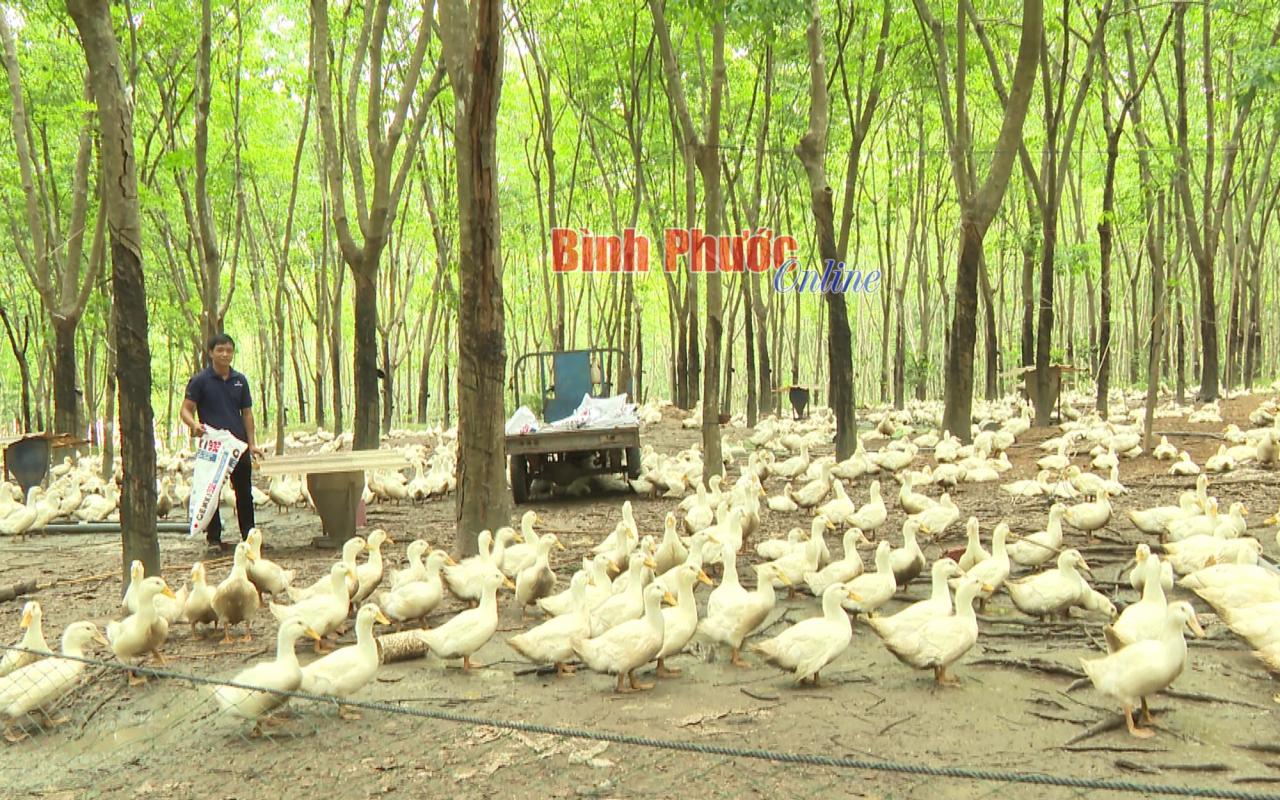
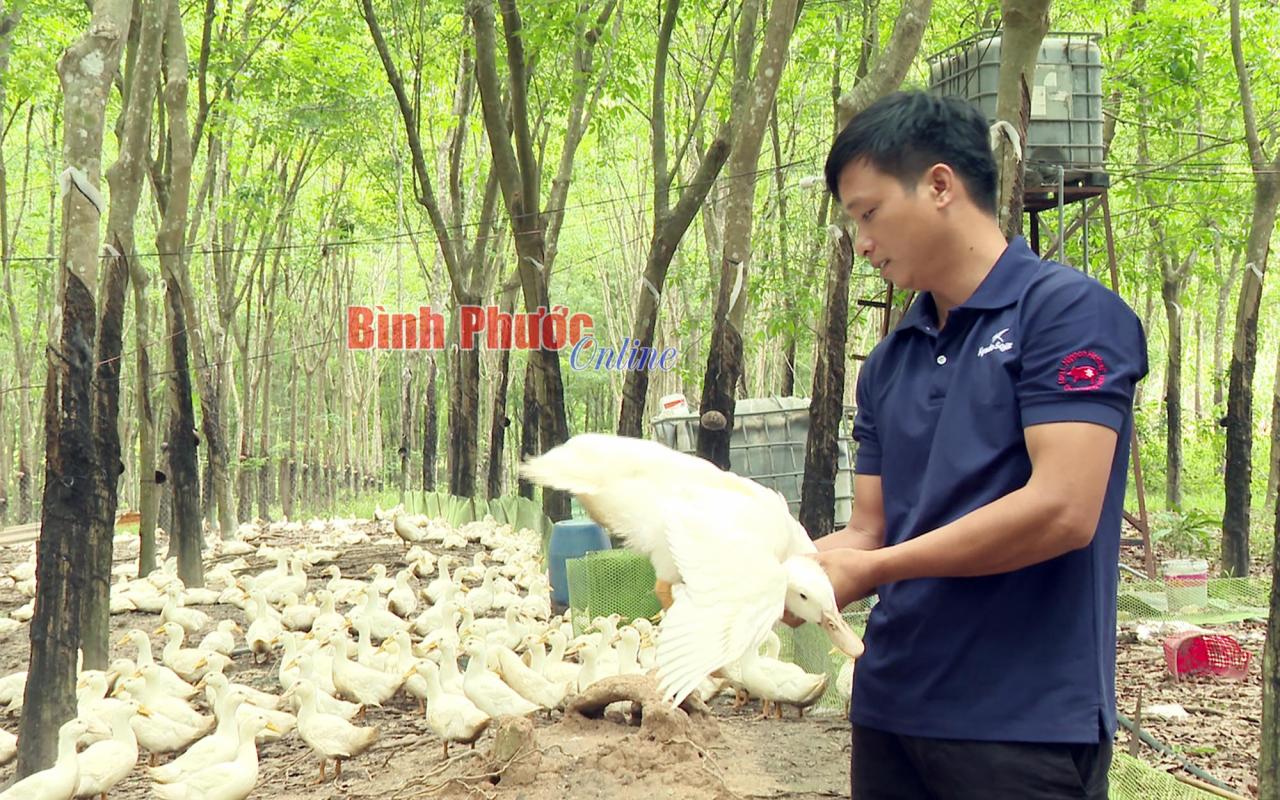
These are two of the five members of the Dong No Agricultural Cooperative who are developing their economy by raising Grimaud lean ducks in rubber plantations. On average, the cooperative members sell more than 150,000 ducks annually. With prices currently ranging from 42,000 to 45,000 VND/kg, each duck brings a profit of about 10,000 VND to the farmers.
According to Mr. Duong Truyen Thong, Director of Dong No Agricultural Cooperative, ducklings are only released into the rubber plantation after being brooded indoors for about 20 days. At this time, their resistance is very good, and their contact with the soil reduces their risk of disease. Every 5-10 days, the farm owner moves the duck pens to a clean location to prevent the ducks from getting sick. Regarding the market, the price of Grimaud ducks has been stable for the past three years, so breeders have made a profit. Especially when raising ducks in rubber plantations, farmers don't have to fertilize the trees, and they get more latex.
Raising Grimaud ducks is one of the successful rural agricultural models for wealth creation. Utilizing the space under rubber trees reduces housing costs, allowing for large-scale concentrated farming while maintaining isolation from the outside environment. The dual benefits of rubber tapping and duck farming provide a better life for farmers. Currently, this model is being replicated by other members of the Dong No Agricultural Cooperative and the people in the commune.
Source link
![[Image] Schools organize meetings and introduce teaching models to students admitted to grade 10.](https://vphoto.vietnam.vn/thumb/1200x675/vietnam/resource/IMAGE/2026/06/25/1782368077271_ndo_br_z7970052192242-1ec8daeb77a6eed1a4e9f58c564ddd3e-jpg.webp)

![[Photo] General Secretary and President To Lam receives Palestinian Ambassador Saadi Salama](https://vphoto.vietnam.vn/thumb/1200x675/vietnam/resource/IMAGE/2026/06/25/1782365384740_a1-bnd-9423-8322-jpg.webp)
![[Image] Ho Chi Minh City: Ma Lang area, Chicken-Rice Market about to change its appearance](https://vphoto.vietnam.vn/thumb/1200x675/vietnam/resource/IMAGE/2026/06/25/1782377698627_ndo_br_m1-jpg.webp)







![[Video] Weather forecast for tonight and tomorrow, June 26, 2026: Northern Vietnam to end heatwave from tomorrow, Central Vietnam to continue experiencing a heatwave.](https://vphoto.vietnam.vn/thumb/402x226/vietnam/resource/IMAGE/2026/06/25/1782392692278_thumb-dem-png.webp)