

 |
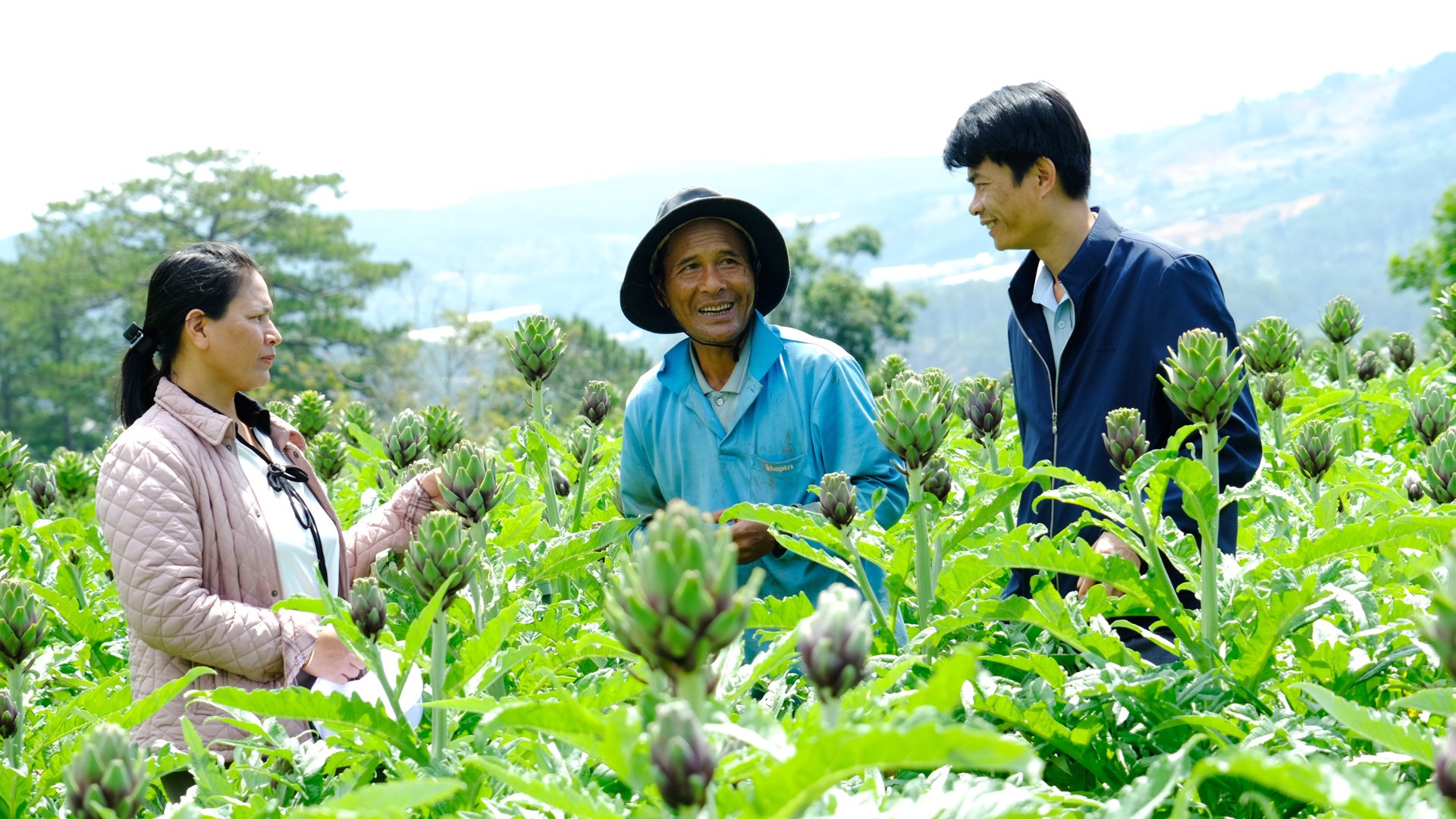
| Thanks to participating in the artichoke farming cooperative, Mr. Ha Hang's family's economic situation has improved significantly. |
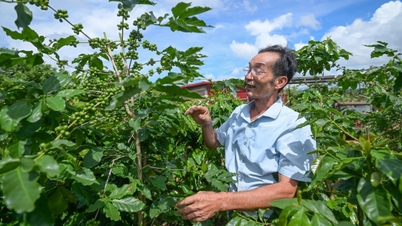
We visited the artichoke farming model of the Lo Mu Ha Hang family in Hamlet 1, Da Sar commune, Lac Duong district, at a time when the farmers were busy harvesting leaves to sell to Ladophar Pharmaceutical Joint Stock Company. Mr. Ha Hang happily said: “The hard work of the growers has paid off. After a long period of transformation, the thriving artichoke gardens stretching across the slopes of our family's farm are now providing a stable income. Thanks to this, not only my family but many ethnic minority households here have escaped poverty thanks to the joint cultivation of medicinal herbs with Ladophar Pharmaceutical Joint Stock Company.”
According to Mr. Ha Hang, since 2015, his family has been researching and experimenting with growing artichokes on their agricultural land. Over the past 10 years, despite periods of difficulty in agricultural product consumption due to disease outbreaks and market fluctuations, the overall economic benefits from artichoke cultivation have been significantly higher than other crops in the area. Currently, Mr. Ha Hang's family cultivates 8 sao (approximately 0.8 hectares) of artichokes; the branches and leaves are purchased by Ladophar Pharmaceutical Joint Stock Company. With 8 sao of artichokes under cultivation, Mr. Ha Hang's family harvests leaves every 15 days on average, yielding about 6 tons. The current purchase price offered by the company is 3,000 VND/kg, resulting in an average monthly income of over 30 million VND for Mr. Ha Hang's family. In addition, he also harvests and sells other products such as cotton, stems, and roots to other buyers in the area.
Mr. Ha Hang added that when participating in cooperative groups for artichoke cultivation with Ladophar Pharmaceutical Joint Stock Company, households receive technical guidance and adhere to the planting process according to instructions, such as using bio-fertilizers and cow manure, and avoiding fish fertilizer on artichoke plants because the leaves are harvested for making tea and medicine. After 4 months of planting, the plants begin to yield leaves for harvesting, and the company guarantees the purchase of all the produce. Every week, the company's technical staff visit the fields to inspect the plants and provide guidance on cultivation techniques. Simultaneously, farmers receive support with fertilizers, cultivation techniques, and harvesting.
According to Mr. Bui Van Trinh, Vice Chairman of the Da Sar Commune People's Committee, there are currently about 25 hectares of artichoke cultivation in the commune. Most of this cultivated area is managed by local people in partnership with companies and units that purchase the produce for further processing. Compared to other crops in the area, the economic efficiency from artichoke cultivation models is quite high, reaching 500-700 million VND/hectare/year. In the future, the local government will continue to act as a bridge between businesses and people to develop and expand the production linkage area, contributing to diversifying the crop structure and increasing income for local people.
According to the Department of Agriculture and Environment of Lac Duong district, the area of artichoke cultivation in the district has increased to 50 hectares, mainly concentrated in the communes of Da Nhim, Da Sar, Da Chais, and Lat. Currently, nearly 100 households in the district are participating in the artichoke cultivation and consumption chain, bringing high income to the local people in remote areas. In addition, Lac Duong district has developed three production and consumption chains for artichoke medicinal products. These are the production, processing, and consumption chain for artichokes in Da Sar and Da Nhim communes, involving Ladophar with 10 households cultivating 5 hectares, Vinh Tien Co., Ltd. with 40 households cultivating 4 hectares, and Tra Ngoc Duy Co., Ltd. with 20 households cultivating 2 hectares. Along with the application of standardized cultivation processes, production linkages are increasingly expanding to ensure stable output for growers as well as quality input for processing businesses.
With its existing potential, Lac Duong will continue to encourage people to expand the area for artichoke cultivation in the coming time. The key solution from now until 2030 is to focus on linking production with the consumption of artichoke products in particular and other potential medicinal plants in the area in general. The focus will be on applying advanced and modern technologies in research, breeding, and cultivation and care techniques to achieve high yields and quality in production and processing, aiming to create medicinal products that are competitive in the market.
Simultaneously, promote the application of information technology in the management and operation of medicinal plant products from planting to production, harvesting, processing, and utilization; support the registration of trademarks, brand names, planting area codes, processing and consumption codes for medicinal plant products, ensuring compliance with national and international standards and regulations in domestic and export markets.
Source: https://baolamdong.vn/kinh-te/202504/hieu-qua-tu-mo-hinh-lien-ket-trong-atiso-d3068d9/









![[Image] Fifth meeting of the Steering Committee for National Projects in the Railway Sector](/_next/image?url=https%3A%2F%2Fvphoto.vietnam.vn%2Fthumb%2F1200x675%2Fvietnam%2Fresource%2FIMAGE%2F2026%2F01%2F06%2F1767712857541_ndo_br_dsc-0581-jpg.webp&w=3840&q=75)























































Comment (0)