


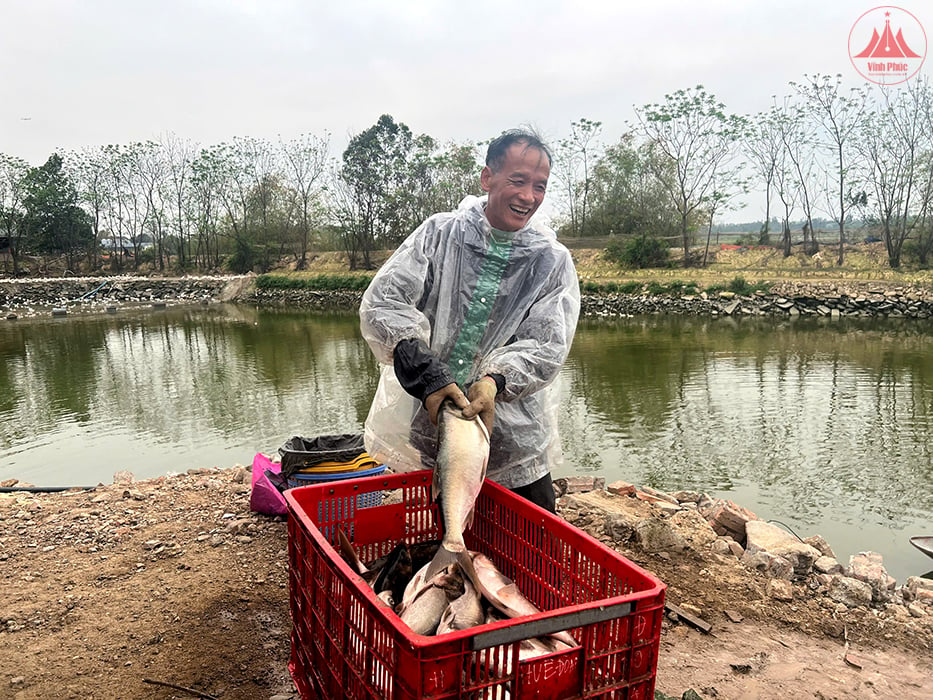
VAC is an integrated agricultural production model that closely combines crop cultivation, aquaculture, and livestock and poultry farming.
Contributing to environmental protection and increasing household income, in recent years, relevant agencies have intensified propaganda and encouraged people to promote the application of science and technology, effectively utilize land, water, and solar energy resources, and recycle livestock waste to create a sustainable ecosystem.
To date, the VAC model has been widely adopted and developed in households, creating jobs for many workers in the area.
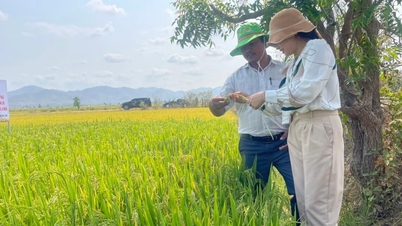
For many years, the VAC (integrated farming system) model of farmer Tran Van Quang, Cao Minh commune (Phuc Yen district), has been visited and studied by many farmers because it not only helps his family develop economically but also creates jobs and stable income for some laborers in the area.
With over 2 hectares of land, Mr. Quang dedicated nearly 1 hectare to digging ponds for raising various fish species such as grass carp, silver carp, common carp, and tilapia; the remaining area was invested in building barns for raising broiler chickens and commercial ducks, and planting fruit trees.
Currently, Mr. Quang's farm maintains 120,000 laying hens and over 4,000 commercial ducks. He sells chicks every 5 days, about 5,000 at a time; for broiler chickens and commercial ducks, he sells them every 3 months, earning several hundred million dong per year.
Mr. Quang stated: "The unique aspect of the VAC model is its regeneration strategy; livestock waste will be used as fertilizer for crops, and some crop by-products can be used as fish feed or composted to fertilize plants."
In addition, the ponds provide irrigation water and mud, which increases soil nutrients and is beneficial for fruit trees. Thanks to this combination, people can maximize land area and food sources, bringing high economic efficiency.
With the increasingly complex situation of dangerous livestock diseases, instead of small-scale traditional farming, Mr. Do Van Thanh, from Yen Phuong commune (Yen Lac district), has adopted a contract farming model through a supply chain linked with businesses, applying scientific and technological advancements to production to improve efficiency and reduce risks. At the same time, he has dug ponds for fish farming and combined it with planting fruit trees to develop a sustainable VAC (Vietnamese acronym for garden, pond, and livestock) model.
Currently, Mr. Thanh's family regularly maintains a herd of 300 pigs per batch, raises various types of fish in 0.5 hectares, and grows several hundred jackfruit, pomelo, and longan trees along the banks, earning several hundred million dong per year.
Sharing about the achievements, Mr. Thanh said: The harmonious combination of VAC (gardening, animal husbandry, and aquaculture) has formed a closed value chain, using short-term gains to support long-term growth, contributing to overcoming the irrationality in managing agricultural by-products and minimizing environmental pollution.
In particular, the contract farming model, where businesses provide breeding stock, technical guidance, disease prevention and control, and guarantee product sales, has brought sustainable economic benefits and stable income to livestock farmers.
To contribute to raising people's incomes and forming concentrated production areas, the province has issued mechanisms and policies to support people in accessing resources and scientific and technological advancements, encouraging the transformation from small-scale agricultural production to commodity production and business along the value chain. At the same time, it has developed production, supported the construction of concentrated commodity production areas, and promoted the application of science and technology and advanced production processes.
As a result, many new livestock breeds with high productivity and quality continue to be introduced into production; technical advancements in animal husbandry and biosafety farming processes have been widely applied, contributing to improved productivity and product quality. In fact, the VAC model not only brings economic benefits to families and localities but also makes a significant contribution to environmental protection.
Despite the positive results achieved, many households are still hesitant to invest in and promote the application of science and technology in production and livestock farming, thus failing to fully utilize the potential of their land and family models.
For the VAC model to develop sustainably and be replicated, more attention and support in terms of capital and technology are needed so that people can be more confident in investing, developing, and expanding the scale of production.
In addition, people need to be flexible and proactive in introducing new plant and animal varieties into farming, combined with aquaculture and livestock breeding, and linked to the consumer market.
Text and photos: Hong Tinh
Source: http://baovinhphuc.com.vn/Multimedia/Images/Id/126103/Hieu-qua-kinh-te-tu-mo-hinh-VAC


![[Photo] General Secretary To Lam attends the opening session of the Peace Council on Gaza.](https://vphoto.vietnam.vn/thumb/1200x675/vietnam/resource/IMAGE/2026/02/19/1771516865192_tbttolam5-jpg.webp)



































Comment (0)