

(NLĐO) - Research into the type of object that acts as the parent star of the closest exoplanets to Earth has revealed a chilling truth.
Writing in the scientific journal Monthly Notices of the Royal Astronomical Society, a team of authors from the Institute for Astronomy at the University of Hawaii (USA) and the Department of Physics at the University of Cambridge (UK) warned that red dwarf stars have a habit of attacking their planets with devastating stellar flares.
Red dwarf stars are faint M-class stars, cooler than our Sun, and account for up to 70% of the stars in the Milky Way galaxy, where Earth resides.
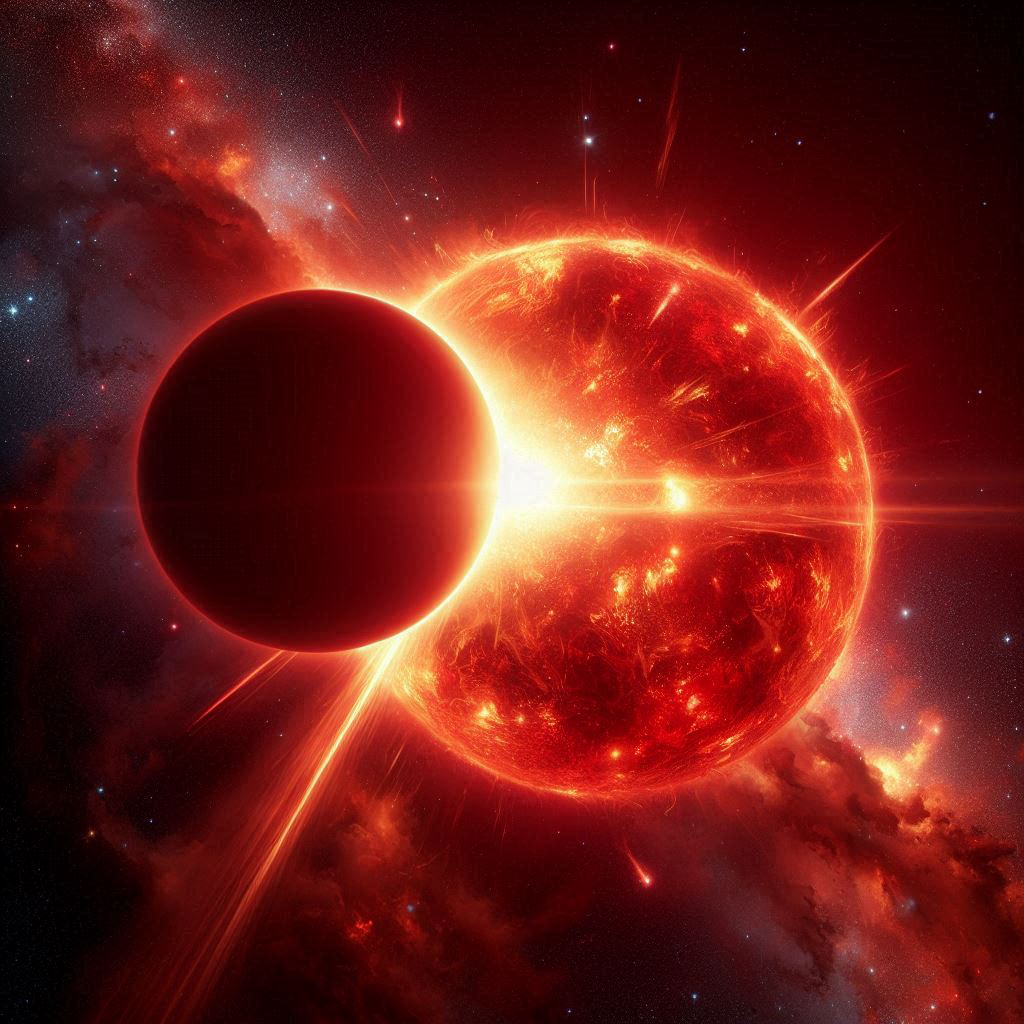
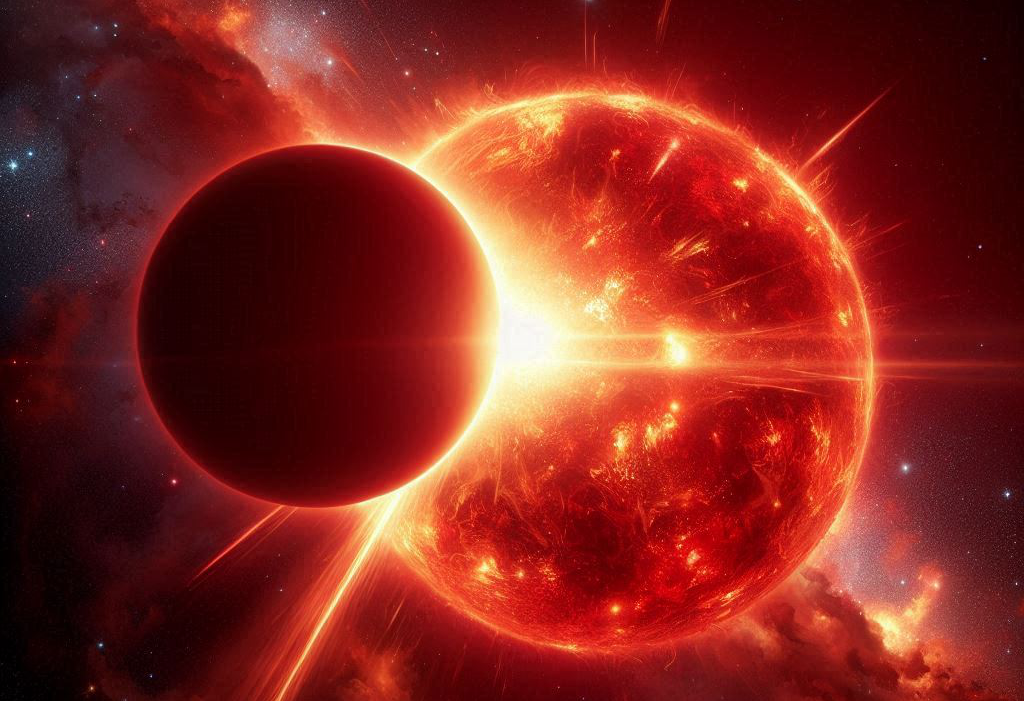
The Earth-like planet Proxima, located 4.2 light-years from us, may possess a frequently erupting "mother planet" - AI illustration: ANH THU
Near our Sun there are also a number of known red dwarf stars, the most famous example being Proxima Centauri, a red dwarf star containing at least one Earth-like planet.
Stable, rich, and highly likely to possess rocky planets orbiting them, red dwarf stars have become attractive targets in the hunt for exoplanetary life.
But new research delivers shocking news when examining some 300,000 stars and focusing on 182 outbreaks originating from M-class systems.
According to the authors, while previous large-scale observational studies of stellar outbursts were primarily conducted at optical wavelengths, their work focuses on the ultraviolet (UV) radiation emitted from these events.
Specifically, this study examined radiation in the near UV (175–275 nm) and far UV (135–175 nm) ranges.
Although this radiation isn't necessarily harmful to the development of the complex molecules we believe are prerequisites for life, this type of radiation can have a significant impact on a planet's habitability.
Dose makes poison: In relatively modest quantities, high-energy photons produced by stellar flares can help catalyze the formation of life-related compounds, but too many can strip a planet of its atmosphere, including its ozone layer.
This further exposes potential life to UV rays and puts it at great risk.
Even if that life has evolved to a certain extent, an excessively powerful UV burst is enough to cause a catastrophic extinction event.
Ninety-eight of the 182 outbreaks recorded by the research team from red dwarf stars released higher-than-expected levels of UV radiation, levels sufficient to cause catastrophe.
"If red dwarf outbursts do indeed produce excessive amounts of UV radiation, the planets orbiting them could be more hostile to life than we previously thought, even if they meet other criteria for habitability," Science Alert quoted the authors' conclusion.
Nevertheless, most astrophysicists believe that life still has a way of squeezing through these narrow openings.
Those planets may not have extraterrestrial life, but they could still possess extreme life forms like those we've found deep underground, beneath the ice, in toxic lakes, or in waters boiling with geothermal energy...
Source: https://nld.com.vn/hanh-tinh-co-su-song-gan-chung-ta-dang-doi-mat-viec-tan-the-196241015091710076.htm


![[Photo] Two flights successfully landed and took off at Long Thanh Airport.](/_next/image?url=https%3A%2F%2Fvphoto.vietnam.vn%2Fthumb%2F1200x675%2Fvietnam%2Fresource%2FIMAGE%2F2025%2F12%2F15%2F1765808718882_ndo_br_img-8897-resize-5807-jpg.webp&w=3840&q=75)

































































































Comment (0)