

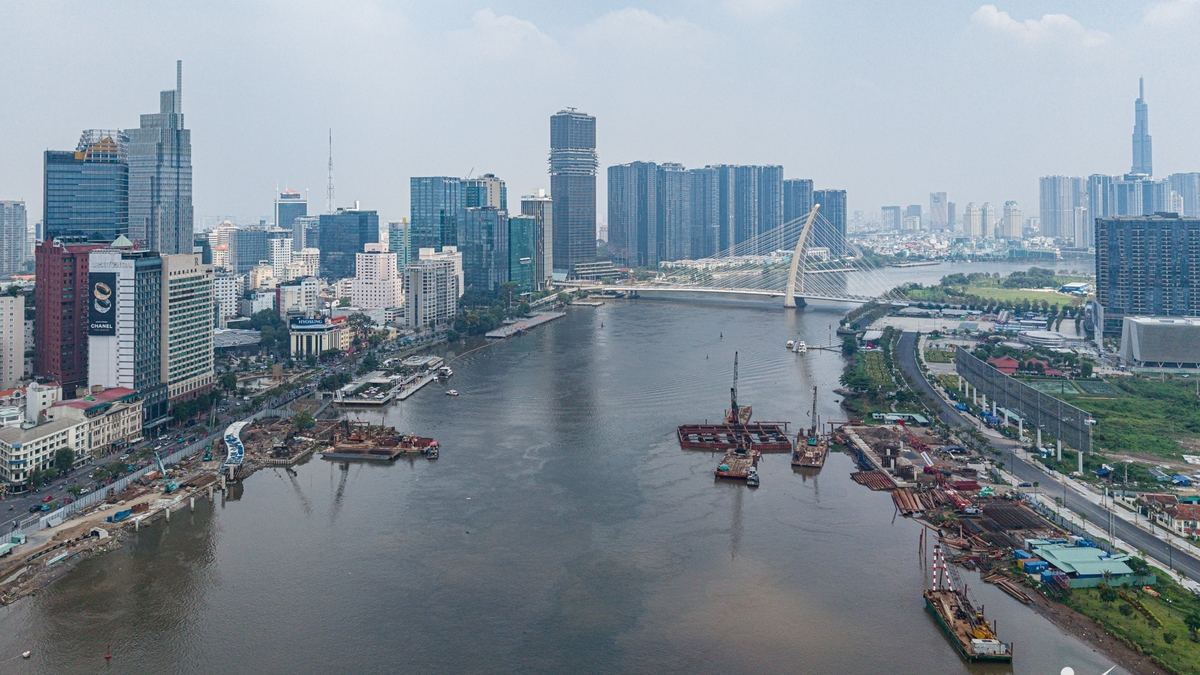
In reality, despite the government's strong directives and numerous meetings and analyses by regulatory agencies and experts to identify the causes and propose solutions, air pollution, especially in large cities like Hanoi and Ho Chi Minh City, remains a persistent problem.
Specifically, according to monitoring data, from October 2024 to the present, Hanoi and some northern provinces have continued to be severely affected by air pollution. Peak periods, such as on March 25-26, showed that according to the global air quality monitoring application (IQAir), Hanoi ranked highest in the world for air pollution levels at certain times.
According to data from the Northern Environmental Monitoring Center, at 1 PM on March 25th, pollution increased in most areas of the North. In particular, the AQI index in Hanoi and Thai Nguyen was recorded at a bad warning level. Most recently, at 1 PM on March 27th, although the AQI index on the IQAir system showed an improvement in air pollution in Hanoi, it still ranked 11th among the most polluted major cities, with an AQI index of 151…
According to the Ministry of Agriculture and Environment, the main causes and components of pollution are primarily road dust, exhaust fumes from vehicles, especially old and dilapidated ones; and PM10 and PM2.5 fine dust. Analyzing this further, an expert suggests that one of the main reasons is the rapid increase in the number of private vehicles while transportation infrastructure, especially public transport, has not kept pace.
Furthermore, extensive construction activities and emissions from neighboring areas have exacerbated pollution and degraded urban air quality. Another reason why air pollution in urban areas remains unresolved is the lack of decisive action and insufficient financial resources allocated by local authorities to implement comprehensive solutions. The planning and implementation of development plans are also inconsistent and lack feasible solutions for environmental protection.
To address this situation, the Ministry of Agriculture and Environment suggests the following immediate measures: monitoring construction projects; planning routes for trucks; controlling old vehicles; and improving public transportation; increasing street cleaning and sweeping; installing sprinkler systems on major roads; tightening management of waste burning and straw burning after harvest; encouraging recycling; assigning and supervising the implementation of responsibilities by local authorities at the district and commune levels; implementing automated monitoring of factory emissions and strictly penalizing violations; and conducting public awareness campaigns and education on the harmful effects of air pollution and mitigation measures.
In the long term, focus should be placed on improving policies for emission control and green transition. Complete the inventory of emission sources, organize strict monitoring; operate a warning and command system based on a database of emission sources, technical solutions, and automated monitoring technologies for major emission sources, and connect them online. Develop a smart, environmentally friendly, and green public transportation system. Increase investment in air quality monitoring, forecasting, and warning systems; connect, exchange, and share information and results of tasks among ministries, sectors, and localities.
Air pollution is an urgent problem; the longer it is left untreated, the greater its impact on health and all aspects of socio-economic life, and the more costly it becomes to mitigate and remedy it. Therefore, it is time for localities to take urgent action and set specific implementation goals.
Source: https://daibieunhandan.vn/hanh-dong-khan-cap-and-muc-tieu-cu-the-post409294.html












![[Infographic] Essential Information About Election Day](https://vphoto.vietnam.vn/thumb/1200x675/vietnam/resource/IMAGE/2026/03/14/1773454962599_ngay-bau-cu-095431_652-100257.webp)
![[Photo] Prime Minister Pham Minh Chinh attends the inauguration ceremony of the Vietnam Space Center.](https://vphoto.vietnam.vn/thumb/1200x675/vietnam/resource/IMAGE/2026/03/13/1773397068038_ndo_br_dsc-3366-jpg.webp)


















































Comment (0)