

SKĐS - Two children in Quang Tri province infected with Burkhoderia Pseudomallei bacteria (the bacteria that causes Whitmore's disease) have been discharged from Hue Central Hospital after receiving intensive treatment.
On the afternoon of August 6th, the leadership of Hue Central Hospital announced that, of the two pediatric patients infected with Burkhoderia seudomallei (the bacteria that causes Whitmore's disease) being treated at the Pediatric Center, one case has recovered well and has been discharged to continue outpatient treatment.
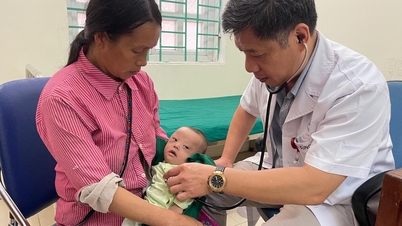
Accordingly, patient NLDH (19 months old, residing in Hai Lang district, Quang Tri province) presented with swelling and pain in the left parotid gland area and was admitted to the Ear, Nose, and Throat Department of Hue Central Hospital for abscess incision. Subsequently, the abscess fluid was cultured and found to contain Burkhoderia Pseudomallei bacteria (the bacteria that causes Whitmore's disease), leading to transfer to the Pediatric Center.

Illustrative image.
After two weeks of intravenous antibiotic treatment, the child's condition stabilized, the earlobe wound dried up, and the child was discharged for outpatient treatment with antibiotics for at least three months, with regular follow-up appointments.
The second case involves a 6-month-old infant named TNN, residing in Cam Lo district, Quang Tri province. The infant developed symptoms 5 days prior to admission, including a continuous high fever, loose stools 6-7 times a day, and rapid, labored breathing.
During treatment at a lower-level hospital, the child was diagnosed and treated for sepsis, but the fever did not subside, and the child experienced rapid breathing and difficulty breathing, so they were transferred to Hue Central Hospital.
Here, blood culture results revealed the presence of Burkholderia Pseudomallei bacteria, leading to a diagnosis of lung abscess with sepsis caused by Burkholderia Pseudomallei. The doctor initiated intensive intravenous antibiotic treatment in combination with oral antibiotics.
After 3 days of intensive care, the child's fever subsided, breathing improved, but he still had a cough and a lot of phlegm. He is currently continuing antibiotic treatment according to the prescribed protocol.
According to MSc. Dr. Tran Thi Hanh Chan, Head of the Gastroenterology, Urology, and Tropical Diseases Department (Pediatric Center), Whitmore's disease is mainly transmitted through skin contact or contaminated food and water. The disease often appears during storms and floods, and in areas with poor sanitation.
Patients with this condition require long-term antibiotic treatment, usually with injectable antibiotics for 2-4 weeks. If the response is good, the disease can be treated on an outpatient basis with oral antibiotics for at least 3 months.
According to MSc. Dr. Tran Thi Hanh Chan, treating Whitmore's disease in children often involves difficulties in adhering to medication due to uncooperative behavior and vomiting. Furthermore, some children experience weakened immunity and relapses during treatment, requiring extended treatment periods of up to a year.
According to statistics, from 2014-2019, Hue Central Hospital received approximately 83 cases diagnosed with Whitmore's disease (positive culture of Burkhoderia Pseudomallei bacteria). Since 2020, the number of cases has gradually decreased. From the beginning of 2024 to the present, the hospital has received 17 cases.
Hoang Dung
Source: https://baoquangtri.vn/hai-chau-be-o-quang-tri-mac-benh-whitmore-187434.htm



![[Photo] National Assembly Chairman Tran Thanh Man successfully concludes his participation in IPU-152](https://vphoto.vietnam.vn/thumb/1200x675/vietnam/resource/IMAGE/2026/04/18/1776502638199_vna-potal-chu-tich-quoc-hoi-ket-thuc-tot-dep-chuong-trinh-tham-du-ipu-152-8709975-jpg.webp)
















































































Comment (0)