

The Hanoi Department of Health has just issued Plan No. 3419/KH-SYT on improving the satisfaction index of people with the quality and services of medical examination and treatment at medical facilities.
Improve patient satisfaction
The Hanoi Department of Health has directed all units within the sector to focus on improving the professional skills, sense of responsibility, and service attitude of healthcare staff in all departments and wards.
 |
| Patient satisfaction rates have tended to increase over time. |
First, the outpatient department ensures a streamlined, convenient, and continuous examination process, linking seamlessly with the laboratory, diagnostic imaging, and functional testing departments.
At the same time, information technology is being applied to shorten patients' waiting times for examinations and to manage medical information and data.
The Hanoi Department of Health has requested that medical facilities avoid prescribing inpatient treatment in unnecessary cases in order to reduce the burden on healthcare and lower patient costs.
Regularly solicit feedback from patients and their families at healthcare facilities through various methods such as suggestion boxes, suggestion books, hotlines, patient council meetings, and direct interviews.
In addition, the Department of Health also requires ensuring that human resources, facilities, equipment, medicines, etc., at the Emergency and Intensive Care and Toxicology Department and the emergency departments of clinical departments are always ready and sufficient according to regulations; adhering to the "Red Alert" procedure for both internal and external hospitals; and preventing medical incidents.
In the Anesthesia and Resuscitation Department, the rooms are arranged in a one-way flow as per regulations. In the operating rooms, each room is equipped with all necessary equipment, supplies, medications, oxygen systems, compressed air, vacuum pumps, anesthesia machines with ventilators, monitors, infusion pumps, etc.
In clinical departments, it is necessary to improve emergency care capabilities and perfect the emergency unit within each department.
Implement routine techniques and the list of techniques according to the assigned level of care, and deploy new and advanced techniques to improve the quality of treatment.
Assisting patients in completing administrative procedures; minimizing the need for patients to share beds; meeting the minimum needs of patients…
In the laboratory department, it is necessary to comply with the regulations of the Ministry of Health regarding laboratory quality management, laboratory quality, and biosafety assurance…
Clearly assign personnel to each stage of the testing and results delivery process, linking the responsibility of technical staff to the quality of test results, and implementing internal and external quality control according to regulations.
Reportedly, in the second quarter of 2024, the Hanoi Department of Health conducted a survey to assess patient satisfaction levels at 41 out of 42 public hospitals and 40 out of 43 private hospitals.
The results show that the overall satisfaction level of patients and the public with the hospital sector is 97.2%; for inpatients it is 96.63%, and for outpatients it is 96.74%.
The survey results of outpatients visiting polyclinics and health stations of 30 district, county, and town health centers and the 115 emergency center showed an average satisfaction rate of 95.76%.
Signs and symptoms of a brain aneurysm.
Ms. NTH (46 years old) from Phu Yen, Son La, experienced frequent headaches accompanied by nausea. She went to Phu Tho Provincial General Hospital for examination, where doctors ordered a 3.0T MRI of the cerebral arteries. The results revealed that Ms. H. had a wide aneurysm of the internal carotid artery on both sides in the cavernous sinus segment.
The left carotid artery had a higher risk of rupture, so the team placed a flow-diverting stent first, while the right carotid artery would be treated later.
The aneurysm measures 4.5mm x 5.5mm with a 4mm neck. This is the cause of the persistent headaches that Ms. H. has been suffering from.
In the case of patient H, after the cerebral aneurysm was detected, the patient was consulted by highly specialized doctors in the field of cerebrovascular intervention at the Stroke Center, Phu Tho Provincial General Hospital, and was prescribed flow-diverting stent placement to treat the aneurysm.
After being advised that brain aneurysms can rupture at any time and that ruptured aneurysms can be very dangerous, leaving severe consequences or even death.
The patient underwent a cerebral artery diversion stenting procedure performed by doctors at the Stroke Center, which took only about 2 hours.
Immediately after stent placement, blood flow into the aneurysm was significantly reduced and controlled, and the risk of aneurysm rupture was also decreased.
Dr. Phan Ngoc Nhu, Head of the Neurological and Subacute Stroke Treatment Department, who directly intervened in the patient, explained that when blood no longer flows into the aneurysm, a blood clot will gradually form inside it, and after a period of time, the aneurysm will disappear completely.
Over time, endothelial cells migrate up the stent, forming a new endothelial layer. The endovascular intervention for the patient with nasopharyngeal carcinoma (NPC) was successful with no complications during or after the procedure.
After the flow-diverting stent is placed, patients can still function and walk normally and can be discharged from the hospital after a few days.
Dr. Nhu added that cerebral aneurysms affect approximately 5% of the population. The worrying aspect is that the symptoms are very vague, simply manifesting as headaches, making them easily mistaken for other conditions.
However, if left untreated, the aneurysm will gradually enlarge over time and could rupture at any time.
To detect cerebral aneurysms early, the only way is to perform a screening cerebral angiography on high-risk individuals, including middle-aged individuals aged 45 and older, those with a family history, and those with conditions affecting blood vessel wall quality such as diabetes, hypertension, atherosclerosis, and obesity.
Those with persistent headaches that don't respond to treatment should also consider screening with an MRI. In unclear cases, a DSA scan to examine blood vessels is necessary.
Kidney failure due to heatstroke
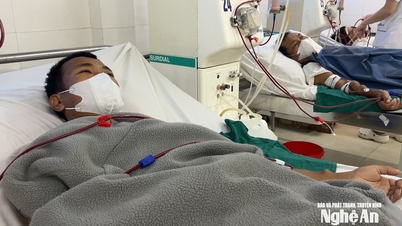
A 60-year-old man, after spraying pesticides in the fields under the scorching midday sun, returned home with muscle cramps, profuse sweating, and thirst. He was hospitalized and diagnosed with kidney failure due to heatstroke.
Information from doctors at Hung Vuong General Hospital diagnosed the patient with hypovolemic shock, rapid pulse (110 beats/minute), low blood pressure (80/40 mmHg), acute renal failure, and increased metabolic acidosis due to heatstroke. The emergency team inserted a central venous catheter and administered fluids and electrolytes to the patient.
After three hours of emergency treatment, the patient's condition stabilized and they continued to be monitored in the Intensive Care Unit.
Heatstroke and sunstroke are common occurrences during the summer, especially on hot days when temperatures rise suddenly. These conditions can cause fatigue, dizziness, headaches, and may even lead to stroke.
Without prompt treatment, patients may suffer irreversible neurological damage or multi-organ damage and death.
To prevent heatstroke, when going outside, cover your body by wearing loose, light-colored clothing, a wide-brimmed hat, and using sunscreen.
Drink plenty of water, even if you don't feel thirsty, drink water mixed with a little salt or drink oral rehydration solution, fruit juice, and avoid sugary sodas and energy drinks.
People suffering from heatstroke or heat exhaustion should be moved to a cool, well-ventilated place, and emergency assistance should be called.
Apply cooling measures to lower the temperature, such as removing clothing and applying cool compresses to the body. Give the victim plenty of water or electrolyte solution if they are conscious and able to drink. Quickly take the victim to the nearest hospital for prompt treatment.
Doctors advise avoiding working in the intense summer sun between 11 am and 2 pm and not wearing too many layers of clothing that are tight and do not wick away sweat.
Source: https://baodautu.vn/tin-moi-y-te-ngay-307-ha-noi-nang-chi-so-hai-long-benh-nhan-d221095.html




























































































Comment (0)