


April, a month of great historical events, gave me the opportunity to accompany the elders—the veterans of the H.50 Transport Brigade—on a pilgrimage to Dai Kai (Duc Linh district)—a former revolutionary base area. Fifty years after the reunification of the country, simple yet profound historical stories have emerged... The names of places, forests, and people still resonate with countless memories in this place.
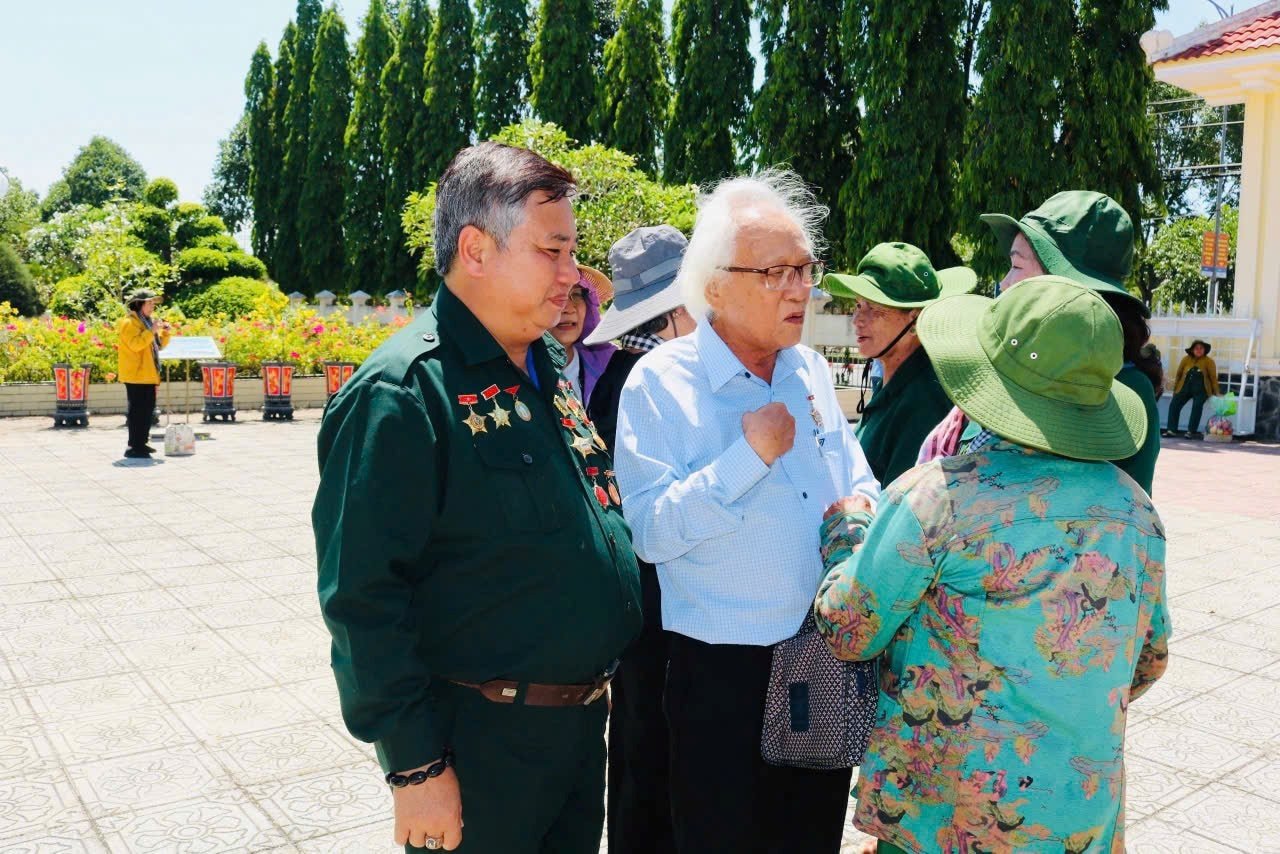
1. Da Kai – the scorching April days. Nearly 200 former youth volunteers from Ninh Thuan , Binh Thuan, Lam Dong provinces and Ho Chi Minh City… now all in their 70s and 80s. That day, they met, embracing each other: “Do you remember me? Remember those days!...” Memories overflowing, sacred emotions suddenly burst forth after decades of reunion. Tears were shed. So many stories, both happy and sad, so many memories of camaraderie and fellowship, of the days spent living and fighting in this place, suddenly came flooding back as if it were yesterday.
During the resistance war against the US, Da Kai was one of the revolutionary base areas, a crucial gateway guarding the northwest of Duc Linh district; it was the strategic point connecting the Central Committee's route to Zone VI. The H.50 transport unit was established in the context of the resistance war against the US in the southernmost part of Central Vietnam and the southern Central Highlands, which demanded weapons and ammunition. Established in April 1967, the H.50 unit was comprised of members in their late teens and early twenties, mostly women from Binh Thuan , Ninh Thuan, and Lam Dong provinces. This unit served as the central hub for receiving all supplies from the Central Committee in the North and the Central Committee of the Southern Region, transporting goods to units directly engaged in combat in battlefields such as Binh Thuan, Ninh Thuan, Binh Tuy, Lam Dong, and Tuyen Duc. In addition to transporting strategic supplies, the unit was also tasked with maintaining the corridor connecting the Military Region and the Southern Region, closely monitoring the North-South supply line, facilitating the movement of convoys, and remaining ready for combat and assignments when needed by the Military Region.
Mr. Van Cong An, from Ninh Thuan province – the former political assistant of the H.50 Transport Group at that time – recounted: “The area was located between the Southeast region, the Central Highlands, and the Central region, and was also the main gateway for our attack on Saigon, the enemy's stronghold from the East and Northeast, so it had a very important strategic position. At that time, the Youth Volunteer Force – H.50 Group fought with the spirit: “The road is the battlefield – Weapons are the goods – Productivity is the victory.” “The battlefield needed guns and ammunition to destroy the enemy, and the soldiers of the H.50 Group did not hesitate to shed their blood. Some said: ‘Even if we die, we will carry the goods on our shoulders, facing the battlefield to die,’ or ‘Even with just our trousers left, we will carry ammunition,’” Mr. An said.
For over eight years (April 1967 - June 1975), the unit transported more than 3,000 tons of weapons, medicine, and food to the battlefield, cut more than 100 roads, built more than 250 bridges, fought and killed 354 enemy soldiers, shot down 2 aircraft, destroyed 2 armored vehicles, and safely evacuated more than 100 wounded soldiers to the North... Place names and forest names like Ru Ri stream, Dat Do hill, Nam Sao field, Bau Em, and Bau Sen in Da Kai commune have given rise to miraculous stories, including those of 158 heroic martyrs of the H50 Transport Unit who sacrificed their lives for the cause of national liberation on this steadfast land. Explaining the name Bau Em, former H50 Transport Unit Youth Volunteers said: Bau Em is the place where they "hid troops." Behind it was an old, uncultivated field. Ahead lies a pond formed by the La Ngà River stream. During the rainy season, the La Ngà River rises, flooding the fields. Numerous canals crisscrossing the area pose obstacles; falling into them can easily result in sprains, and heavy loads can bury people underwater. Therefore, those ahead help those behind, and those behind support those ahead. Particularly noteworthy are stories that seem like jokes but reflect the harsh realities of the fighting days here, such as eating rice contaminated with poison. Former Youth Volunteers call this eating "seeds of death" to survive and fight. Mr. Dang Dinh Bong, former Vice Chairman of the Association of Former Youth Volunteers of Binh Thuan Province, said: “Usually, when the enemy attacks our ammunition and food depots, they take everything. But at that time, there was still a rice depot. Instead of taking it, they spread poison on it. Although we knew the rice was contaminated, we had to eat it because we had nothing else to eat. Every time we cooked rice, we put it in a basket under the stream for the water to flow over. We didn't dare touch it, because touching it would crush it. When the water boiled, we put the rice in. And we ate like that to feel full, to have the strength to transport food and weapons to the battlefield,” Mr. Bong said.
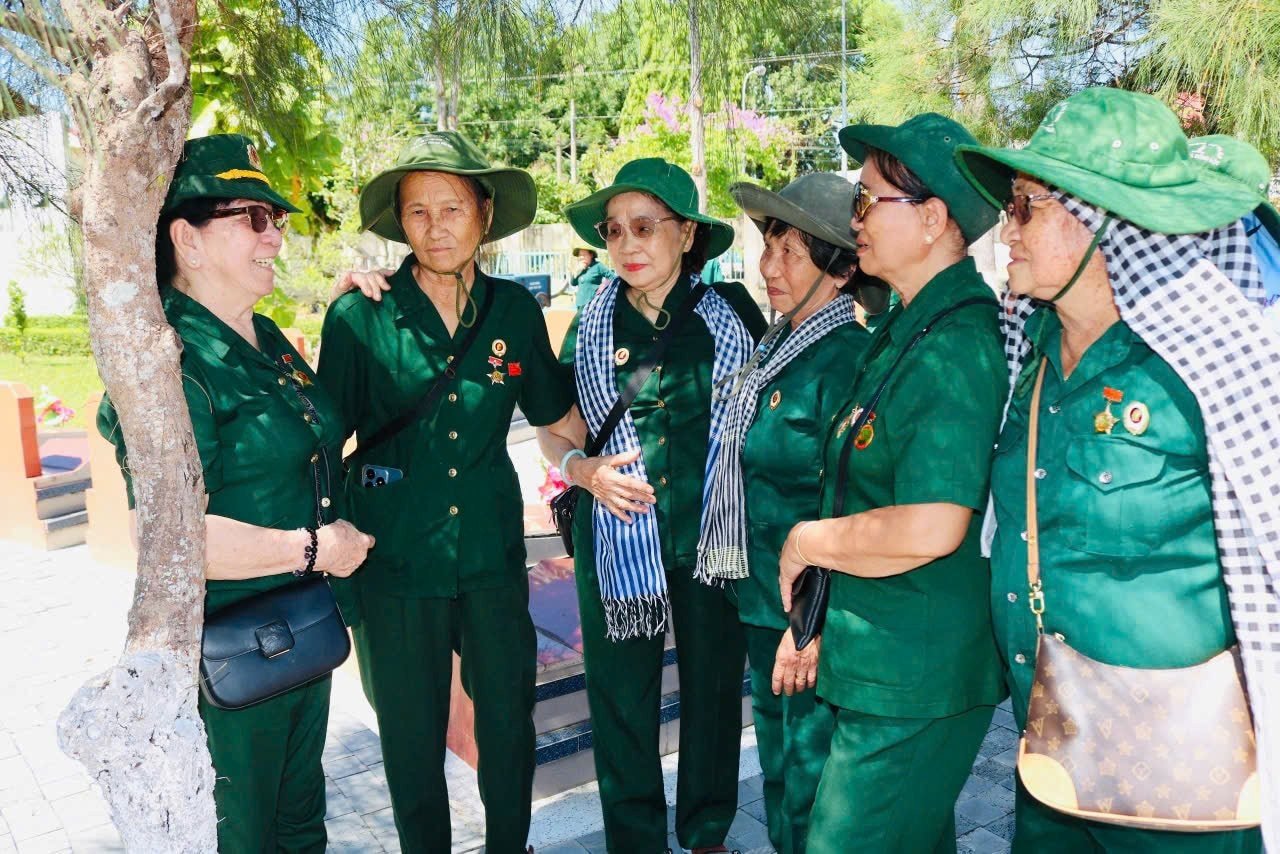
2. The last rays of sunlight of the day fell on the bundles of goods carried on their shoulders, and wartime love stories began here. Following the introduction from the Association of Former Youth Volunteers of Da Kai commune, we visited the home of former Youth Volunteer couple Nguyen Thi Mai and Dao Cao Ve, one of the couples who found love at the H.50 "house." On this steadfast land, the former Youth Volunteer couple warmly welcomed us. The photograph of their daughter, who received the title of "Hero of Victory" nearly 50 years ago, suddenly made us feel incredibly close. Mr. Ve enthusiastically recounted: Like thousands of young people his age, in August 1964 he volunteered to join the Vietnam People's Army, serving in the Laotian battlefield - Unit 119. In 1968, he transferred to the battlefield of Zone 6 - Transport Unit H.50. During the fighting, he was severely wounded and required treatment, resulting in a 50% disability rating. Sympathizing with him, Ms. Nguyen Thi Mai, Deputy Political Officer of C8 - H50 Regiment, Military Region VI, a passionate young woman from Phan Thiet, married him and they remained together for life. “Speaking of hardship, who doesn’t remember the H50 Regiment? Eating betel leaves and cassava instead of rice for months was commonplace. And during those fierce years, my wife and I met and fell in love without even realizing it. That love gave us the strength to overcome difficulties and transport ammunition to the battlefield,” Mr. Ve said.
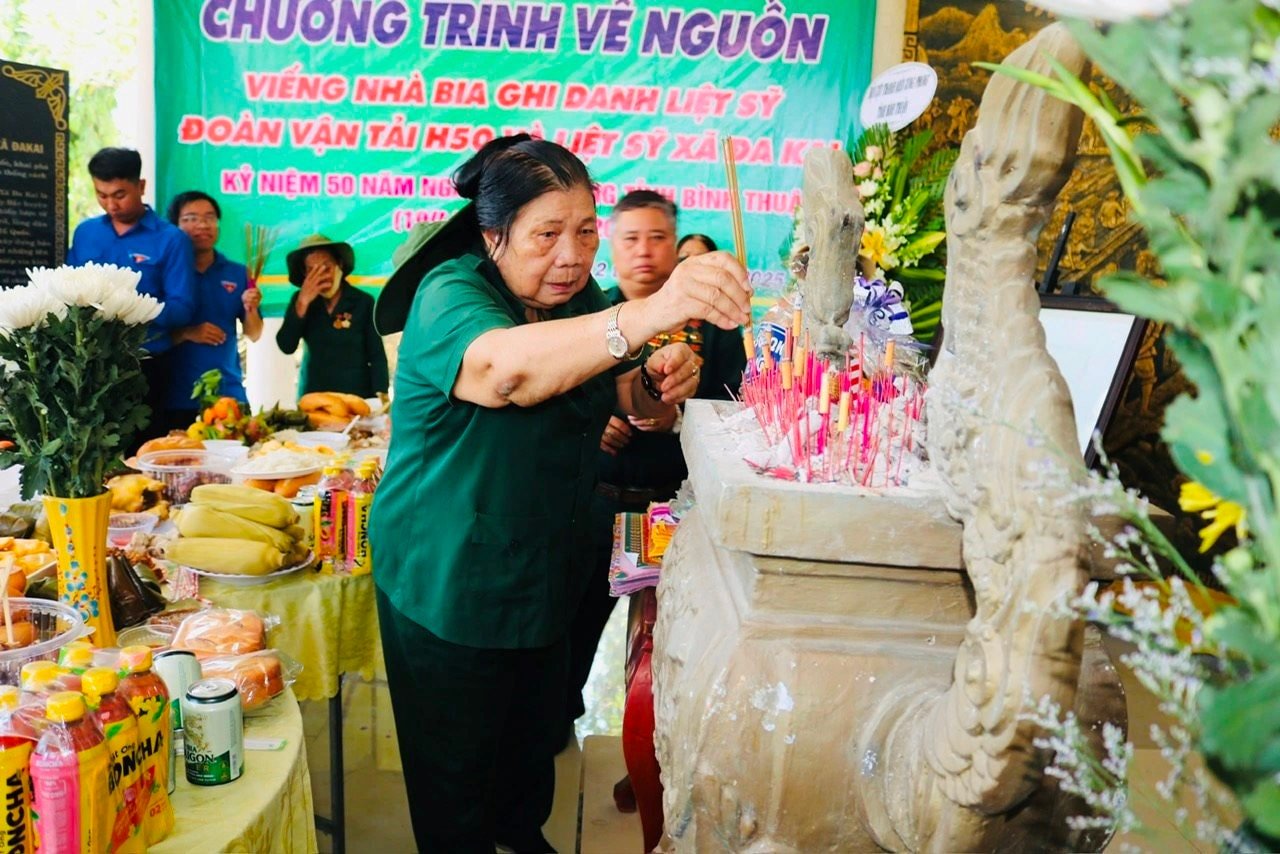
Fifty years after liberation, the land once ravaged by bombs and bullets is now a green expanse of peaceful life. Thanks to the attention of the Provincial Party Committee, the Provincial People's Committee, the Binh Thuan Provincial Association of Former Youth Volunteers, and Da Kai commune, a memorial monument commemorating 158 martyrs was built in this steadfast land through social mobilization. Since its construction, this site has become a "red address," a place for educating the younger generation about revolutionary traditions, patriotism, and national pride. At the same time, the monument has become a place of pilgrimage for former Youth Volunteers of Unit H.50, cadres, soldiers, youth union members, students, and people from all walks of life in the province. Today, the young men and women of the Youth Volunteers of yesteryear now have graying hair. Tears well up in their eyes as they recall the heroic traditions of a time of bombs and bullets before the memorial monument honoring the 158 martyrs. Ms. Nguyen Thi Sau (a Youth Volunteer from Ham Thuan Bac district) visited the resting place of her fallen comrades, her heart filled with emotion. “Today, returning to this land after so many years, it feels like just yesterday we were together, participating in clearing roads, fighting mudslides, and transporting ammunition and food to the battlefield. We can never forget those arduous yet heroic days, filled with danger but also the warmth of camaraderie. Letters from family sent to one of us were like letters to the whole squad, easing the homesickness in each of our hearts. I remember the radiant eyes and bright smiles when we shared a packet of dried rations and a plate of wild vegetables. I feel so much compassion for those female Youth Volunteers, unaccustomed to torrential rain and artillery fire, who resolutely volunteered to go to the front lines, despite the calluses left by carrying the wounded and transporting ammunition,” Ms. Sau said.
Eight years of fighting on the crucial battlefield of Military Region VI, the former Youth Volunteers, whether they remained in this land or returned to their hometowns, will forever remember H.50, remember Da Kai, the beloved land where the unit was stationed and from which they achieved great victories. Those years, and even to this day, the fierce moments, the places, the events, and the specific people have become unforgettable memories.
Source: https://baobinhthuan.com.vn/h-50-huyen-thoai-tren-vung-dat-da-kai-129454.html
![[Image] Fifth meeting of the Steering Committee for National Projects in the Railway Sector](/_next/image?url=https%3A%2F%2Fvphoto.vietnam.vn%2Fthumb%2F1200x675%2Fvietnam%2Fresource%2FIMAGE%2F2026%2F01%2F06%2F1767712857541_ndo_br_dsc-0581-jpg.webp&w=3840&q=75)
![[Photo] Prime Minister Pham Minh Chinh receives Canadian Minister of International Development Randeep Sarai](/_next/image?url=https%3A%2F%2Fvphoto.vietnam.vn%2Fthumb%2F1200x675%2Fvietnam%2Fresource%2FIMAGE%2F2026%2F01%2F06%2F1767708661052_image123-3433-jpg.webp&w=3840&q=75)

![[Photo] Prime Minister Pham Minh Chinh attends the Conference on the Implementation of Tasks for the Finance Sector in 2026](/_next/image?url=https%3A%2F%2Fvphoto.vietnam.vn%2Fthumb%2F1200x675%2Fvietnam%2Fresource%2FIMAGE%2F2026%2F01%2F06%2F1767699638245_ndo_br_dsc-0196-jpg.webp&w=3840&q=75)





































Comment (0)