

(NLĐO) - NASA's Perseverance rover has just discovered important new evidence of a world that once harbored extraterrestrial life.
According to Universal Today, the new discovery by the life-hunting robot Perseverance occurred in an area called Bright Angel, inside a vast impact plain called Jezero Crater on Mars.
These unusual rocks—which scientists call "popcorn rocks"—are evidence of something NASA has always hoped to find: the presence—or former presence—of water.
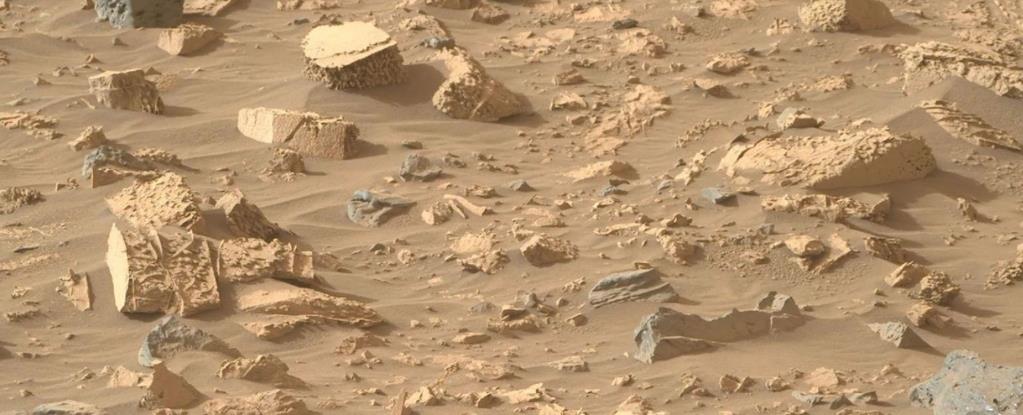
Images of the area being explored by NASA's life-hunting robot show a type of light-colored, rough-surfaced rock, similar to popcorn, that is quite common. - Photo: NASA
Perseverance's mission focuses on the possibility of ancient Martian life.
Along with searching for fossil evidence of ancient life, or, more fortunately, something that is still alive, it also searches for and attempts to understand environments that could support life.
New evidence supports the hypothesis that NASA believed when launching this expensive robot to Mars: Jezero Crater may have been a humid plain billions of years ago, home to an Earth-like system of rivers and lakes teeming with life.
The Bright Angel area that NASA's robot is exploring is a scientifically fascinating region. It's part of a river branch that leads into Jezero Crater.
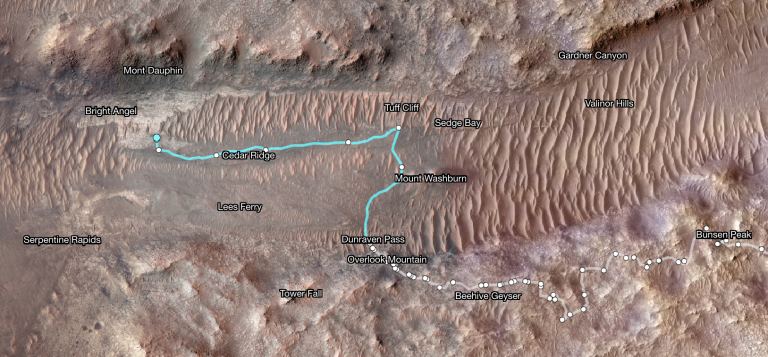
The image, taken from above by a NASA orbiter, marks the river branch and the route that Perseverance traveled - Photo: NASA
The unusual rocks in this area are strikingly bright in color, with a rough, popcorn-like surface and numerous ridges that resemble mineral veins.
Mineral veins are formed when water transports minerals through rocks and deposits them, which is common in Earth's rocks. Therefore, scientists believe that "popcorn rocks" are evidence of a world similar to Earth's river and lake areas.
The next step is to identify the minerals present in these popcorn-like rocks.
Perseverance will use abrasive tools and other instruments for a closer examination. It will vaporize some of the rocks and use the SuperCam toolkit to test the rocks' chemical properties.
If the results are positive, it could collect samples in tubes, one tube carried along and another dropped back at the site so that NASA spacecraft can approach and bring them back to Earth.
Source: https://nld.com.vn/nasa-tim-ra-da-bap-rang-ngoai-hanh-tinh-goi-y-ve-su-song-196240620174544711.htm

![[Image] "Journey of Hope" promotes the organ and tissue donation movement in Vietnam.](https://vphoto.vietnam.vn/thumb/1200x675/vietnam/resource/IMAGE/2026/05/20/1779294400833_1-8910-jpg.webp)
![[Photo] General Secretary and President To Lam works with the Party Committee of the Ministry of Health on the work of Vietnamese traditional medicine.](https://vphoto.vietnam.vn/thumb/1200x675/vietnam/resource/IMAGE/2026/05/20/1779294323718_a1-bnd-2978-3319-jpg.webp)









![[GALELLRY] The final BMW M3 CS Handschalter – Special Limited Edition 2027](https://vphoto.vietnam.vn/thumb/402x226/vietnam/resource/IMAGE/2026/05/21/1779320626712_8-3325-jpg.webp)



















































































Comment (0)