

HA TINH - After years of organic rice cultivation, the fields have become fertile. This also creates favorable conditions for the return of the mudworm after many years of disappearance.
Over the years, organic rice production in areas where mud crabs and other crustaceans are raised in some localities in Ha Tinh province has not only produced safe rice but also contributed to environmental protection, restored natural mud crab and other crustacean populations, and brought high economic efficiency.
Recently, some localities in Ha Tinh have leveraged their advantages to expand organic rice production combined with mudworm farming, aiming to build specialized production areas to enhance economic value.
The mud crabs and shrimp return.
The area along the Lam River in Xuan Lam commune (Nghi Xuan district, Ha Tinh province) has over 12 hectares of rice paddies that are regularly enriched with alluvial soil, making the land quite rich in humus, favorable for the growth and development of rice as well as earthworms. However, after many years of traditional farming methods, rice yields have been low, and the number of earthworms has gradually decreased.
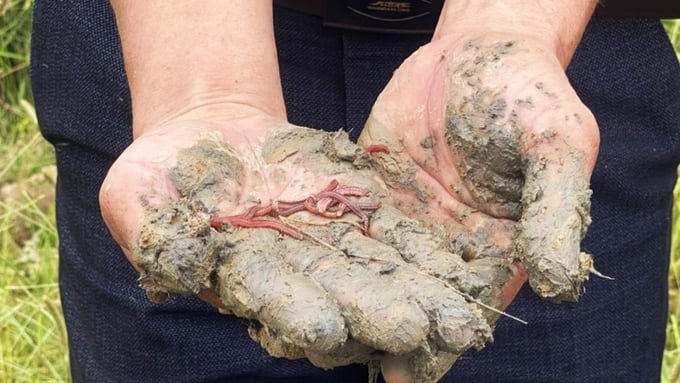
The number of earthworms in organic rice fields in Xuan Lam commune (Nghi Xuan district, Ha Tinh province) has been increasing. Photo: Nguyen Hoan.
To restore the natural population of mud crabs and increase rice productivity and quality, in September 2022, Xuan Lam commune directed the implementation of land improvement to carry out an organic rice production model combined with mud crab farming in hamlets 2 and 3 on a scale of 10 hectares, assigned to Thong Nhat Agricultural Cooperative (Xuan Lam commune). After the cooperatives completed land leveling and field improvement, ensuring the necessary conditions, in the spring of 2023, cooperative members began planting the first organic rice crop.
The family of Mr. Le Anh Son in Hamlet 2, Xuan Lam Commune, is one of the households participating in the organic rice production model combined with earthworm farming implemented by Thong Nhat Agricultural Cooperative. The spring crop of 2024 was the second time Mr. Son's family planted ST25 rice in their earthworm-harvesting fields. Besides higher organic rice yields compared to the first crop, earthworms also appeared in greater numbers than before.
Mr. Son said: "After the rice fields were renovated, the ground level became lower, creating favorable conditions for river water to flow in and out, depositing alluvial soil. Along with organic rice cultivation, the soil is rich in nutrients, so in addition to achieving a rice yield of 270 kg/sao (500 m2 sao), 50 kg/sao higher than before, we also harvested more mudworms."
While previously, naturally occurring rice paddies only yielded a density of 10-15 worms/m2 and were harvested in September-October (lunar calendar), now, organic rice paddies, supplemented with nutrients, have increased the density to 35-40 worms/m2, and in some places over 100 worms/m2, allowing for harvesting in May-June (lunar calendar). Although the family only cultivates 4 sao (approximately 0.4 hectares) of rice, the first harvest yielded over 1 ton of rice and nearly 100 kg of worms, worth over 100 million VND. Based on monitoring, this season's worm yield is sure to be even higher.
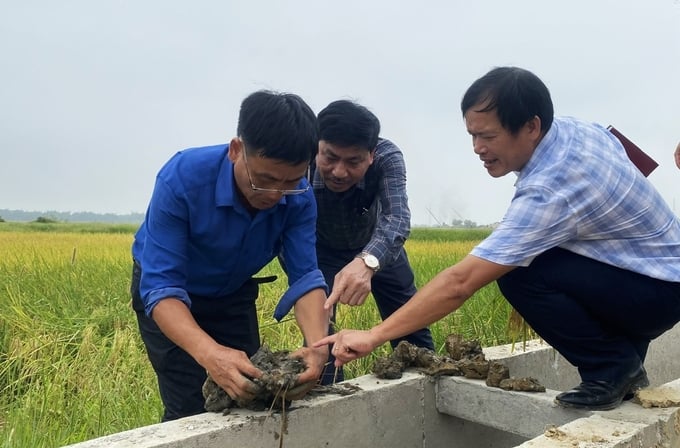
Checking the source of earthworms in organic rice fields at Thong Nhat Agricultural Cooperative. Photo: Nguyen Hoan.
Mr. Nguyen Van Chien, Director of Thong Nhat Agricultural Cooperative, said: "The implementation of this model aims to exploit the advantages of the locality, create safe rice, mud crabs, and other seafood products, thereby laying the foundation for the locality to develop mud crab rice products that meet OCOP 3-star standards; aiming to build a product value chain, increase added value, and contribute to increasing income for the people."
Over two production cycles, the yield of organic rice grown in fields with earthworms has increased significantly, reaching an average of 54 quintals/hectare, earthworms at 2.5 quintals/hectare, and crabs at 3.5 quintals/hectare. From an initial area of 10 hectares, the cooperative is continuing to develop a specialized organic rice cultivation area combined with earthworm and crab farming on a concentrated scale of 80 hectares.
Hearing about the restoration of the mudworm population makes me very happy.
The organic rice farming area in Dong Lang, Dau Giang hamlet, Ky Khang commune (Ky Anh district, Ha Tinh province), which is located in a low-lying area (next to Nha Le canal), used to have a considerable natural population of mudworms in its brackish water. However, for a long time, due to the use of pesticides by local people, mudworms and other aquatic organisms in the rice fields gradually disappeared. After six seasons of persistently practicing organic rice farming, saying "no" to pesticides and chemical fertilizers, mudworms and crabs have reappeared. This is a welcome sign, giving the local people hope for new values and opening up new directions for economic development.
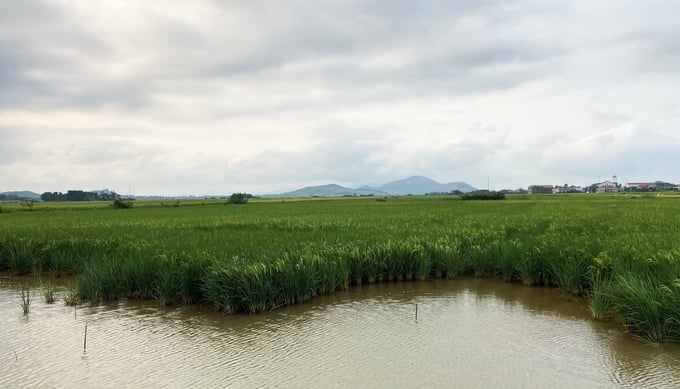
The ecosystem in the rice-growing fields combined with organic mudworm farming in Dau Giang village, Ky Khang commune (Ky Anh district, Ha Tinh province) is gradually recovering. Photo: Nguyen Hoan.
In line with the policy of producing commercial rice using organic methods, starting from the spring crop of 2022, Ky Anh district began piloting a model of transferring organic rice production techniques combined with the regeneration and restoration of natural mudworm resources in Dau Giang village (Ky Khang commune) with an area of 5 hectares and 8 participating households.
Having been involved with this rice field for decades and having previously earned income from mudworms right here in this area, Mr. Nguyen Van Huan was extremely excited to learn about the village and commune's plan to restore natural mudworm production and organic rice farming.
Mr. Huan shared: “Previously, there were many mudworms and crabs in this field, but after many years of rice cultivation using chemical fertilizers, pesticides, and herbicides, the mudworms and crabs gradually disappeared. When the policy of growing organic rice to restore the mudworms and crabs was introduced, I was very happy to hear about it, so I immediately registered to do it in the first season with 15 acres of land. To date, I have participated in organic rice production for the sixth season, and I see that mudworms have reappeared, with some fields having a density of up to 50-60 worms/m2. Last year, after harvesting the summer-autumn rice crop, I harvested a considerable amount of mudworms, so I hope to harvest even more this year.”
Farmers are no longer abandoning their fields.
Worms are very sensitive to their environment; even small amounts of chemicals can weaken their resistance, stop their growth, and cause mass deaths. After nearly three years of organic rice production, farmers no longer use inorganic fertilizers or pesticides in their fields. The ecosystem has gradually recovered, the field environment has improved, and in addition to worms, crabs, snails, shrimp, and fish have also appeared in greater numbers.
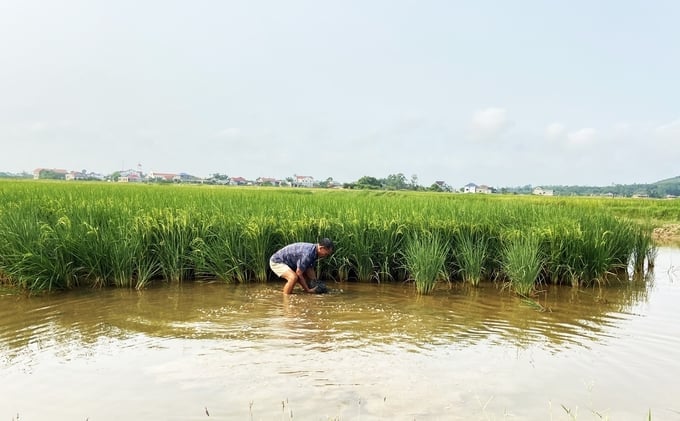
Mr. Nguyen Van Huan checks the density of earthworms in his organic rice field. Photo: Nguyen Hoan.
Ms. Hoang Thi Vinh, head of the rice-worm production cooperative in Dau Giang village (Ky Khang commune), shared: "When we first started, many households were hesitant because they thought organic rice farming was hard work. But after participating in the trial for the first few seasons, the farmers saw the benefits and found it easier than traditional farming. The fields are only fertilized with organic microbial fertilizer and well-rotted manure. After the rice plants absorb the nutrients, the organic matter accumulates in the fields. In the following season, the amount of fertilizer needed decreased from 70kg to 60kg, then 50kg, and the rice still grew and developed well, reducing investment costs. The farmers were very happy."
Not only do they produce delicious, high-priced rice, but each harvest also provides farmers with additional income of 500,000-700,000 VND per sao (approximately 1000 square meters) from selling mud crabs, shrimp, and fish. Therefore, farmers in the region no longer intend to abandon their fields and are strictly adhering to organic rice production processes, saying "no" to chemical fertilizers and pesticides, while also hoping to expand the area under organic rice cultivation.
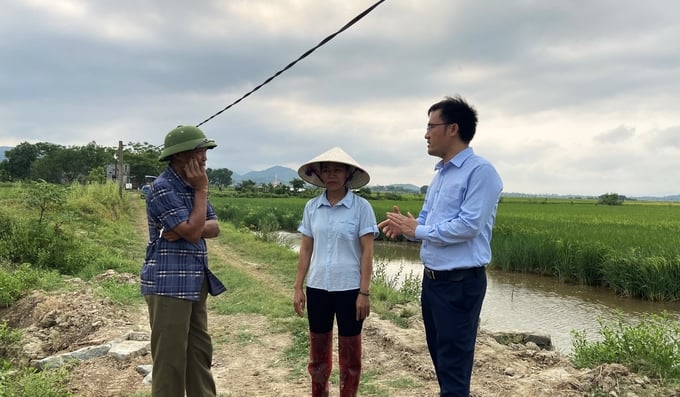
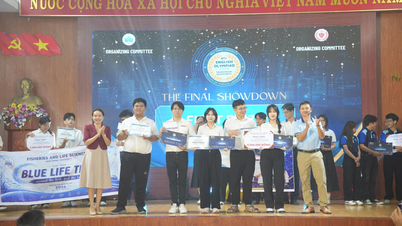
Mr. Nguyen Thanh Hai, Vice Chairman of the Ky Anh District People's Committee (far right), always accompanies farmers in implementing the organic rice production model on mudflats in Ky Khang commune. Photo: Nguyen Hoan.
In recent years, alongside land transformation, Ky Anh district has been promoting sustainable agricultural development, with many integrated production models and organic farming models being widely developed, yielding outstanding incomes.
Mr. Nguyen Thanh Hai, Vice Chairman of the Ky Anh District People's Committee, said: After nearly 3 years of implementation, the district has now developed more than 32 hectares of organic rice. Specifically, the model of transferring organic rice production techniques combined with the regeneration and restoration of natural mudworm resources in Dau Giang village (Ky Khang commune) has expanded from 5 hectares to 17 hectares and will eventually be expanded to 25 hectares throughout the district. Along with this, the district is continuing to utilize all resources to focus on building synchronous infrastructure; transferring techniques for caring for, regenerating, and exploiting mudworms and crabs correctly; and linking with businesses to both develop the production model and build the brand of Ky Anh district's rice and mudworms.
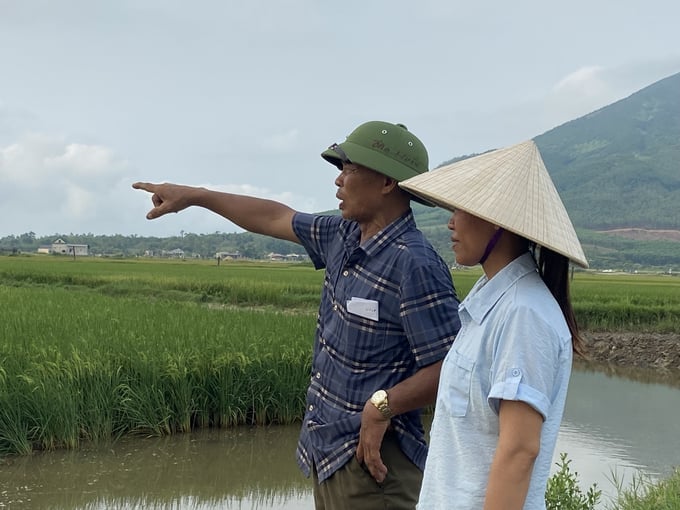
Ha Tinh province continues to expand organic rice production by 57 hectares in areas used for harvesting mudworms during the 2024-2030 period. Photo: Nguyen Hoan.
In reality, the organic rice production model, after 2-3 seasons without the use of pesticides and chemical fertilizers, has made the soil fertile, eliminated harmful substances, and resulted in strong rice growth, requiring almost no pest and disease control, with stable yields of 250-280 kg/sao (1 sao = 360 square meters). In addition, each sao of organically grown rice also yields 20-25 kg of earthworms and 40-50 kg of crabs, bringing in an income of 10-15 million VND. These rice-earthworm-crab farming areas in Ky Khang commune (Ky Anh district), Xuan Lam commune (Nghi Xuan district), and many other localities in the province have been helping people earn high incomes and restoring the agricultural ecosystem.
Currently, Ha Tinh province has over 133 hectares of rice cultivated organically in areas used for harvesting mud crabs and other crustaceans, bringing "double benefits" to farmers. Recently, the People's Committee of Ha Tinh province approved expanding this production model to an additional 57 hectares in localities belonging to Ky Anh, Duc Tho, Nghi Xuan districts, Ha Tinh city, and Hong Linh town.
Source: https://nongsanviet.nongnghiep.vn/goi-ruoi-ve-nhung-dong-lua-huu-co-d388032.html

























































































Comment (0)