


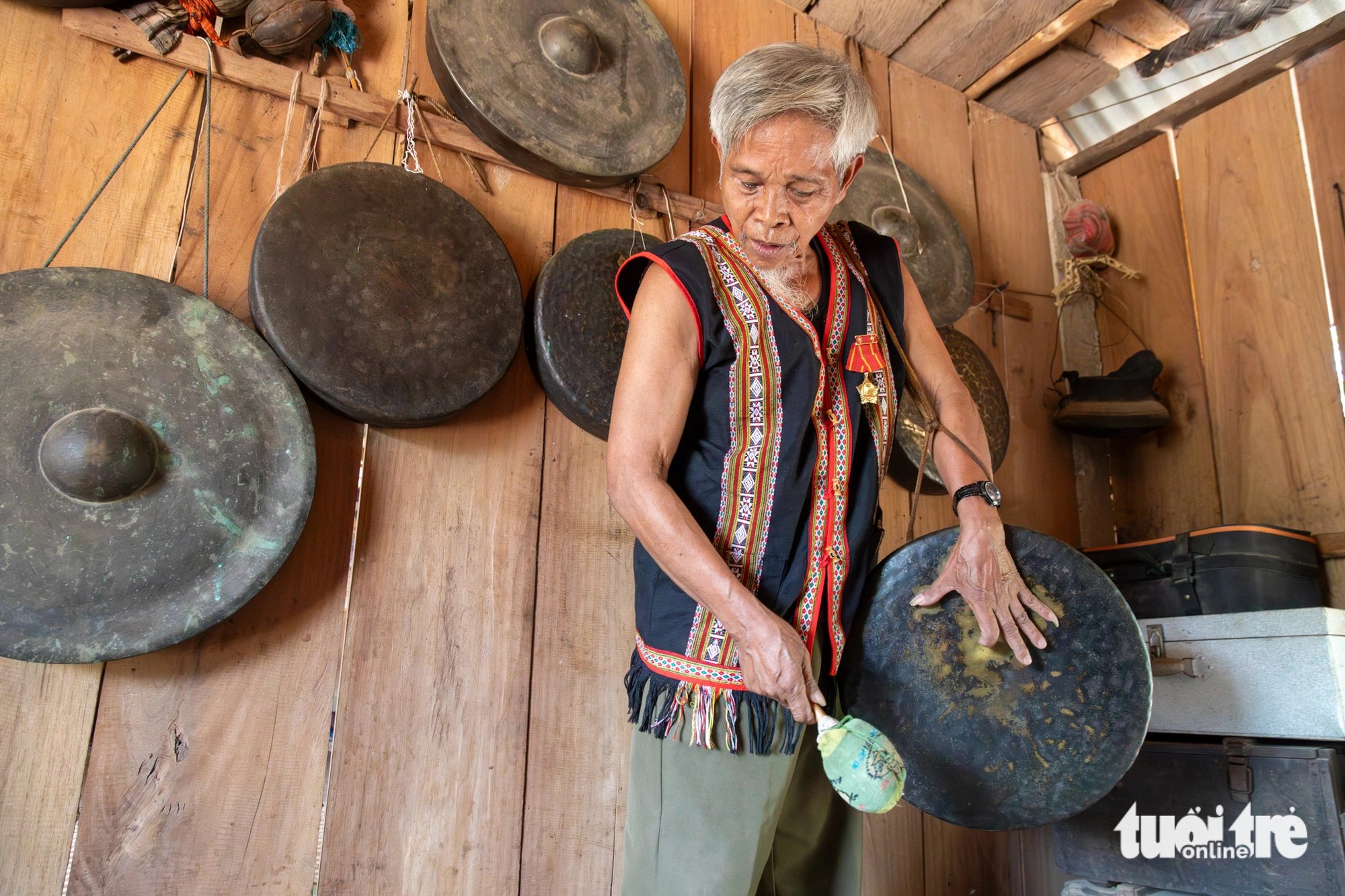
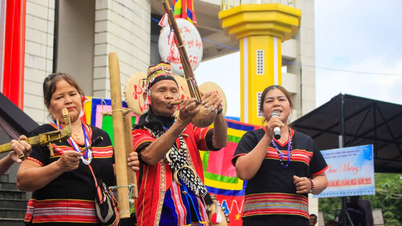
Mr. Côn Bắt performs a gong dance - Photo: HOÀNG TÁO
With 200 bronze gongs still preserved in households, Ta Rut commune (Dakrong district) is considered the mountainous commune with the most gongs in Quang Tri province.
Losing gongs is like losing a person's soul.
On weekends, Mr. Ho Van Phieng's house (in Ta Rut commune) is crowded with visitors, both old and young. They come to immerse themselves in the sounds of gongs and drums, reliving the sounds of the majestic Truong Son mountain range.
On the walls of Mr. Phiêng's house hang many traditional musical instruments, including one gong, six cymbals, drums, horns, etc. His family is one of the few that still possesses bronze gongs and cymbals.
The elderly come to visit to play the gongs and reminisce about the folk songs they sang by the stream when they were young.
Young people come to listen, to nourish their souls with folk songs accompanied by the melodious sounds of gongs.
"In the past, only wealthy and influential families could afford gongs, because they were made of copper and therefore very expensive. Each gong was worth as much as a mature male buffalo. Having gongs at home meant you were respected wherever you went," Mr. Phiêng recounted.
However, the years of war and displacement led to the loss of some gongs. Then, 20-30 years ago, people from the lowlands came up to buy a lot of gongs.
"Many Pa Kô people sell everything for a living. As for me, I've inherited the gongs from my ancestors; I'll only buy more, I absolutely will not sell them. Losing the gongs means the Pa Kô people lose their soul," Mr. Phiêng said.
Besides signifying status within the village, gongs are used extensively in spiritual rituals. "There are gongs specifically used for ceremonies; customs and traditions forbid them from being played for other purposes. Without the resounding sound of gongs, our ancestors will not come to attend the ceremony with their descendants," Mr. Phiêng recounted.
In everyday life, when friends come to visit, gongs are brought out to sing celebratory songs, and young men and women go to the stream to sing love songs.
Determined to preserve the soul of the mountain gongs.
Mr. Con Bat also preserved four gongs and four cymbals passed down from his grandparents. Looking at the gongs and cymbals on the wooden wall, Mr. Bat said that in the old days, marrying a beautiful wife was thanks to having many gongs and cymbals in the family.
"According to custom, when getting married, you must give a gong or a copper pot as a gift to the bride's family," he recounted, then used his hands to play the gong, humming a poignant love song. After singing, both he and his wife smiled brightly.
He and his wife have five sons. Over the years, not only has he preserved the gongs physically, but he has also strived to teach his children and grandchildren how to play traditional musical instruments and sing Pa Kô love songs that leave any woman who hears them deeply moved.
"This is a fortune. I'm old now, so I'm passing it on to my children and grandchildren," Mr. Con Bat said.
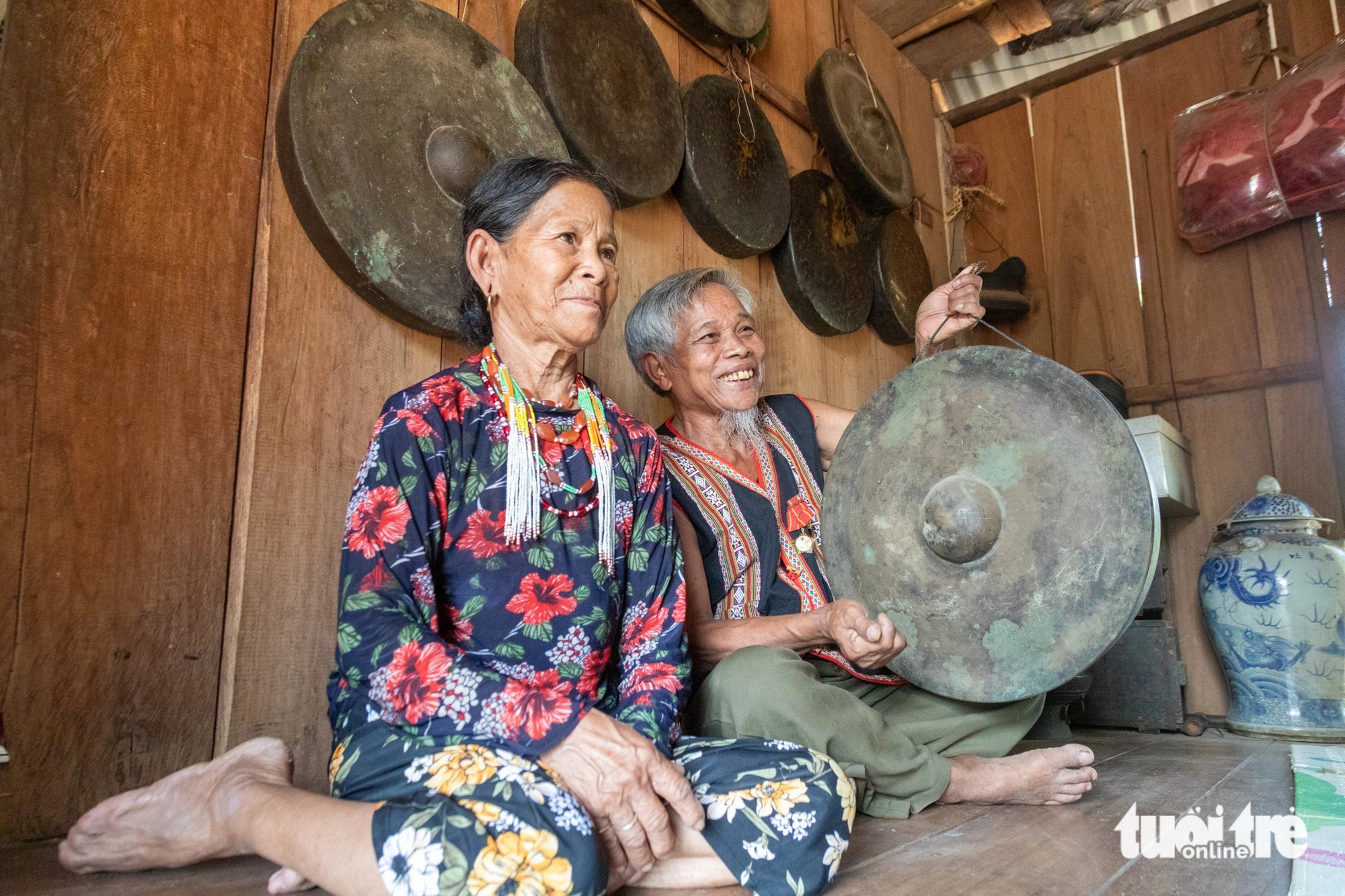
Mr. Con Bat and his wife with their family's collection of gongs and drums - Photo: HOANG TAO
According to artisan Kray Sức (residing in Tà Rụt commune), gongs are a bridge that helps the Pa Kô people communicate with their ancestors and invisible deities, and are deeply ingrained in the Pa Kô people's subconscious.
"To preserve gong music, we must let young people know about it, understand it, see it, hear it, and practice playing it," said Mr. Kray Sức.
Mr. Ho Van Ngo, a cultural officer of Ta Rut commune, informed that Ta Rut commune still preserves 200 gongs of various types.
"The commune reaches out to each family, urging them not to sell their gongs for any reason. Every year, the commune organizes folk song and dance classes with about 40 participants to preserve the cultural traditions of the Pa Kô people," Mr. Ngô said.
Source: https://tuoitre.vn/giu-linh-hon-cong-chieng-phia-nui-truong-son-20240510091106007.htm


![[Photo] Prime Minister Pham Minh Chinh receives Canadian Minister of International Development Randeep Sarai](/_next/image?url=https%3A%2F%2Fvphoto.vietnam.vn%2Fthumb%2F1200x675%2Fvietnam%2Fresource%2FIMAGE%2F2026%2F01%2F06%2F1767708661052_image123-3433-jpg.webp&w=3840&q=75)
![[Photo] Prime Minister Pham Minh Chinh attends the Conference on the Implementation of Tasks for the Finance Sector in 2026](/_next/image?url=https%3A%2F%2Fvphoto.vietnam.vn%2Fthumb%2F1200x675%2Fvietnam%2Fresource%2FIMAGE%2F2026%2F01%2F06%2F1767699638245_ndo_br_dsc-0196-jpg.webp&w=3840&q=75)
![[Image] Fifth meeting of the Steering Committee for National Projects in the Railway Sector](/_next/image?url=https%3A%2F%2Fvphoto.vietnam.vn%2Fthumb%2F1200x675%2Fvietnam%2Fresource%2FIMAGE%2F2026%2F01%2F06%2F1767712857541_ndo_br_dsc-0581-jpg.webp&w=3840&q=75)
![[Photo] Standing Committee member of the Party Central Committee Tran Cam Tu inspects preparations for the 14th Party Congress.](/_next/image?url=https%3A%2F%2Fvphoto.vietnam.vn%2Fthumb%2F1200x675%2Fvietnam%2Fresource%2FIMAGE%2F2026%2F01%2F06%2F1767695749033_image1122-1262-jpg.webp&w=3840&q=75)
















































Comment (0)