

According to doctors, the success of the surgery not only brings new hope for the patient but also opens up a path forward for patients with severe epilepsy who do not respond to medication.
Twenty-one years ago, T.D. ( Hanoi ) was born via Cesarean section. Unfortunately, she suffered from amniotic fluid asphyxiation, leading to brain damage and epilepsy from birth.
Since then, D has frequently suffered epileptic seizures, which have become increasingly frequent and severe. On some days, the patient endures 50 to 100 seizures, some lasting up to two hours.
Repeated injuries due to a lack of self-control have caused the patient's head to become deformed, requiring frequent medication.
D had been examined in many places, including by specialists abroad. The doctors concluded that this is a difficult disease to cure completely, requiring the patient to learn to live with the disease for life.
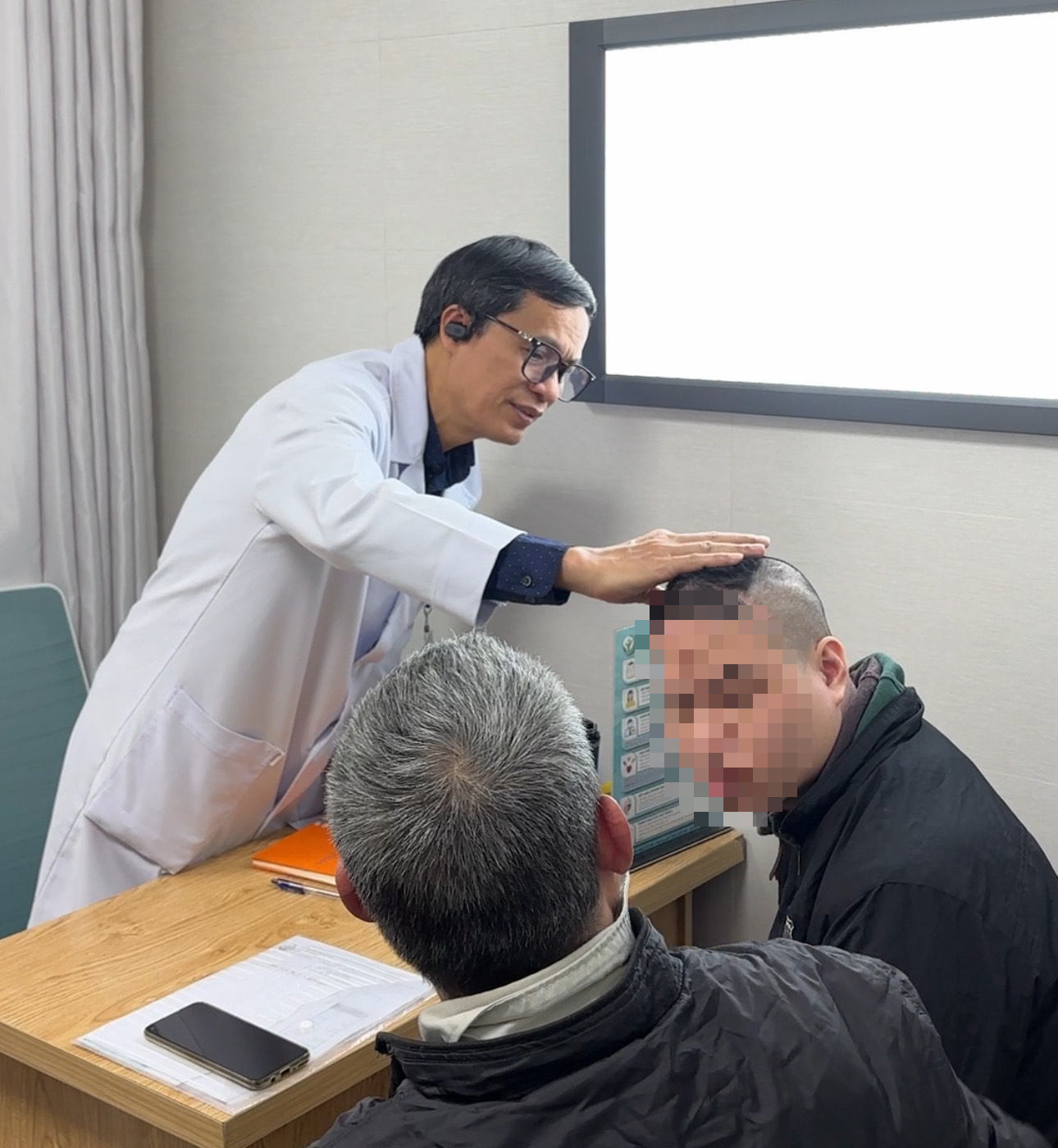
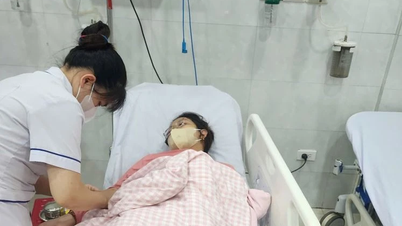
Associate Professor Dr. Dong Van He examines a patient after surgery. Photo: Provided by the hospital.
Recently, the patient was brought to Viet Duc Friendship Hospital by family members. There, Associate Professor Dr. Dong Van He – President of the ASEAN Neurosurgery Society, President of the Vietnam Neurosurgery Society, and Deputy Director of Viet Duc Friendship Hospital – received and examined the patient.
After thorough consultation, Associate Professor Hệ decided to perform surgery to remove the entire corpus callosum, the part connecting the two cerebral hemispheres, to reduce epileptic seizures.
" This is a complex case. In typical cases, we perform surgery when we identify the epileptic focus, such as hippocampal atrophy or dysplasia. However, this patient has a diffuse epileptic focus affecting both hemispheres, making medication ineffective. The corpus callosum resection surgery aims to block the epileptic signal from spreading between the two hemispheres, thus reducing seizures," said Associate Professor Dong Van He.
Fortunately, the results after the surgery far exceeded expectations. From an expected 50% reduction, the patient experienced a 90% reduction in seizures. Currently, the patient only has 3-4 seizures per day and continues to receive supportive medication.
According to doctors, while not a complete cure, this is still a major step forward in alleviating symptoms and improving the quality of life for patients.
" The success of each case is proof of the continuous efforts in researching and applying new medical methods. More importantly, it brings hope to patients and their families, " Assoc. Prof. Dr. Dong Van He emphasized.
Source: https://giadinh.suckhoedoisong.vn/giam-90-so-con-dong-kinh-cho-nam-thanh-nien-21-tuoi-mac-benh-tu-luc-chao-doi-172250116103458384.htm


![[Image] Vietnam's colorful journey of innovation](/_next/image?url=https%3A%2F%2Fvphoto.vietnam.vn%2Fthumb%2F1200x675%2Fvietnam%2Fresource%2FIMAGE%2F2025%2F12%2F14%2F1765703036409_image-1.jpeg&w=3840&q=75)

















































![[Image] Vietnam's colorful journey of innovation](https://vphoto.vietnam.vn/thumb/402x226/vietnam/resource/IMAGE/2025/12/14/1765703036409_image-1.jpeg)




























Comment (0)