

Domestic gold price increased 17 times faster than world gold price
The General Statistics Office (GSO) has just released its report on the socio -economic situation in May and the first five months of 2023. One of the key pieces of data that has attracted attention is the exceptionally rapid increase in domestic gold prices compared to world gold prices.
According to the General Statistics Office (GSO), domestic gold prices fluctuate in line with world gold prices. As of May 25, 2023, the average world gold price was $2,005.44 per ounce, up 0.06% compared to April 2023 due to concerns about instability in the financial system and signs of economic recession.
In addition, world gold prices rose sharply after the US Federal Reserve (FED) decided to raise interest rates for the 10th consecutive time on May 3, 2023, increasing the benchmark interest rate by 0.25 percentage points to 5% - 5.25%, the highest level since the summer of 2007.
Domestically, the gold price index in May 2023 increased by 1.02% compared to the previous month; increased by 3.97% compared to December 2022; increased by 0.44% compared to the same period last year; and the average for the first five months of 2023 increased by 0.62%.
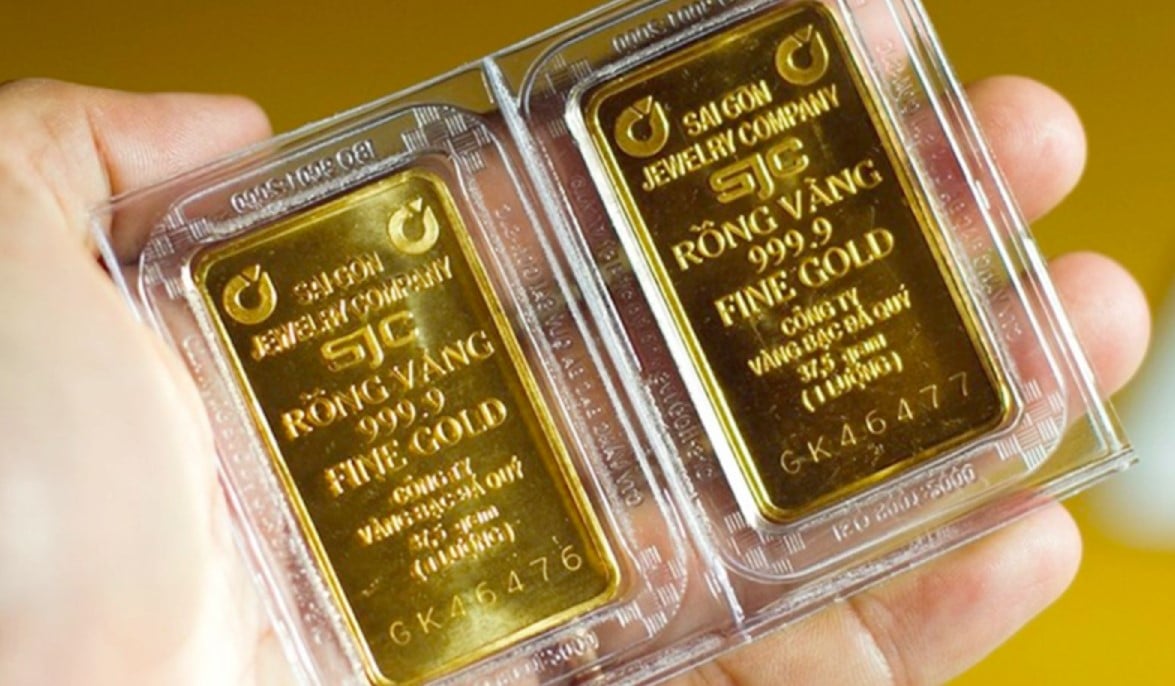
In May, domestic gold prices surged 17 times faster than world gold prices, making SJC gold increasingly expensive. (Illustrative image)
However, after the GSO's calculations, world gold prices unexpectedly plummeted and moved away from the important $2,000/ounce mark.
Early on the morning of May 29th, the world gold price in the Asian market was trading at $1,945.5 per ounce, down $59.94 per ounce, or 3%, compared to May 25th. At $1,945.5 per ounce, the converted price of SJC gold was approximately VND 55.05 million per tael.
Meanwhile, gold prices in the domestic market declined at a much slower pace, falling by only about 66.45 million VND/ounce - 66.98 million VND/ounce, almost unchanged compared to May 25th; Thang Long gold prices decreased by 110,000 VND/ounce, equivalent to 0.2%, to 55.77 million VND/ounce - 56.67 million VND/ounce.
It can be seen that when on an upward trend, domestic gold prices increase sharply, 17 times faster than world gold prices. But when on a downward trend, world gold prices fall sharply at a rate 15 times faster. This causes the difference between the two prices to widen significantly.
Currently, the price of SJC gold is about 12 million VND/ounce higher than the world gold price, while the price of non-SJC gold is about 1.62 million VND/ounce higher than the world gold price.
At many other establishments, the price of SJC gold also did not fluctuate significantly despite the sharp drop in world gold prices. At Phu Nhuan Jewelry Company (PNJ) and Saigon Jewelry Company (SCJ), the price of SJC gold was listed at VND 66.40 million/ounce - VND 67 million/ounce. The price of SJC gold at Doji Group was traded at VND 66.35 million/ounce - VND 66.95 million/ounce.
Gold prices risk breaking below $1,900 per ounce.
Gold is trending down $35 this week, with June gold futures on the Comex last trading at $1,945.80 an ounce. Despite the sell-off, gold is still up more than 6% year-to-date.
Bart Melek, head of global commodity strategy at TD Securities, told Kitco News that macroeconomic data was the main driver influencing gold prices at the end of the week.
Melek said: “Durable goods volumes, personal spending and PCE inflation measures all exceeded expectations. Inflation not only failed to fall, the Federal Reserve’s preferred measure of inflation – the core PCE price index – rose to 4.7% in April.”

World gold prices risk falling below the $1,900/ounce mark. (Illustrative image)
Inflation near 5% is too high for the Fed to justify a pause in June, and the market is pricing that in. The latest market expectations suggest a 60% chance of a rate hike at the June 13-14 meeting, Gainesville Coins precious metals expert Everett Millman told Kitco News.
Above all, the US dollar performed well and gold responded with a price drop. “We believe gold prices could fall for much of the quarter and possibly into the beginning of Q3,” Melek said. “The market misjudged the Fed’s intentions.”
With the Fed focused on inflation, there's little chance of influencing the central bank ahead of the June meeting. Millman added that the dramatic debate over the debt ceiling is something to watch closely because any downgrade to US credit ratings would trigger safe-haven flows into gold.
Meanwhile, negotiations to raise the U.S. government's $31.4 trillion debt ceiling before June 1 hit some snags on Friday. Earlier, Democratic and Republican negotiators had nearly reached an agreement to raise the debt ceiling for two years while also limiting some spending.
Millman said the next support level for gold is $1,940 per ounce. Below that, investors should watch for levels at $1,915 and $1,900 per ounce.
Analysts are not ruling out the possibility of a drop to $1,900. Melek said, “The company’s support level is around $1,900-$1,896 per ounce.”
Frank Cholly, senior market strategist at RJO Futures, told Kitco News that it's too early to say gold has bottomed out, even though the precious metal has fallen more than $125 since testing its record high a few weeks ago.
“The market is telling us we’re going to see another rate hike in June and possibly another in July. Gold doesn’t like that,” Cholly said. He predicted: “Somewhere in the 1,950-1,925 range on the August futures contract, traders will find value and the market will form a base before moving higher.”
Source

![[Photo] Prime Minister Pham Minh Chinh holds a phone call with the CEO of Russia's Rosatom Corporation.](/_next/image?url=https%3A%2F%2Fvphoto.vietnam.vn%2Fthumb%2F1200x675%2Fvietnam%2Fresource%2FIMAGE%2F2025%2F12%2F11%2F1765464552365_dsc-5295-jpg.webp&w=3840&q=75)


![[Photo] Closing Ceremony of the 10th Session of the 15th National Assembly](/_next/image?url=https%3A%2F%2Fvphoto.vietnam.vn%2Fthumb%2F1200x675%2Fvietnam%2Fresource%2FIMAGE%2F2025%2F12%2F11%2F1765448959967_image-1437-jpg.webp&w=3840&q=75)















































![[OFFICIAL] MISA GROUP ANNOUNCES ITS PIONEERING BRAND POSITIONING IN BUILDING AGENTIC AI FOR BUSINESSES, HOUSEHOLDS, AND THE GOVERNMENT](https://vphoto.vietnam.vn/thumb/402x226/vietnam/resource/IMAGE/2025/12/11/1765444754256_agentic-ai_postfb-scaled.png)













































Comment (0)