


Artisan Nguyen The, Chairman of the Hue Folk Literature Association, took us to the Toa Kham ferry terminal. The water was calm, and as the ferry left the dock, pentatonic melodies echoed across the river. There, a family has lived for four generations, practicing the art of Hue folk singing.
This family, who have lived with Hue folk singing their whole lives, welcomed us warmly. They introduced each member who has been closely associated with the Hue Folk Singing Club, which will celebrate its 40th anniversary on August 22nd.
Mr. Vo Que, the narrator, said that in 1980, there was a boatman named Dai at this dock. He carved his name on the side of his boat with the words "Brother Dai's Boat" - which, when read aloud, means "That's my life." This was the first boat to experiment with organizing Hue folk singing performances for tourists.
Gradually, Mr. Dai and many other locals developed Hue folk singing on the Perfume River into an indispensable cultural activity in the ancient capital. In 1983, the Hue Folk Singing Club was established.
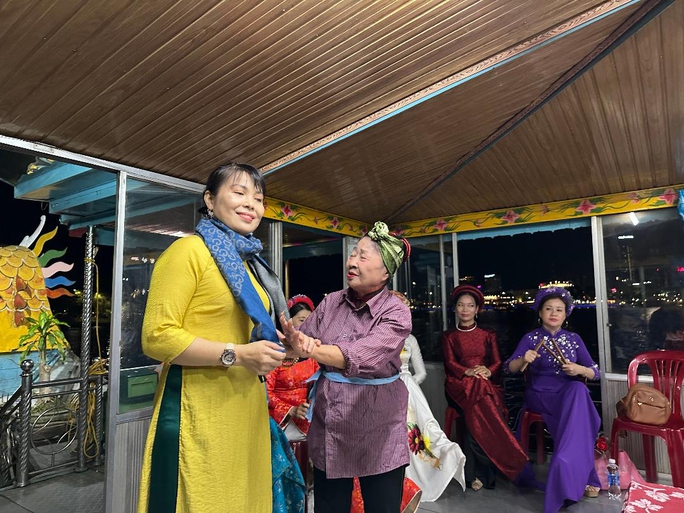
Meritorious Artist Kim Vàng (right) and artist Châu Loan perform the folk opera "Mother Suốt" on the Perfume River.
According to Mr. Vo Que, with the gentle flow of the Perfume River, the sounds of Hue folk songs will reach the water's surface and then "release" back onto the boat. Therefore, Hue folk singing on the Perfume River is an art form.
The aforementioned Hue folk singing family originated from the artist couple Ngoc Yen and Kim Oanh. The entire family – from sons and daughters to daughters-in-law, sons-in-law, and grandchildren – are all active in the field of Hue folk singing. Their eldest son, People's Artist Ngoc Binh, is considered a precious talent of the Hue folk opera stage.
In 2000, Ngoc Binh challenged himself by portraying President Ho Chi Minh in the epic musical performance "Epic Music and Dance". This role left a deep impression on audiences from many regions. Not only a talented actor, he is also the director of over 100 performances in various genres, most notably Hue folk songs.
This Hue singing family also includes a daughter who is artist Sao Mai, a great-grandson who is musician Khanh "Bau", a son-in-law who is artist Dinh Hung, and more than 15 grandchildren and great-grandchildren who participate in Hue singing under the guidance of Meritorious Artist Kim Vang (Khanh "Bau"'s grandmother).
Meritorious Artist Kim Vàng shared: "My parents left a great legacy for their descendants, which is the art of Hue singing. Hue singing has formed as a cultural stream, and we will cling to this stream, passing it on to future generations to preserve and cherish it."
Meritorious Artist Kim Vàng said that no matter how difficult life gets, her family prioritizes passing on their craft, ensuring that Hue folk singing does not fade away. Artist Kim Vàng proudly shared that in 1995, her brother, People's Artist Ngọc Bình, held the important position of Head of the Hue Folk Opera Troupe. He traveled extensively, calling on his brothers and sisters who were working in various other professions to return to the troupe to practice and develop programs that reflected the unique identity of Hue.
Under the guidance of People's Artist Ngoc Binh, the Hue Opera and Drama Troupe has increasingly affirmed its position as a traditional theatrical art form for audiences both domestically and internationally. In 1997, the Hue Opera and Drama Troupe was honored to receive the Second Class Labor Medal.
Musician Khánh "bầu" proudly stated: "The Hue Singing Club is about to celebrate its 40th anniversary. As the younger generation inheriting the tradition, we always strive to preserve the standards of Hue singing, so that visitors to the ancient capital will be captivated by the boats and melodies of Hue singing performances on the romantic Perfume River."
Besides the aforementioned Hue singing family, the ancient capital region also has artisan Ha Trung (specializing in the zither) and Master Dinh Hung (Hue Conservatory of Music) who are very active in passing on their skills to many young people who love traditional musical instruments, so that they can both play and sing Hue songs.
Source






![[Photo] Radiant smiles at the "Building Tet" festival in Da Nang](https://vphoto.vietnam.vn/thumb/1200x675/vietnam/resource/IMAGE/2026/02/12/1770872911216_ndo_br_nhan-qua-jpg.webp)



































Comment (0)