


In late February, a Jrai village in the border commune of Ia Grai district held a communal house ceremony to punish the village's "offenders." These were six young couples who had gotten pregnant out of wedlock, including some cases of child marriage.
According to village custom, families must contribute money to buy a buffalo to offer at the communal house, and then use it to feed the villagers. This is a long-standing tradition in this Jrai border village. However, in recent years, some people no longer agree with the custom, arguing that it is no longer suitable for the lifestyle of the younger generation and that the punishment lacks deterrent value and becomes a financial burden. Among the young couples who were punished, some were in very difficult circumstances and had to borrow money to contribute to buying the buffalo.
Some years, the village only had one case of "getting pregnant before marriage," and they had to bear the entire burden of buying a buffalo for the communal house ceremony.
The friend who told me this story requested anonymity for fear of being "expelled from the village because the Jrai people are always bound to the community. If the council of elders has made such a decision, then no one dares to do otherwise," he said.
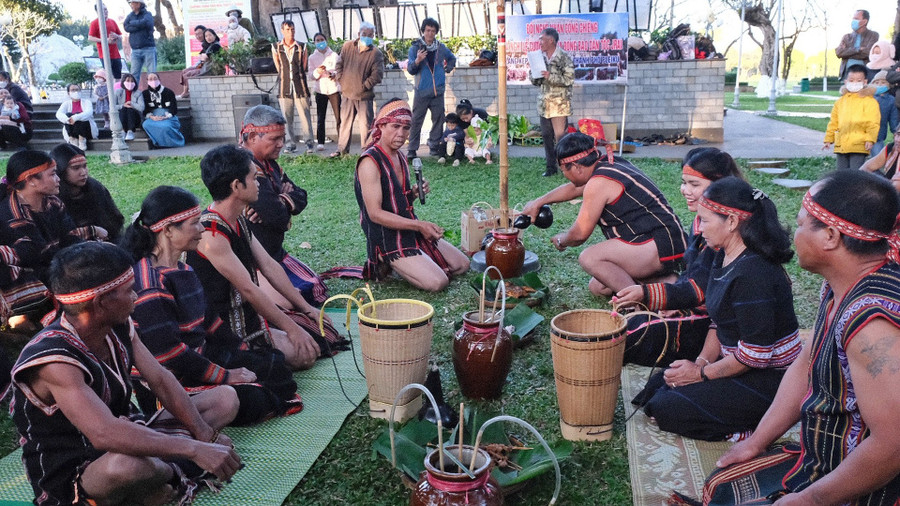
Recreating the rituals of a traditional Jrai wedding ceremony. Photo: MC
The story above also reveals many aspects of the cultural life of the Jrai people in particular and the Central Highlands people in general. Throughout their development, there has always been a struggle and conflict between the old and the new, between outdated customs and traditions in village life, and between the younger generation and the elders who "hold the scales of justice" to maintain order and discipline in the village.
Journalist Ngoc Tan, formerly a correspondent for the Rural Today newspaper based in Gia Lai, recounted: "In the past, when I returned to the villages, I witnessed many strange occurrences stemming from traditional customs and the tragic fates of people ostracized by their communities simply because of suspicions of 'evil spirits' or 'poisonous spells.' These phenomena have now been almost completely eradicated."
There are strange occurrences, such as in the Kon Pne area (Kbang district), where whenever a thunderstorm breaks out, the Bahnar people believe it signals the return of the souls of the dead to the afterlife , and everyone refrains from doing anything. He visited the village on such a day and couldn't find anyone to ask for information; even the Party Secretary of the commune refused to speak to him because of the superstition of not working.
The village of De Kjieng, located at the headwaters of the Ayun River (Ayun commune, Mang Yang district), once had many traditional rituals. Village elder Hyek recounted: "In the past, whenever people heard thunder and lightning, encountered bad luck in the fields, had their houses burned down, or even experienced something inexplicable or witnessed an unusual phenomenon, they would slaughter pigs and chickens for offerings. The people became increasingly impoverished simply because they maintained so many rituals. However, these customs that hindered economic development have now been abolished."
Some customs are abolished to facilitate development, but conversely, some customs are distorted by development, such as the custom of challenging the bride's family with a dowry in Krông Pa. Originally a beautiful cultural tradition, it was at one point transformed into a burden for many families.
According to Jrai custom, a girl must pay the dowry demanded by the groom's family when she marries. However, as living standards improve, the dowry demands become too high for many poor girls. Therefore, many poor girls choose to marry first and pay off the dowry later. Some dowry debts take a lifetime to repay, leading many into destitution. Some even only manage to pay off their dowry debts at the end of their lives. Despite this, when asked if they want to abolish the dowry demand custom, many still believe it is a unique aspect of Jrai culture that should be preserved.
For generations, the people of the Central Highlands have lived alongside their customs, creating a unique beauty and charm in the culture of their ethnic groups. In the course of development, unsuitable practices have gradually been refined, but internal struggles within village communities remain, as the line between tradition and outdated customs is sometimes very thin.
In a conversation with a reporter from Gia Lai Newspaper, Associate Professor-Doctor Bui Hoai Son, Standing Member of the National Assembly's Committee on Culture and Education, stated: "In reality, some cultural elements that were previously considered superstition are now seen as unique values, reflecting the national cultural identity. This shows us that examining cultural phenomena requires a dialectical perspective, being both objective and incorporating the perspective of those directly involved."
According to Associate Professor Dr. Bui Hoai Son: "Separating the wheat from the chaff" in cultural development requires coordination and active participation from the subjects of these cultural activities, so that they have a voice in choosing the beauty and cultural values of their own culture. Any intervention from the State should be limited to providing the most accurate and complete understanding so that people can proactively make their choices.
"By doing so, we can not only eliminate inappropriate customs but also create conditions for positive cultural activities to continue to be practiced, contributing to the development of the Vietnamese ethnic communities as well as the country's socio-economic development," Mr. Son said.
Source: https://baogialai.com.vn/gan-duc-khoi-trong-de-phat-trien-van-hoa-post316478.html

![[Image] Current situation of houses precariously balanced due to road leveling in Dong Nai.](https://vphoto.vietnam.vn/thumb/1200x675/vietnam/resource/IMAGE/2026/03/02/1772455749144_ndo_br_z7579763955585-6e80a60471e75768fa835d035eba45ea-6979-jpg.webp)
![[Photo] Procession of a giant "pig" weighing over 200kg at the La Phu Village Festival](https://vphoto.vietnam.vn/thumb/1200x675/vietnam/resource/IMAGE/2026/03/02/1772444501339_anh-man-hinh-2026-03-02-luc-16-40-20.png)



























![[Photo] National Assembly Chairman Tran Thanh Man receives the First Vice President of the Greek Parliament](https://vphoto.vietnam.vn/thumb/402x226/vietnam/resource/IMAGE/2026/03/02/1772444080600_anh-man-hinh-2026-03-02-luc-16-34-09.png)
















Comment (0)