

Enfarm was founded out of concern that 60% of fertilizers are not absorbed by plants, while fertilizers contribute up to 5% of total greenhouse gas emissions.
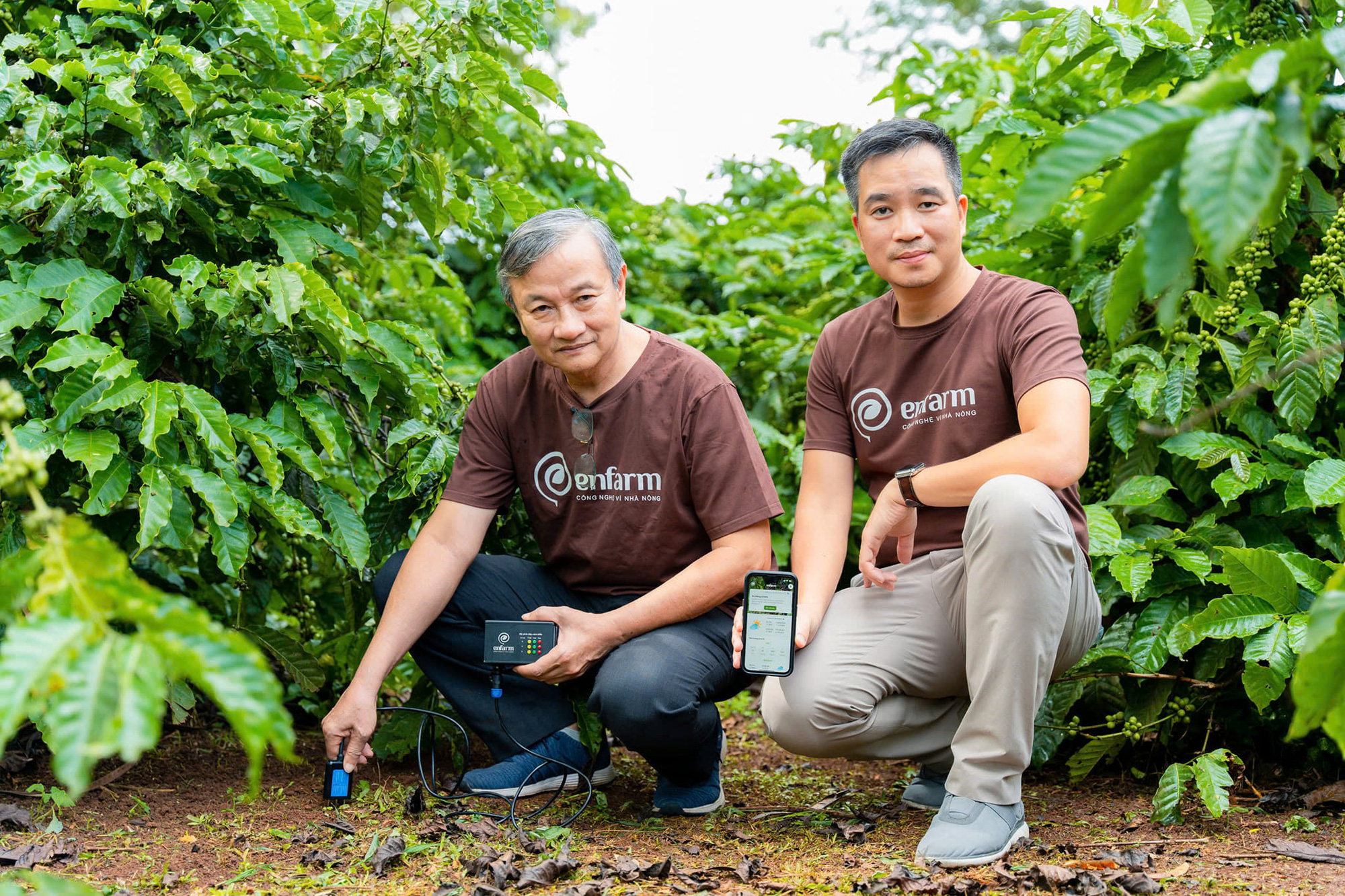
The foundation for this platform was formed through a collaboration between environmental science doctor Ho Long Phi (left) and urban planning expert Nguyen Do Dung - Photo: Provided by the interviewee.
Soil nutrition measurement and advisory technology is a product of enfarm Agricultural Technology Co., Ltd. This platform originated from a collaboration between urban planning expert Nguyen Do Dung and environmental science PhD Ho Long Phi.
Enfarm accompanies farmers 24/7.
Nguyen Do Dung, co-founder and CEO of enfarm, expressed his confidence and pride in the technology they possess. This technology helps farmers, who used to work in the fields, become agricultural experts with a thorough understanding of the soil.
They firmly believe that a smart fertilization process, a platform connecting farmers to the market, is also a crucial solution for increasing farmers' income. At the same time, it ensures the development of green and sustainable agriculture.
Dũng shared his concerns about land, fertilizers, green agriculture, and sustainable development in a conversation with Tuổi Trẻ Online .
Utilizing the Internet of Things (IoT) and artificial intelligence (AI), enfarm researches and develops smart fertilizer application technology solutions. Currently, enfarm produces two types of devices: handheld units and systems for farms larger than 10 hectares.
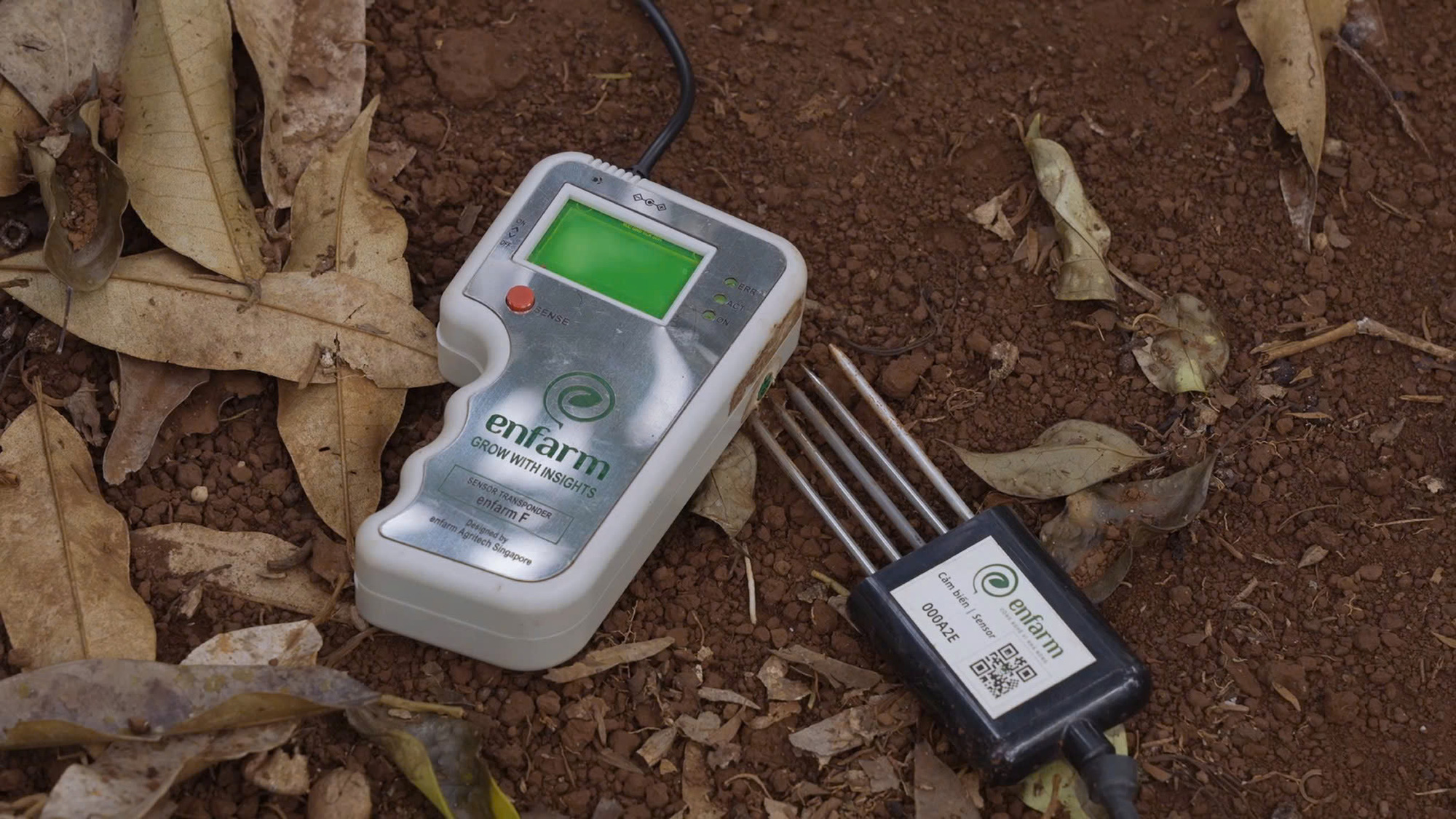
By applying the Internet of Things (IoT) and artificial intelligence (AI), enfarm focuses on researching and developing smart fertilizer application technology solutions.
The numbers speak for themselves.
- Fertilizers account for 35% of farmers' farming costs (According to USDS, Ministry of Agriculture and Rural Development , 2022).
- 60% of the fertilizer used is not absorbed by the plants (research by Xing Yu et al., 2022).
- Approximately $120 billion is wasted globally due to inefficient fertilization (calculated by Zion Market Research, 2022).
- 34% of global arable land is degraded primarily due to over-fertilization (research by Gebremedhin et al., 2022).
- 2.6 gigatons of greenhouse gases are emitted from fertilizers, accounting for 5% of total global greenhouse gas emissions (research by Gao and Serrenho, 2023).
The integrated sensor system collects information and is embedded deep in the ground. The device records and transmits data to the server system every 15 minutes.
AI is responsible for evaluating the criteria of four components: soil, water, crops, and fertilizer. Based on this, it provides specific solutions such as what fertilizer to use, how much, when to apply it, and how much water to use for irrigation… all via phone.
"We leverage machine learning technology and user data to convert signals from the sensors into NPK indicators. The accuracy is comparable to laboratory tests," said Dung.
But the soil in each region is different. Therefore, the nutrient content will also vary. Not to mention that the types of plants grown there are also different.
These are issues that enfarm has anticipated. For the device to be able to measure, calculate, and provide accurate diagnoses and recommendations, everything must be based on scientific principles and the vast database that enfarm has collected and built up over a long period.
Enfarm can verify the soil characteristics of each type of perennial industrial crop such as coffee, durian, and dragon fruit, which are widely grown in Vietnam.
As a Vietnamese technology produced by Vietnamese people, it is currently the only technology on the market that provides advice to farmers in Vietnamese. That's why many people liken enfarm to an "AI doctor accompanying farmers 24/7".
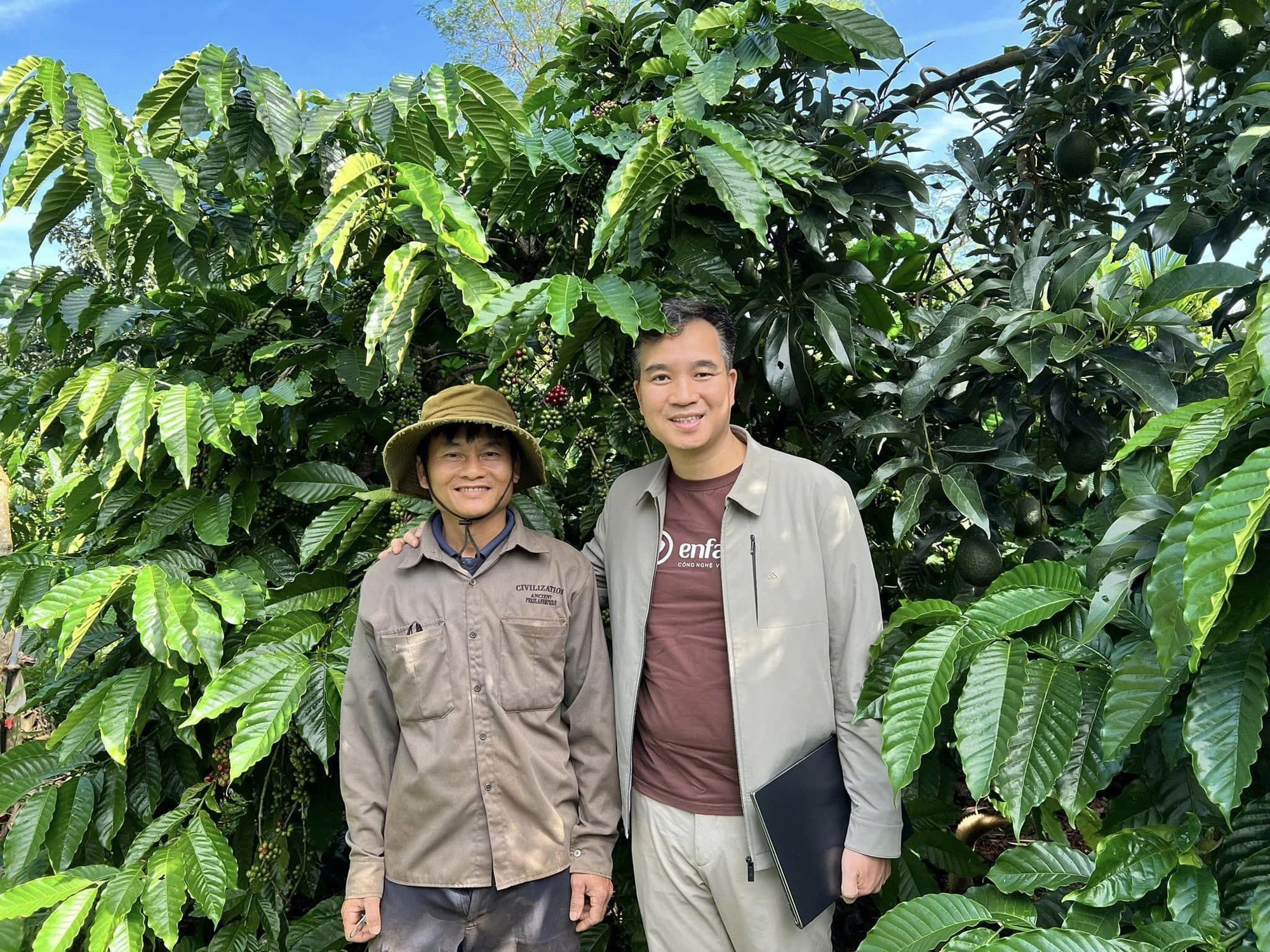
One very new and distinctive feature that has been successfully integrated into enfarm is the ability to provide essential advice to help farmers increase their income - Photo: Provided by the author.
Enhancing the economic value of agricultural products, even at low prices.
"One very new and different feature," Mr. Dung proudly stated, "is the successful integration into enfarm, which can provide essential advice to help farmers increase their income."
The data was collected by enfarm from two cooperatives and ten individual farmers across 1,000 hectares of coffee plantations in Dak Lak. The results showed a 20% increase in yield with the same or up to 50% less fertilizer use, along with AI-powered pest and disease diagnosis and market price forecasting.
"Increasing productivity by 20% with the same investment costs could bring gardeners a considerable amount of money. On the other hand, if the soil environment is improved, less polluted, and greener, the world will have a different view of Vietnamese agricultural products," Mr. Dung shared.
Enfarm also integrates many other functions such as weather forecasting, providing information on humidity, pH, irrigation levels and crop health, farm management, etc.
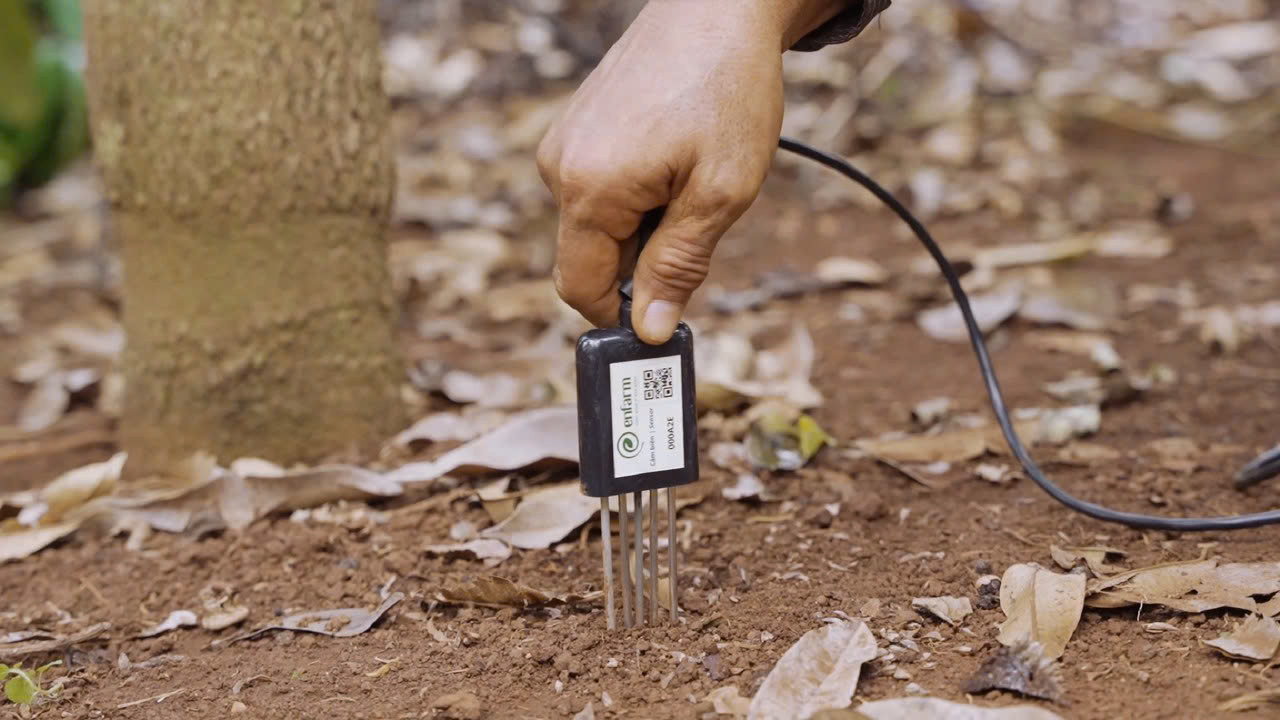
Seven soil indicators, including NPK fertilizer, moisture content, pH, electrical conductivity, and temperature, are measured by enfarm and reported to the owner's phone.
Furthermore, enfarm can identify pests and diseases using AI. Specifically, by simply taking a picture of a leaf or tree trunk, the application will tell you what pests or diseases the tree is experiencing and how to address them. This is one of the positive things created by technology developed by Vietnamese people.
In the future, farmers may use this tool to register for certifications related to green, clean, and organic agriculture.
Similar products with comparable functions are available from various countries at different price points: $1,500 (China), $3,000 (USA), and $9,000 (Malaysia).
Enfarm is currently renting out its equipment at a price of approximately 5.1 million VND/hectare per year. In return, users receive information on seven soil indicators, including three NPK fertilizer indicators, moisture content, pH level, electrical conductivity, and temperature.
Source: https://tuoitre.vn/enfarm-bat-benh-ke-toa-cho-dat-20241024164752926.htm
![[Photo] General Secretary To Lam receives President of the European Council Antonio Costa](/_next/image?url=https%3A%2F%2Fvphoto.vietnam.vn%2Fthumb%2F1200x675%2Fvietnam%2Fresource%2FIMAGE%2F2026%2F01%2F29%2F1769697816651_a1-bnd-5216-9741-jpg.webp&w=3840&q=75)


![OCOP during Tet season: [Part 3] Ultra-thin rice paper takes off.](/_next/image?url=https%3A%2F%2Fvphoto.vietnam.vn%2Fthumb%2F402x226%2Fvietnam%2Fresource%2FIMAGE%2F2026%2F01%2F28%2F1769562783429_004-194121_651-081010.jpeg&w=3840&q=75)


![OCOP during Tet season: [Part 2] Hoa Thanh incense village glows red.](/_next/image?url=https%3A%2F%2Fvphoto.vietnam.vn%2Fthumb%2F402x226%2Fvietnam%2Fresource%2FIMAGE%2F2026%2F01%2F27%2F1769480573807_505139049_683408031333867_2820052735775418136_n-180643_808-092229.jpeg&w=3840&q=75)
![OCOP during Tet season: [Part 1] Ba Den custard apples in their 'golden season'](/_next/image?url=https%3A%2F%2Fvphoto.vietnam.vn%2Fthumb%2F402x226%2Fvietnam%2Fresource%2FIMAGE%2F2026%2F01%2F26%2F1769417540049_03-174213_554-154843.jpeg&w=3840&q=75)





Comment (0)