

There are no more rush hours because there's always traffic congestion.
Having booked a ride-hailing service from her home in Phuoc Kien commune, Nha Be district (Ho Chi Minh City) at 9:00 AM on January 23rd, Ms. Duong Nghi expected to arrive at her office in District 3 by 9:30 AM, nearly 10 minutes ahead of the estimated travel time shown on the app. At this point, the driver was notified that they were almost there, only about 4 minutes from Ms. Nghi's house. However, after waiting until 9:10 AM, the driver still hadn't arrived, and tracking the vehicle on her phone showed it was barely moving.
Feeling anxious, Ms. Duong Nghi contacted the driver and was informed that the car was near the roundabout in front of the PV Gas Tower, only about 200 meters from the pickup point, but the road was too crowded and they had waited through four green lights without getting out of the roundabout. Around 9:20 AM, the driver finally appeared, just as hurried as the passenger, as he had another appointment to pick up a passenger in District 1 at 10 AM.
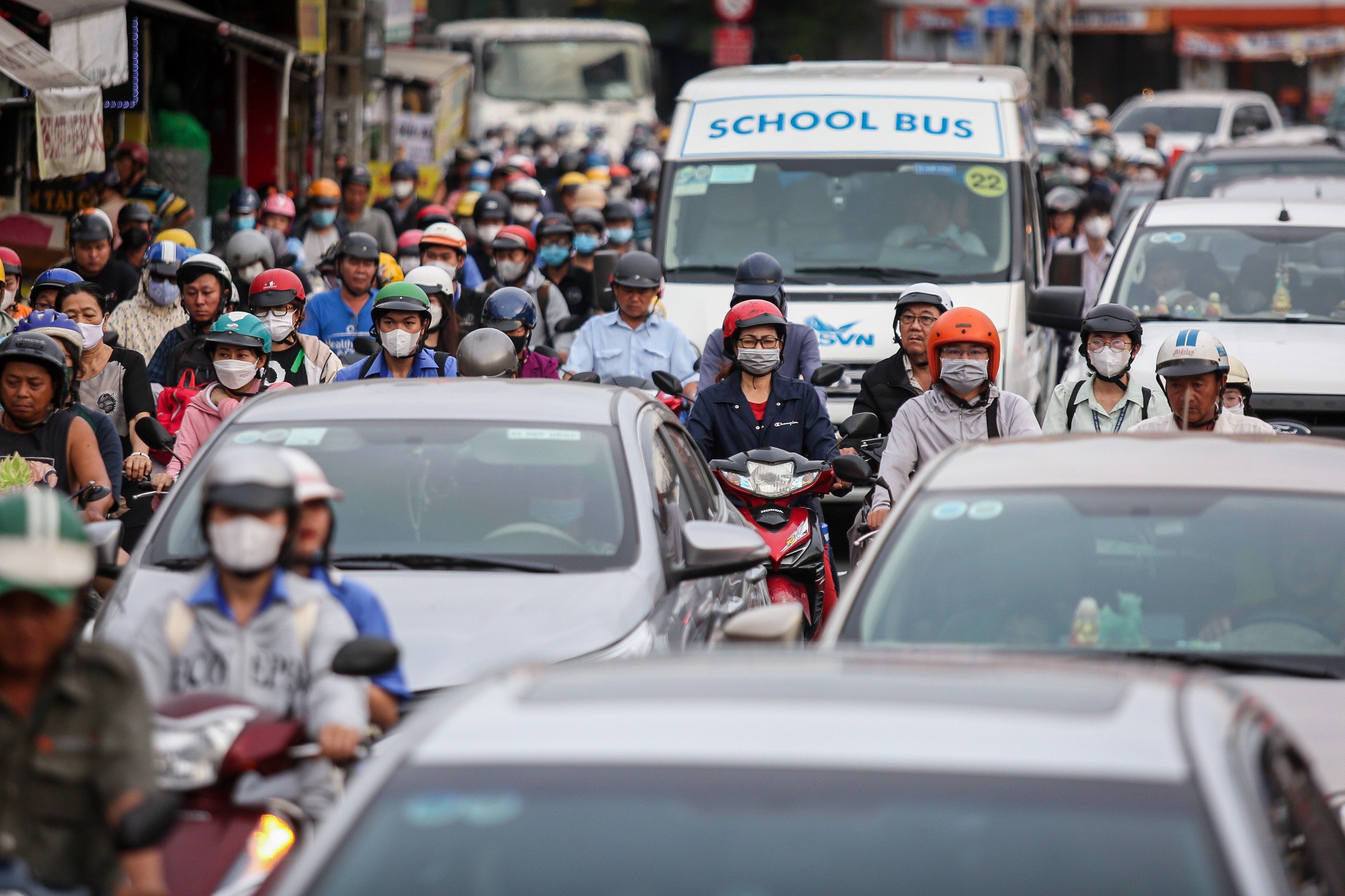
Traffic congestion at the intersection of Truong Chinh and Au Co streets (Tan Binh District, Ho Chi Minh City)
The traffic scene at the roundabout became chaotic. Tanker trucks, lorries, and cars occupied both lanes, stretching from the intersection with the East-West road (Phuoc Kien commune, Nha Be district) to Rach Dia 2 bridge. A 60-second green light wasn't enough for four cars to pass because they kept cutting each other off, with no one willing to yield. Normally, traffic police would be present in this area from early morning to regulate traffic, but recently they haven't been seen, exacerbating the chaos. Motorbikes squeezed into the gaps, even climbing onto the narrow 1-meter-wide sidewalks reserved for pedestrians on Rach Dia 2 bridge. Thousands of vehicles crawled along, inching forward, only to finally escape the nightmare of Rach Dia 2 bridge and join the "ordeal" of the Nguyen Van Linh - Nguyen Huu Tho roundabout.
Seeing the massive traffic jam ahead, the driver proactively "avoided" it by taking Le Van Luong Street, heading towards Nguyen Thi Thap Street, then merging onto Nguyen Huu Tho Street at Lotte Supermarket (District 7), but couldn't escape it either. The speedometer barely managed to reach 40 km/h for less than 5 minutes before encountering the "legendary" Kenh Te Bridge. One traffic jam followed another, and it was past 10:10 AM when Ms. Duong Nghi finally arrived at work, while the driver had to hastily inform the passenger that she would be 30 minutes late. "I deliberately tried to avoid rush hour, leaving at 9 AM, but I still couldn't escape it. It's the same when I go home from work; normally, the traffic doesn't start getting heavy until 5 PM, but lately, even if I leave early at 4 PM or wait until 8 PM, I still have to queue on the road. During Tet (Lunar New Year), everyone travels a lot, so every road is congested, every hour is jammed," Ms. Nghi said, shaking her head in frustration.
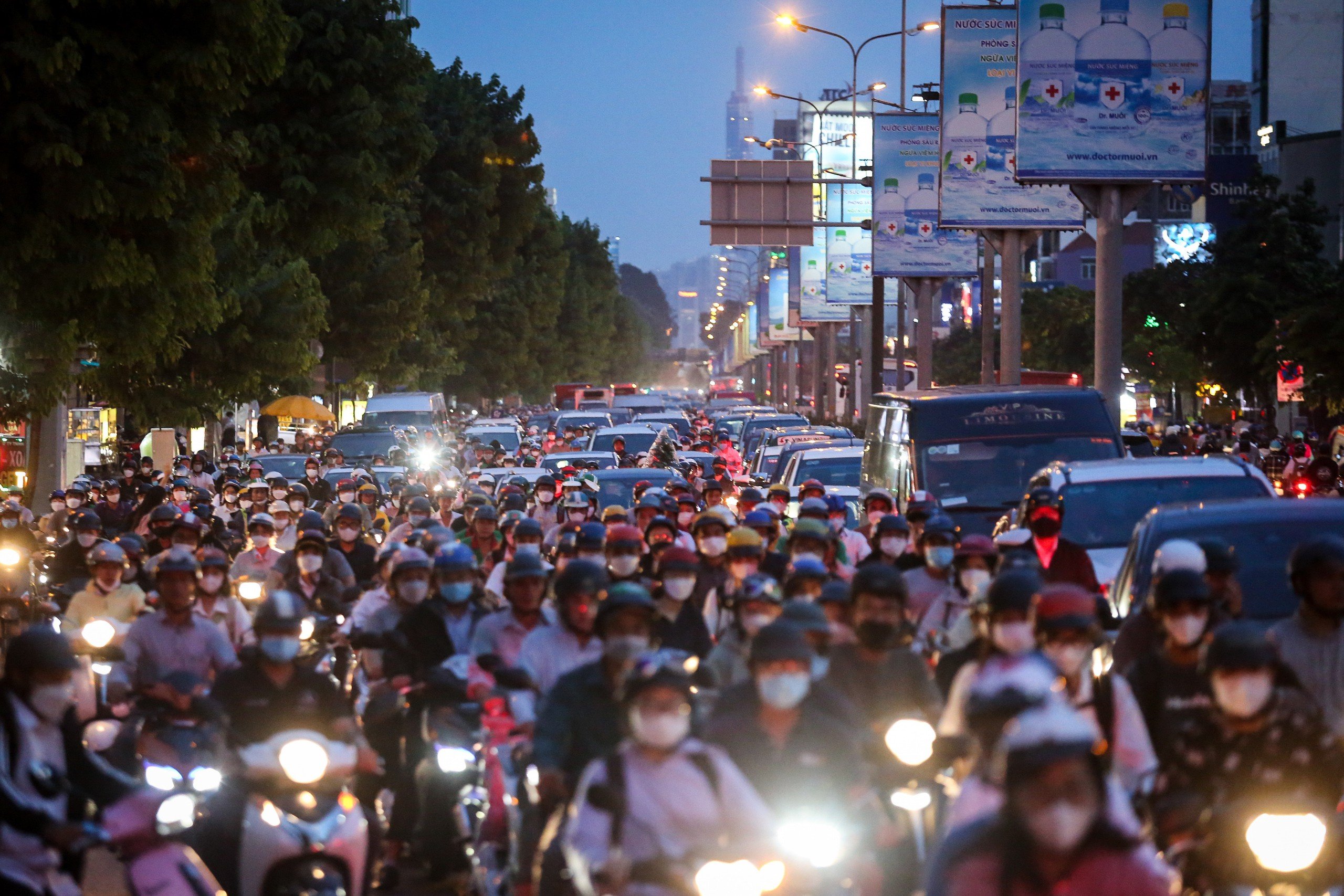
Traffic congestion in the Cong Hoa area (Tan Binh District).
Similarly, at just 7 a.m., the extended section of Nam Ky Khoi Nghia Street, connecting to Nguyen Van Troi Street, from the city center to the entrance of Tan Son Nhat Airport, was already packed with vehicles. Despite the relatively wide road, in both directions, cars had to encroach on the motorbike lanes, and motorbikes squeezed into every available space to get there on time. In the suburbs, roads like Truong Chinh, Cong Hoa, and the Hang Xanh intersection were already suffocating with dust and traffic jams under the scorching sun of early dry season Saigon. Not only the gateway areas, but also numerous central roads such as Ly Tu Trong, Le Thanh Ton, Hai Ba Trung, Nam Ky Khoi Nghia, Pasteur, Nguyen Thi Minh Khai (District 1)… extending to the area around Cach Mang Thang Tam Street (District 3)… were constantly marked in yellow and red on maps from morning to evening, warning drivers about heavy traffic and slow movement.
Due to the high volume of vehicles, even a minor incident lasting only a short time can cause severe traffic congestion in the entire area. For example, a crane used for the construction of bridge girders for metro line 1 (Ben Thanh - Suoi Tien line) broke down on the night of January 21st and early morning of January 22nd, causing the construction unit to delay restoring the road surface the following morning. This turned the entire Rach Chiec bridge into a "giant parking lot" during the morning rush hour on January 22nd. Although traffic police quickly arrived to regulate traffic from early morning, the line of vehicles stretching for kilometers took several hours to clear.
Minimize barricades and bunkers as much as possible.
Speaking to Thanh Nien newspaper , an official from the Ho Chi Minh City Department of Transport said that as of December 2023, Ho Chi Minh City managed nearly 9.2 million vehicles, an increase of 4.69% compared to the same period in 2022. Of these, nearly 934,500 were cars and nearly 8.3 million were motorcycles. With the current rate of vehicle growth, the transportation infrastructure is overloaded and exceeding its capacity. Especially now, with only a few days left until the Lunar New Year, those staying in the city for the holiday need to shop for supplies, and those returning to their hometowns also need to buy gifts and other necessities.
Therefore, traffic congestion frequently occurs on routes leading to shopping malls, supermarkets, and large retail stores. In addition, government agencies, companies, and businesses are simultaneously holding year-end parties and gatherings, resulting in more people on the streets during lunchtime and early evening. At the city's gateways, the transportation of goods and business activities in preparation for Tet (Lunar New Year) also increase. Furthermore, during this period, the city is implementing large-scale, key construction projects in several gateway areas, occupying significant land areas, which also somewhat affects people's movement.
To minimize traffic congestion, the Ho Chi Minh City Department of Transport has proactively coordinated with traffic police and civil defense forces to strengthen checkpoints at intersections and frequently congested routes to help manage traffic flow for the public. Simultaneously, it has published a list of routes and road sections under its management where road construction and excavation will be restricted in 2024. In parallel, the Department has also requested that investors and project management boards needing to carry out construction during the Lunar New Year holiday promptly provide the Road Infrastructure Management Center and the Urban Traffic Management Center with plans and methods for organizing construction for projects that will maintain barricades during the holiday.
For construction projects with barriers occupying the road surface, the investor and project management board are required to clean the construction site daily, ensuring no garbage, dust, or debris remains on the road; repair or replace old, faded, torn, or damaged fences, construction information signs, and traffic signs; and asphalt and paint the road to ensure the safety of pedestrians and maintain traffic flow at locations where construction sites have been received from the road management authority.
Before February 2nd (the 23rd day of the 12th lunar month), project investors must reduce construction site fences to the permitted size; repair or replace fences, ensuring environmental hygiene and urban aesthetics. They are not allowed to erect fences solely for the purpose of stockpiling materials, in accordance with regulations, and must not affect the movement and daily lives of residents during the Tet holiday. For locations where fences are removed before February 2nd, the construction site must be thoroughly cleaned, and all sections of road under construction must be restored to ensure safety, smoothness, and aesthetics.
Ho Chi Minh City Department of Transport
Source link


![[Photo] General Secretary To Lam receives the Special Envoy of General Secretary and President of China Xi Jinping](/_next/image?url=https%3A%2F%2Fvphoto.vietnam.vn%2Fthumb%2F1200x675%2Fvietnam%2Fresource%2FIMAGE%2F2026%2F01%2F30%2F1769759383835_a1-bnd-5347-7855-jpg.webp&w=3840&q=75)


![OCOP during Tet season: [Part 3] Ultra-thin rice paper takes off.](/_next/image?url=https%3A%2F%2Fvphoto.vietnam.vn%2Fthumb%2F402x226%2Fvietnam%2Fresource%2FIMAGE%2F2026%2F01%2F28%2F1769562783429_004-194121_651-081010.jpeg&w=3840&q=75)

![OCOP during Tet season: [Part 2] Hoa Thanh incense village glows red.](/_next/image?url=https%3A%2F%2Fvphoto.vietnam.vn%2Fthumb%2F402x226%2Fvietnam%2Fresource%2FIMAGE%2F2026%2F01%2F27%2F1769480573807_505139049_683408031333867_2820052735775418136_n-180643_808-092229.jpeg&w=3840&q=75)



Comment (0)