

The goals for high school education stated in the 2018 General Education Program are career-oriented, but many students choose subjects and graduation exam subjects based on the criteria of being "easy to take and easy to pass".
UNDERSTANDING THE REASONS WHY STUDENTS CHOOSE SOCIAL SCIENCES AS AN EXAM SUBJECT IS INCREASING.
Fundamental and comprehensive reform of education and training defines the goal for general education as: "Ensuring that students at the lower secondary level have a foundation of general knowledge, meeting the requirements for strong streaming after lower secondary education; upper secondary education must provide access to vocational training and prepare students for quality post-secondary education."
High school is a career-oriented level where students choose subjects and take exams that align with their career goals. However, for various reasons, students sometimes choose subjects and exams that don't match their career aspirations, creating a trend that may be contrary to the needs of the workforce. Over the past eight years (2017-2024), the number of students choosing social science subjects has steadily increased. In 2024, the highest percentage of students chose social science subjects at 63%, while only 37% chose natural science subjects. Meanwhile, the demand for human resources in science, technology, and engineering is steadily rising.
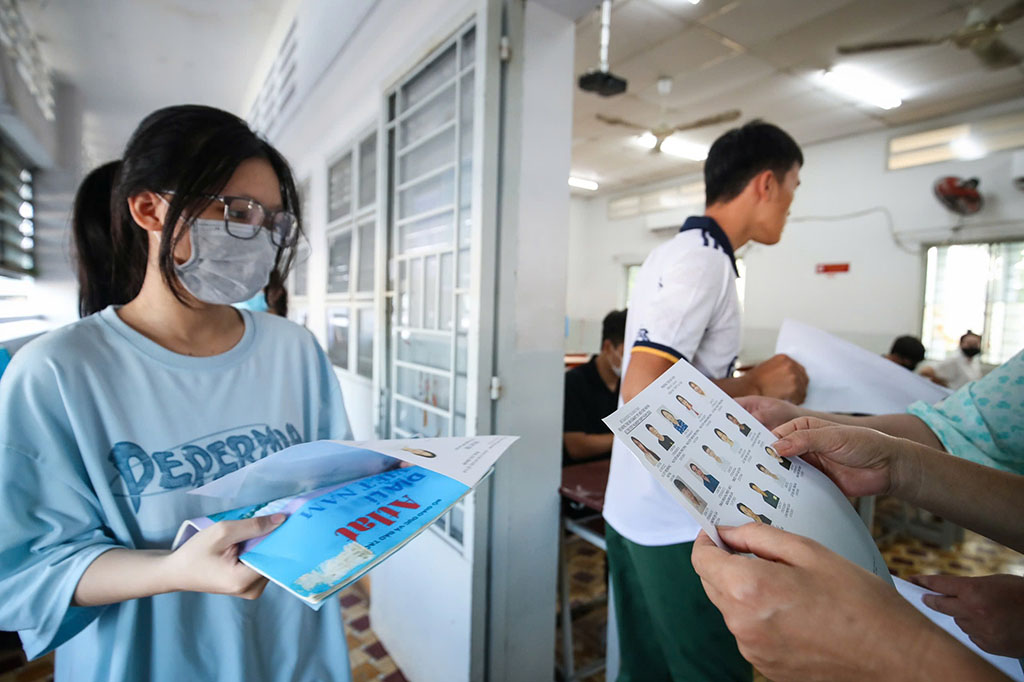
Candidates are registering to take the social science subject combination in the 2024 high school graduation exam. In recent years, the number of candidates choosing this subject combination has been increasing.
First of all, this is because social science subjects are easier to learn and easier to score high marks in exams. The average annual exam score for history, geography, and civics is always higher than the average exam score for physics, chemistry, and biology.
Next, according to some high school principals in mountainous districts, due to the low quality of incoming students, the schools have to guide students to choose social sciences to study and prepare for exams right from grade 10. Only a very small number of students who excel in natural sciences choose the natural science combination.
The average high school graduation rate nationwide is high (approximately 99%), creating pressure on schools in disadvantaged areas. Some schools achieve a rate of 80-90%, but are still considered low compared to the general standard, forcing them to organize teaching and learning activities aimed at increasing the graduation rate.
According to the 2018 General Education Program, at the high school level, compulsory subjects lean towards social sciences and humanities. Specifically, there are 8 compulsory subjects and educational activities, including: mathematics, literature, foreign language, history, physical education, national defense and security education, experiential activities, career guidance, and local education. Of these, only mathematics belongs to the natural sciences, while the other subjects and educational activities belong to the social sciences and humanities.
With the curriculum designed to lean towards social sciences and humanities, it's understandable that students choose social science subjects to study and take exams in. In fact, according to the Association of Universities and Colleges, over the past three years, in some provinces, the number of students choosing subjects like physics, chemistry, and biology only accounts for 11-15%.
The number of majors related to social sciences has increased in recent years, including fields such as: journalism, law, education, culture, tourism, police, military, psychology, etc. Even some technical schools now offer programs that include history, geography, economics , and law. This is also why the number of students choosing to study and take exams in social sciences has increased.
However, in some localities with developed socio-economic conditions, the increasing demand for human resources in science, technology, and economics may lead to a higher number of students choosing natural science subjects for their studies and exams. Ho Chi Minh City is a prime example. In 2024, the percentage of students in Ho Chi Minh City choosing the natural science subject combination was nearly 61%, the highest in the country.
C. BALANCE EXAM SUBJECTS TO MEET HUMAN RESOURCE NEEDS
In reality, the labor needs of society are very diverse. The socio-economic development orientation of our country in this era of progress demands an increasing number of human resources in science, technology, economics, and services, in addition to social sciences and humanities.
However, the structure of differentiating students into two groups, natural sciences-engineering and social sciences-humanities, is too broad and needs to be divided into more groups. For example, the group of subjects including mathematics, physics, chemistry, biology, computer science, and technology should be divided into smaller groups such as: mathematics-physics-chemistry, physics-chemistry-biology, mathematics-computer science-physics, mathematics-physics-technology, etc.
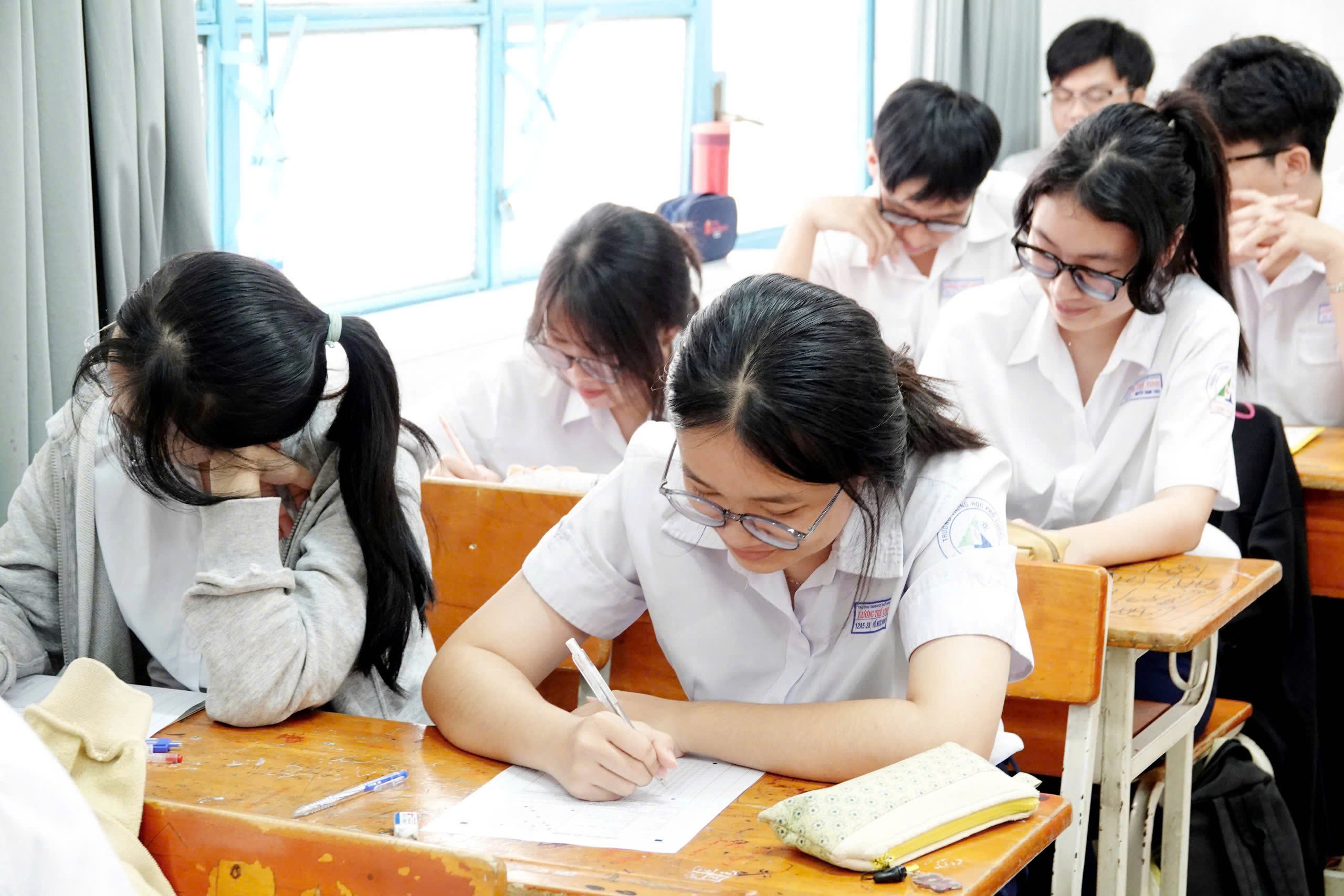
High school seniors will enter the 2025 high school graduation exam with many changes.
photo; jade digging
To overcome the aforementioned limitations, the general education curriculum needs to be restructured to better align with career guidance objectives.
At the high school level, students should be divided into three main streams: the first stream focuses on general education and takes the high school graduation exam; the second stream focuses on specific vocational fields such as healthcare, engineering, arts, business administration, social sciences, foreign languages, agriculture, etc., pursued at vocational or technical high schools (students in vocational and technical high schools study both high school subjects and vocational skills, graduating with a "vocational high school" diploma equivalent to a high school diploma, and can then continue their education at college and university); the third stream focuses on direct labor, but requires basic vocational training. The vocational/technical high school model has been successfully implemented in many countries with the direct participation of businesses, helping students learn theory while accumulating practical experience.
There is a need to train a professional team of career guidance counselors. Teacher training universities, in addition to training professional career guidance teachers, should also teach experiential career guidance courses to all teacher training students, including primary school teachers. The career guidance counseling team could come from public or private schools, or other professional social organizations, with the participation of businesses. Early career guidance experiences at businesses and universities/colleges for junior high school students will help them access career opportunities and start learning and working sooner.
The transfer of vocational education to the Ministry of Education and Training is an advantage and an opportunity to arrange and channel students at all levels of education in a scientific, rational manner and in accordance with human resource needs.
Source: https://thanhnien.vn/thi-tot-nghiep-thpt-dung-de-thi-sinh-chon-mon-vi-de-thi-de-do-185250113183014608.htm




Comment (0)