

On the almost deserted river, not a single boat was in sight: occasionally, along the shore, one could see a fishing boat, a small sampan nestled under the trees, or a small boat where the oar was taking a nap in a hut while waiting for the tide.
After the turbulence of the sea voyage, the roar of the ocean, the solitude under this bright sky, this stillness and immobility of everything brings a strange feeling.
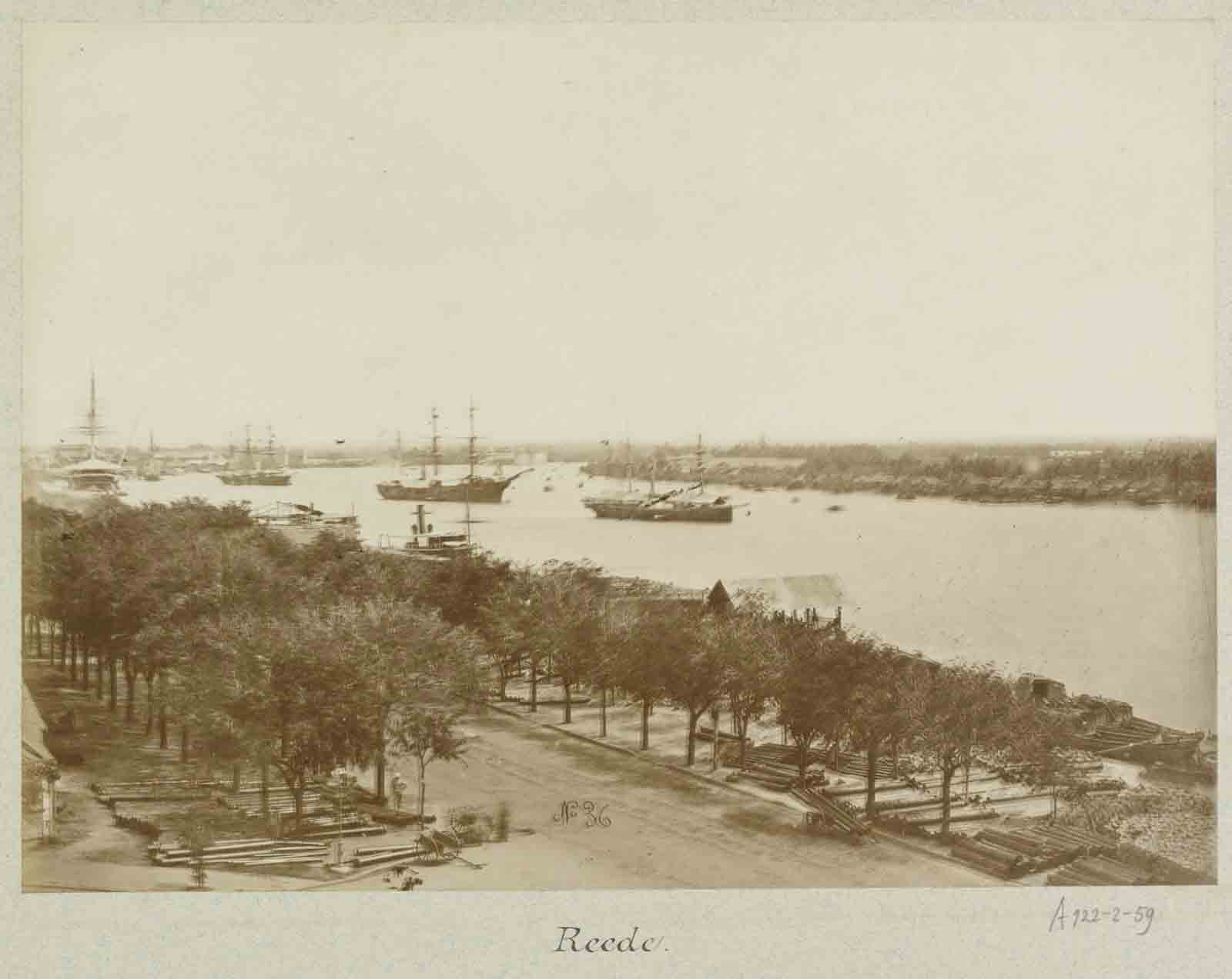
Boats on the Saigon River
Those who enjoy traveling consider Saigon to be just an uninteresting stop on the Far East route, somewhat like 36 hours sitting in a combustion chamber.
Surely no one, not even the most unconventional thinkers, would praise the climate of this region and present Saigon as an ideal winter retreat.
In fact, the city is quite spacious. It is certainly one of the most beautiful cities in the intertropical part of Asia and perhaps the most charming. There are other cities that are larger and more bustling, but none are as charming and magnificent as Saigon. In this respect, despite being newly established, Saigon is in no way inferior to its older rivals in the British East Indies or the Dutch East Indies [now Indonesia].
In short, Saigon is the achievement that France is most proud of. While I don't mean to disparage our other colonial cities, I would like to add that, in my opinion, no city in our overseas colonies can compare to [Saigon], except, of course, for Algeria and Tunisia!
That was my impression of Saigon when I first came here in 1885, and it's the same on this return trip, seeing the city renovated, with new avenues opened, more spacious than ever, and full of optimism despite the current troubles, the devaluation of the Indochinese silver, and the difficulties in trade.
Even the unsightly surroundings and the slow, tedious sea voyage were just fitting preparations for the unexpected joy upon arrival.
For over three hours, we have been following the winding curves of the river, which has no banks, amidst the half-submerged, half-exposed islets formed by a labyrinth of canals. The river widens like a large lake and then narrows into meandering streams.
At times, the bends were so close together, so sharp, that the stern of the boat nearly struck a tree branch while the bow skidded past the opposite bank. At one of these bends, the rudder chain snapped, and the speed caused the boat to run aground in the forest. However, it was not dangerous; the boat only hit the bushes like a knife piercing a block of butter. After an hour's rest, the chain was reconnected, the boat reversed, and we continued on our way.
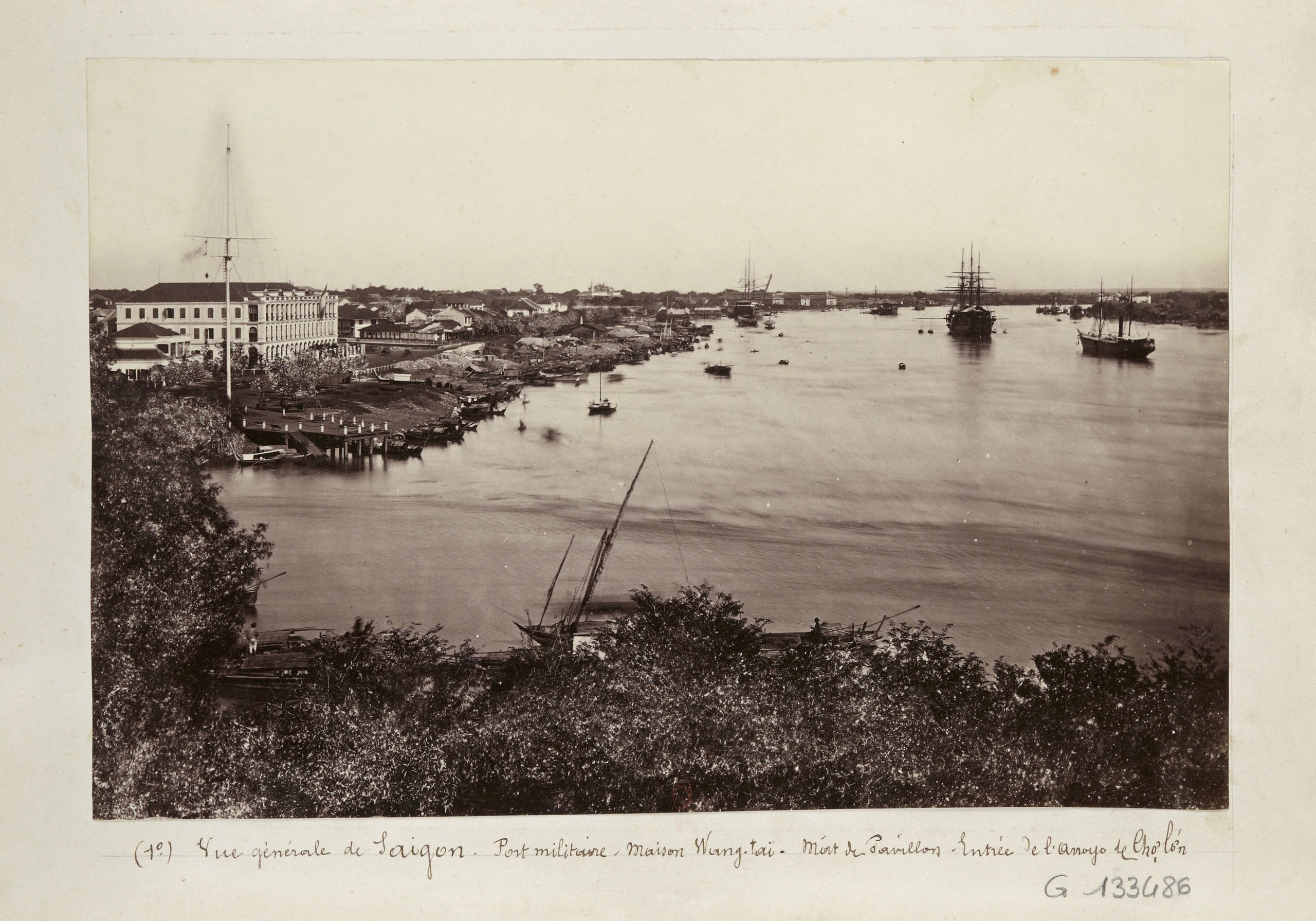
Saigon River
More than ever, we couldn't believe we were near a city; nature was incredibly wild, with no sign of human presence. The sun was setting.
This land has no sunset; night will fall in just half an hour. We had now reached the confluence of the Saigon and Dong Nai rivers. We had just left the majestic river originating from the Central Highlands, and the scenery on the starboard side of the ship suddenly changed.
The curtain of shrubs that once covered the banks is torn apart, revealing undulating fields of cultivated land and rice paddies, a vibrant green stretching to the horizon, where fertile land replaces the mangrove forests. In the twilight, the countryside seems truly peaceful. Scattered bushes—marking the location of a village or a solitary thatched hut—become indistinguishable dark patches from the foliage. At dusk, this small corner of Asia evokes memories of distant Europe, of a late June afternoon in fields of ripening wheat.
To the left, numerous large buildings appeared: sheds, warehouses, the tall chimneys of rice mills; further in the distance was the old forest, against which the masts, signs, and bell towers of the new cathedral [Notre Dame Cathedral] soared into the sky. After the last bend was the harbor: warships anchored in the river, their white hulls gleaming in the moonlight, like large seabirds resting. The dark silhouettes of three or four steam-powered merchant ships, then a fleet of Chinese ships, sleds, barges, and boats, bustled in and out of the Cholon canal. Finally, small Annamese sampans, with storm lamps hanging from the bow and fireplaces at the stern, moved back and forth like a beehive, flickering like fireflies. (to be continued)
(Excerpt from *Around Asia: Southern, Central, and Northern Vietnam *, translated by Hoang Thi Hang and Bui Thi He, published by AlphaBooks - National Archives Center I and Dan Tri Publishing House in July 2024)
Source: https://thanhnien.vn/du-ky-viet-nam-sai-gon-do-thi-duyen-dang-nhat-185241202235211284.htm


![[Photo] General Secretary To Lam receives the Special Envoy of General Secretary and President of China Xi Jinping](/_next/image?url=https%3A%2F%2Fvphoto.vietnam.vn%2Fthumb%2F1200x675%2Fvietnam%2Fresource%2FIMAGE%2F2026%2F01%2F30%2F1769759383835_a1-bnd-5347-7855-jpg.webp&w=3840&q=75)


![OCOP during Tet season: [Part 3] Ultra-thin rice paper takes off.](/_next/image?url=https%3A%2F%2Fvphoto.vietnam.vn%2Fthumb%2F402x226%2Fvietnam%2Fresource%2FIMAGE%2F2026%2F01%2F28%2F1769562783429_004-194121_651-081010.jpeg&w=3840&q=75)

![OCOP during Tet season: [Part 2] Hoa Thanh incense village glows red.](/_next/image?url=https%3A%2F%2Fvphoto.vietnam.vn%2Fthumb%2F402x226%2Fvietnam%2Fresource%2FIMAGE%2F2026%2F01%2F27%2F1769480573807_505139049_683408031333867_2820052735775418136_n-180643_808-092229.jpeg&w=3840&q=75)




Comment (0)