

Beautiful Dresden is situated on both banks of the Elbe River. |
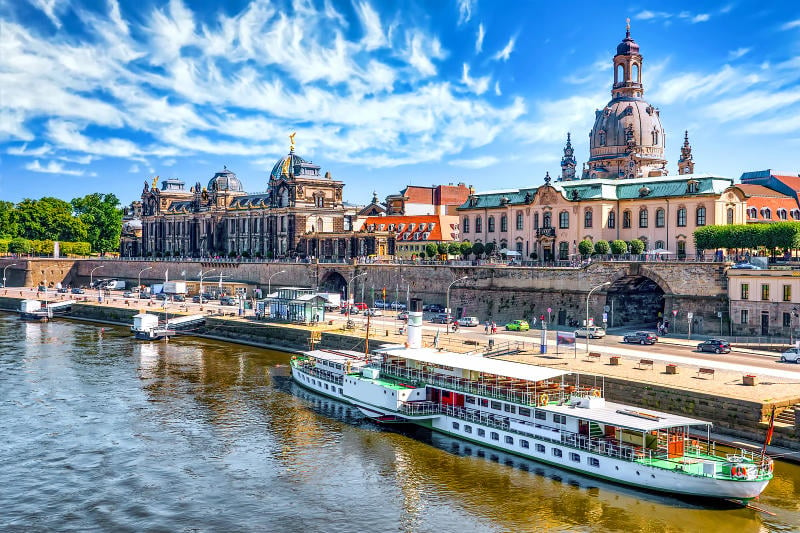
Florence on the Elbe River
Dresden is the capital of the state of Saxony in Germany, situated on both banks of the Elbe River, primarily within the Dresdner Elbtal Weitung valley, between the southern end of the Ost Erzgebirge mountain range on one side and the steep Lausitz granite ridge and the Elbsandsteingebirge sandstone range on the other.
Known as the Florence on the Elbe, Dresden is famous for its picturesque natural scenery. The Elbe River divides the city into two parts: the ancient Altstadt with its stunning Baroque architecture and the vibrant, youthful Neustadt. Altstadt is notable for the Semperoper Theatre, the Zwinger district, and numerous museums and churches. Neustadt attracts visitors with the statue of King August der Starke, the Japanisches Palais, and the Yenidze. Both areas offer unique cultural and historical experiences.
Dresden is one of the greenest cities in Europe. The city has many nature reserves, especially the 20km-long Dresden Valley, which is recognized by UNESCO as a World Heritage Site.
The Dresden suburbs are equally fascinating, with their famous vineyards and wine production. Visitors can use transportation options such as long-distance buses or trains to enjoy the scenery along the way, experience firsthand the process by visiting vineyards and wineries, participating in winemaking, and tasting wine for free. Visitors can also purchase a few bottles as gifts for family and friends at a relatively low price.
Furthermore, thanks to its location in a temperate climate zone and the influence of a continental climate, Dresden consistently enjoys warm temperatures. All of this makes Dresden one of the most worthwhile cities to visit in Germany.
Impressive architectural structures
Dresden, with a history dating back to the 12th century, was a major cultural, educational, and industrial center of Eastern Europe. Following the reunification of Germany in 1990, Dresden underwent a period of significant renewal and development. Today, Dresden is an important cultural and economic hub in Germany and Europe, boasting numerous popular tourist attractions such as the Frauenkirche Church, the Zwinger Palace, and the Dresden National Museum.
The Frauenkirche (Church of Our Lady of the Frauenkirche) is one of the most famous architectural landmarks in Dresden, Germany. Built in the 19th century, the church features Baroque architecture. It has weathered many historical events, from destruction during World War II to its reconstruction in the 1990s.
The highlight of the church is the Glockenspiel clock, located on the tower, which can play music and display moving scenes. Frauenkirche Church is one of the most popular tourist destinations in Dresden, with many people coming here to visit and admire the beauty of this architectural masterpiece.
The Zwinger Palace is a Baroque-style palace located in the city of Dresden. It was built in the 18th century by Augustus the Strong, Elector of Saxony and King of Poland, as a venue for court parties and to display his power and wealth.
The palace is renowned for its impressive architecture and lavish ornamentation, including murals, oil paintings, and sculptures by some of the most famous artists of the era, such as Johann Joachim Kaendler, Johann Friedrich Böttger, and Johann Christoph Gärtner. The palace also houses numerous museums and art galleries, including the Dresden porcelain collection, the Museum of Ancient Paintings, and the Royal Collection of Mathematical and Physical Instruments.
Today, the Zwinger Palace is one of the most popular tourist attractions in Dresden, and is considered one of the best examples of Baroque architecture in Europe.
Dresdner Residenzschloss Palace is a historic palace located in the heart of Dresden. Built between the 16th and 18th centuries, it has undergone numerous renovations and reconstructions. It once served as the residence of the kings of Saxony and now houses several museums and art galleries.
The palace boasts diverse architecture, combining styles from Gothic to Baroque and Rococo. The rooms within the palace are decorated with sculptures, statues, and paintings by renowned artists such as Rafael, Rembrandt, and Vermeer.
The Semperoper is the largest opera house in Dresden, with exquisitely gilded interior decorations. This opera house has been rebuilt three times; the first two buildings were destroyed by fire and the second by World War II. The architect who designed it was Gottfried Semper F. “Semperoper”.
The museums and galleries within the palace include the Dresden History Museum, the Museum of Greek and Roman Art, the Dresden Porcelain Museum, and the Dresden Museum of Ancient Paintings. These collections embody the historical and cultural events of the city of Dresden and the Saxony region.
NGUYEN THAO
Source: https://baobariavungtau.com.vn/du-lich/202503/dresden-hon-ngoc-quy-cua-nuoc-duc-1038195/


![OCOP during Tet season: [Part 3] Ultra-thin rice paper takes off.](/_next/image?url=https%3A%2F%2Fvphoto.vietnam.vn%2Fthumb%2F402x226%2Fvietnam%2Fresource%2FIMAGE%2F2026%2F01%2F28%2F1769562783429_004-194121_651-081010.jpeg&w=3840&q=75)


Comment (0)