

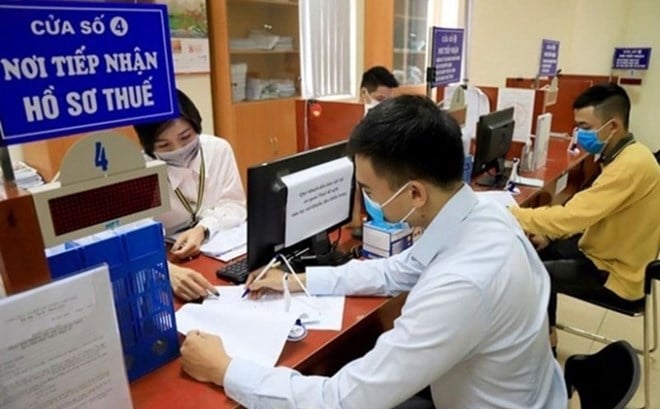
State budget revenue showed good growth.
Over the past period, fiscal policy has contributed to achieving socio-economic development goals, yielding many positive results. Production and business activities have recovered, economic growth has remained positive, inflation has been kept under control, and macroeconomic stability has been ensured.
In addition to effectively implementing tax and fee exemption and reduction policies to support businesses and citizens, the Ministry of Finance has strengthened the implementation of innovative solutions for revenue collection, especially increasing revenue in areas that previously had no revenue.
Since 2021, total annual state budget revenue has reached over 1,563 trillion VND, exceeding the projected figure by 219.9 trillion VND.
In 2022, cumulative state budget revenue reached nearly 1,785 trillion VND, equivalent to 126.4% of the projected figure and an increase of 13.8% compared to the previous year.
In 2023, amidst numerous difficulties and challenges facing the Vietnamese economy, with slower economic growth compared to 2022, a series of tax and fee reduction policies were promptly issued and effectively implemented to support businesses and the people. As a result, state budget revenue in 2023 decreased slightly compared to 2022, but still exceeded the projected target by approximately 8.12%. As of December 31, 2023, estimated revenue reached over 1,752 trillion VND.
In the first six months of 2024, policies supporting the economy continued to be maintained. State budget revenue reached approximately 1,038 trillion VND, equivalent to 61% of the projected amount.
Increase budget revenue from previously uncollected revenue sources.
To harmonize all factors, increase budget revenue without affecting the health of businesses, the Ministry of Finance has implemented many innovative solutions, focusing on finding ways to collect potential revenue, modernizing revenue management, especially collecting revenue from previously uncollectible sources such as cross-border e-commerce platforms, taxes on real estate transfers, and e-commerce businesses.
The explosive growth of the digital economy with cross-border services has posed many challenges for tax administration, as controlling business transactions in the era of Industry 4.0 and determining the basis for tax calculation is no longer as easy as with traditional business transactions.
Since March 2022, the Ministry of Finance has officially launched the Electronic Portal for Foreign Suppliers (NFSCs) to modernize tax management, creating convenience, equality, and transparency in tax registration, tax declaration, and tax payment in line with international tax management trends.
The online portal serves as the address for foreign entities to register, declare, and pay taxes, as well as to search for information and learn about Vietnam's tax policy and legal system. With this new tax collection method, Vietnam has become one of the first four countries in the ASEAN region to assert its national sovereignty in taxing foreign organizations and individuals engaged in cross-border e-commerce business in the country.
In the first six months of 2024, an additional 26 foreign-owned enterprises (NGOs) registered, declared, and paid taxes in Vietnam through the Electronic Information Portal for NGOs.
To date, a total of 101 foreign taxpayers have registered, declared, and paid taxes through the Electronic Information Portal, coming from many countries such as the US; the Netherlands; South Korea; Singapore; Hong Kong (China); Ireland; Switzerland; Australia; the UK; Switzerland...
In particular, the goal of increasing tax revenue from online businesses is a priority for Minister of Finance Ho Duc Phoc.
Accordingly, the Ministry of Finance has connected the tax authority's database to the Ministry of Public Security's population database and coordinated with the State Bank of Vietnam to control payments on e-commerce platforms; and requested the State Bank of Vietnam to strengthen cashless payments. These solutions are expected to help increase tax revenue from the online business sector, as nearly 50,000 billion VND has been collected from this sector in just the past two quarters.
Furthermore, with the rapid implementation of electronic invoicing for each sale at 100% of gas stations nationwide, experts believe that this year's budget revenue will be positive. The data will be directly linked to the tax authority's data.
Reportedly, the Ministry of Finance has developed software to control electronic invoices and online electronic invoices to combat fraud in value-added tax refunds. Notably, there is a solution involving a lottery system for invoices based on lucky invoice numbers to encourage people to obtain invoices; those who win will receive a reward.
Source: https://laodong.vn/kinh-doanh/dot-pha-nguon-thu-tao-dong-luc-thuc-hien-chinh-sach-ho-tro-1383031.ldo



































































































Comment (0)