In the Democratic Republic of Congo, the Ruki River contains so many dissolved organic compounds that it is darker than the Rio Negro, which flows through the Amazon rainforest.
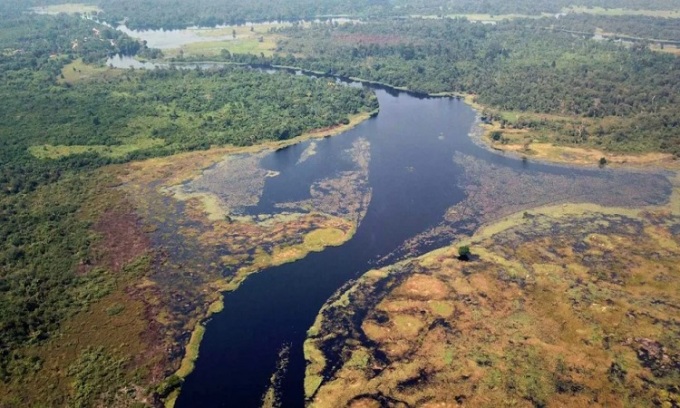
The Ruki River as seen from above. Photo: Matti Barthel / ETH Zurich
The Ruki River is half a kilometer wide at its mouth and has a much larger average flow than the Rhine, yet very few people outside of Africa have ever heard of it. To those living along its banks, its color seems quite normal, but researchers from ETH Zurich were astonished to see the river's color and set out to discover the reason behind its dark hue.



"We were quite surprised by the color of the river water," shared Dr. Travis Drake. Many rivers are dark enough to be called "black water." One of the largest tributaries of the Amazon, the world's fifth-largest river by flow, is called the Rio Negro (Black River) because of the organic matter that darkens its water. However, the Ruki River still stands out among them.
Like many other blackwater rivers, Ruki's color comes from dissolved organic matter (DOC) in the water. Its lack of sediment also contributes to this. While the soil darkens the clear spring water flowing from the mountains, it rarely becomes as pitch black as the material in tropical rainforests, which gives Ruki its characteristic color. Ruki flows over a nearly flat surface, so it doesn't accumulate much sediment. The research findings on the river were published in the journal Limnology and Oceanography, IFL Science reported on October 19th.
On the other hand, heavy rains in the region wash away DOC from vegetation on the forest floor. During the rainy season, the flat surface causes large areas to be flooded for weeks at a time, leading to the leakage of even more compounds. Realizing there was no scientific explanation for why the Ruki River was darker than other rivers flowing through the rainforest, Drake and his colleagues decided to find the answer. They set up a monitoring station to investigate the river's chemical composition before it flows into the Congo River. The research team used on-site measurements because there was no electricity supply in the area.
Researchers can measure the density and age of DOC in water to determine if it originated from peat bogs along the riverbanks. These bogs retain vast amounts of undissolved plant matter. Currently, this process turns the area into a carbon sink. But if the carbon in the bogs were to escape and be released into the atmosphere, it would become a major contributor to global warming. The research team's carbon dating results indicate this is highly unlikely.



Drake and colleagues found that the Ruki River has four times the amount of DOC per liter compared to the Congo River and 1.5 times the amount compared to the Rio Negro. Although the river is rich in organic acids that can dissolve carbonates and release carbon dioxide, this doesn't happen to alarming levels. The river is very calm, and when the water becomes saturated with carbon dioxide (CO2), the gas cannot escape easily, preventing the formation of more CO2.
An Khang (According to IFL Science )
Source link