

The Dong Nai River originates from the Lang Biang mountain range, overcoming numerous rapids and waterfalls, flowing through vast, lush green forests before emptying into the Ta Lai plain. From its final waterfall, Tri An, it joins the La Nga River from Binh Thuan and the Song Be River from Binh Phuoc before passing through Binh Duong, Dong Nai, Ho Chi Minh City, and Ba Ria - Vung Tau, finally merging into the sea. For over 500 kilometers, day and night, the river tirelessly deposits alluvial soil, nourishing its banks with fragrant trees and sweet fruits.
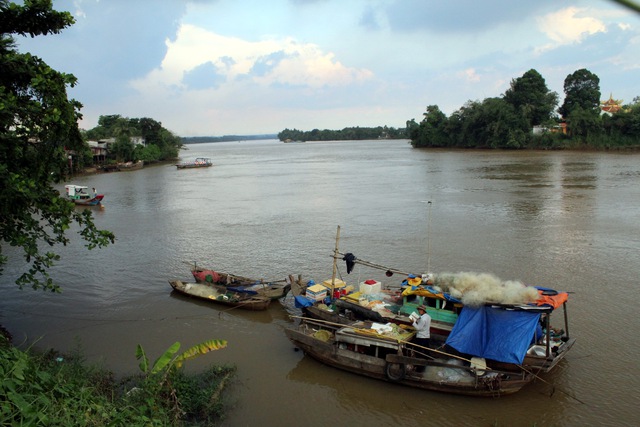
For the people living on both banks of the Dong Nai River, the river is not just a memory of childhood docks, the sound of oars splashing as people cast their nets, or the ferry returning home in the evening...
For thousands of years, the Dong Nai River has been a lifeline, witnessing countless historical changes from the indigenous Ma, S'tieng, and K'ho people to the first Vietnamese migrants who came to explore and establish villages in this generous southern land more than 325 years ago.
Like many other rivers, the Dong Nai River holds within it many fascinating stories of the conquests of its inhabitants from ancient times to the present day. Unlike in the highlands, where the river is like a strong young man overcoming numerous rapids and waterfalls, when it flows into the lowlands it becomes gentle, embracing lush green islets, as peaceful as the kind-hearted nature of the people of this red soil region.
Known as the longest inland river in Vietnam, with a vast basin affecting 12 provinces and cities, the land along the Dong Nai River embraces a rich and diverse cultural heritage, bearing the imprint of our ancestors' early days of settling the land. These include archaeological sites such as Cat Tien Sanctuary, Doc Chua, and Cu Lao Rua, as well as numerous religious structures, temples, and pagodas dating back to the time when Le Thanh Hau Nguyen Huu Canh established the boundaries of the Tran Bien - Gia Dinh region in 1698.
For the people living on both banks of the Dong Nai River, the river is not only a reminder of childhood memories, the sounds of oars splashing as people cast their nets, and the ferries returning home in the evenings... but it also carries the profound memories of a lifetime spent growing up by this river. In Bien Hoa, the remnants of the Ghenh Bridge, built over 120 years ago, still stand, spanning this river. It is a memory of the early days of trade between Bien Hoa and Saigon - Gia Dinh. On the day the Ghenh Bridge collapsed after being struck by a barge in 2016, hundreds of people from Cu Lao Pho flocked to see the bridge's remnants, filled with sorrow and nostalgia for the memories associated with it.
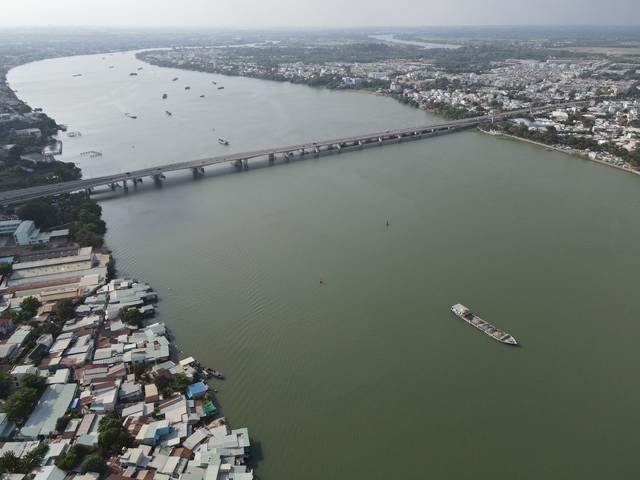
The place where the river splits in two has now become a vital transportation artery.
"The Nhà Bè river divides in two, / Whoever goes to Gia Định or Đồng Nai, let them go," the place where the river splits has now become a vital transportation artery, connecting the key economic region of Southern Vietnam with the region and the world. It embodies the people of the Eastern region, "hardworking and courageous," innovative, and pioneering in the process of industrialization and modernization.
The Đồng Nai River, with its compassionate and tolerant spirit, welcomes countless people from all over to study, work, and build their lives here. From hydroelectric power plants and high-tech agricultural zones to multi-billion dollar industrial projects, the Đồng Nai River, together with the people of the Eastern region, is "nurturing green shoots." During the difficult times of Covid-19, the people of the Southeast region united and joined hands to overcome the pandemic, gradually getting the economic engine rolling again.
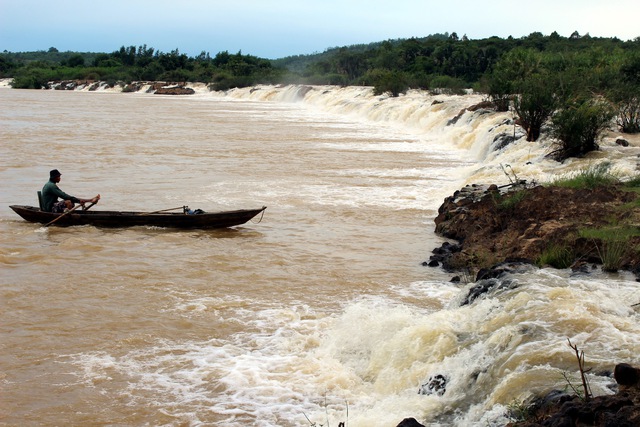
That river always holds wonders that we will never fully discover.
Along with the bridges spanning the Dong Nai River that are gradually taking shape, such as Bach Dang 2, Nhon Trach, Phuoc Khanh, Binh Goi, Phuoc An..., and the expansion of ports, the Southeast region is breaking through "transportation bottlenecks" to accelerate its development. Among these, Long Thanh Airport and the Cai Mep - Thi Vai deep-water port, and the Phu My inland port... are important highlights for the entire region to take off and reach further.
However, the river – which holds immense importance for Vietnam's economy, not to mention the cultural heritage still hidden beneath its surface – still faces the challenges of urban life, including pollution and erosion. I'm not a researcher or a cultural expert to understand everything firsthand, but I still know that this river holds wonders that we will never fully discover.

Source link
![[Photo] Commemorating the unwavering friendship between Vietnam and Laos](/_next/image?url=https%3A%2F%2Fvphoto.vietnam.vn%2Fthumb%2F1200x675%2Fvietnam%2Fresource%2FIMAGE%2F2026%2F01%2F27%2F1769518372051_ndo_br_1-jpg.webp&w=3840&q=75)


![[Photo] Announcement Ceremony of the Art Program “Light Concert – Welcoming the New Year 2026”](/_next/image?url=https%3A%2F%2Fvphoto.vietnam.vn%2Fthumb%2F1200x675%2Fvietnam%2Fresource%2FIMAGE%2F2026%2F01%2F27%2F1769514762857_le-cong-bo-ct-hoa-nhac-anh-sang-1772-9042-jpg.webp&w=3840&q=75)


![OCOP during Tet season: [Part 3] Ultra-thin rice paper takes off.](/_next/image?url=https%3A%2F%2Fvphoto.vietnam.vn%2Fthumb%2F402x226%2Fvietnam%2Fresource%2FIMAGE%2F2026%2F01%2F28%2F1769562783429_004-194121_651-081010.jpeg&w=3840&q=75)


![OCOP during Tet season: [Part 2] Hoa Thanh incense village glows red.](/_next/image?url=https%3A%2F%2Fvphoto.vietnam.vn%2Fthumb%2F402x226%2Fvietnam%2Fresource%2FIMAGE%2F2026%2F01%2F27%2F1769480573807_505139049_683408031333867_2820052735775418136_n-180643_808-092229.jpeg&w=3840&q=75)
![OCOP during Tet season: [Part 1] Ba Den custard apples in their 'golden season'](/_next/image?url=https%3A%2F%2Fvphoto.vietnam.vn%2Fthumb%2F402x226%2Fvietnam%2Fresource%2FIMAGE%2F2026%2F01%2F26%2F1769417540049_03-174213_554-154843.jpeg&w=3840&q=75)


Comment (0)