


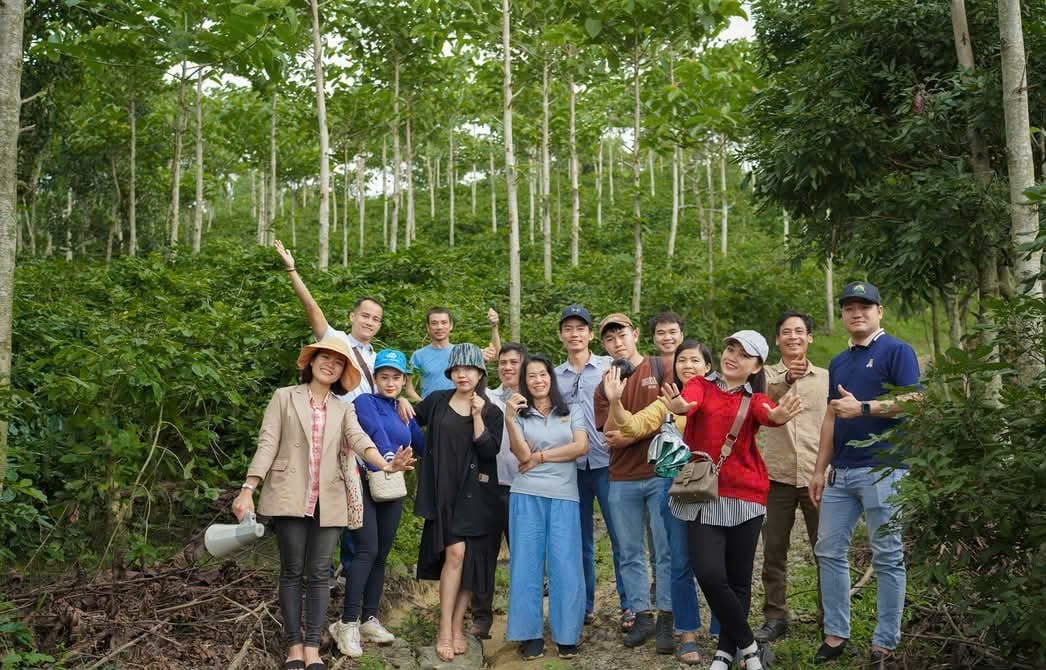
Tourists visit the coffee garden shaded by golden teak trees belonging to Ms. Tran Mai Huong - Photo: LT
Pioneers
When we researched specialty coffee in Huong Hoa, many people mentioned Ms. Tran Mai Huong (commonly known as Madam Huong) in Cop village, Huong Phung commune. Currently, Ms. Huong's coffee plantation, shaded by golden teak trees, is a popular tourist destination. This is also the birthplace of the specialty coffee product that was honored as the top green coffee bean in Southeast Asia in 2024.
Every year, until December, when most coffee and tea plantations in Huong Phung commune have finished their harvest season, the workers at Mrs. Huong's coffee plantation are still diligently picking the fruit. The coffee ripens gradually, and although it requires a lot of effort to harvest, instead of trying every method to achieve high yields and simultaneous ripening, Mrs. Huong still chooses this farming method. She says this is the way to obtain the highest quality coffee beans.
“The golden teak tree creates a thick layer of vegetation that increases humus content and retains moisture in the soil. Thanks to the canopy cover of the golden teak forest, the coffee beans undergo a long development process, resulting in a delicious, rich, and very distinctive flavor when ripe.” As a result, in the 2022-2023 season, she successfully experimented with the first batch of specialty Arabica coffee using whole-fruit anaerobic fermentation. By the 2023-2024 season, she had stabilized the processing and produced batches of the highest quality coffee. The product was recognized as specialty coffee by the World Coffee Quality Institute with 84.75 points.
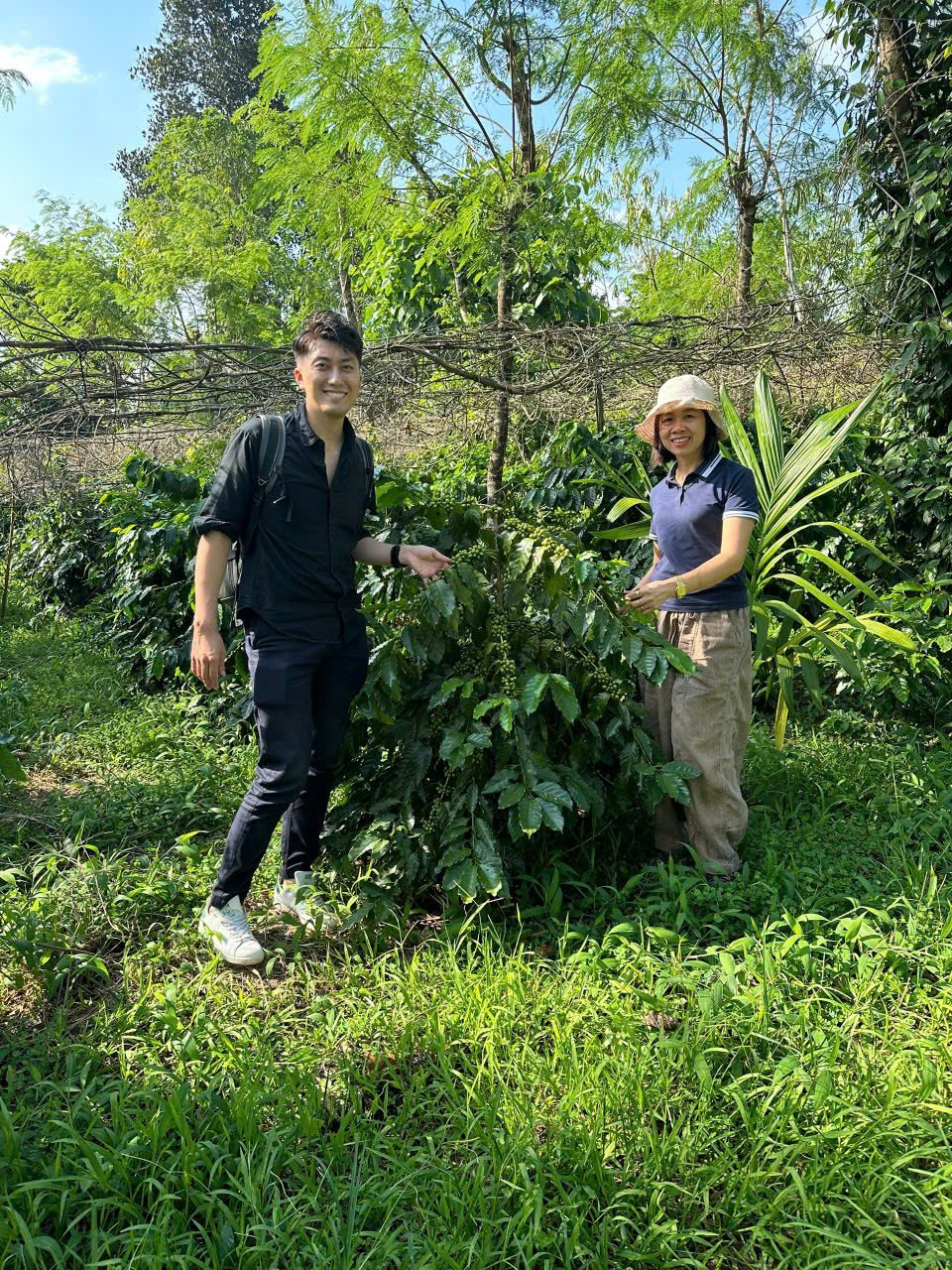
A coffee plantation combining agriculture and forestry in Huong Phung commune - Photo: LT
In September 2024, Ms. Huong's Liberica coffee product was honored as the top product at the Southeast Asian Coffee Association's 2024 Southeast Asian Green Coffee Competition held in Thailand. “The Arabica coffee plant originated as a small shrub, growing naturally in the old-growth forests of Africa. Cultivating coffee plants under the forest canopy has brought them back to their original nature. This is the best version of it, creating the highest quality raw materials for processing into distinctive coffee products,” Ms. Huong shared.
The concept of specialty coffee refers to coffee products from growing regions with specific natural conditions and special cultivation, harvesting, and processing procedures. When tasted, this type of coffee has a unique flavor and scores 80 points or higher according to the standards and evaluation procedures of the Specialty Coffee Association (SCA) and the Coffee Quality Institute (CQI). |
Some people in Huong Phung have also become familiar with growing coffee under the forest canopy, including Mr. Le Duc Binh in Xa Ry village. In recent years, as the pepper plants have degenerated, he has shifted his focus and started intercropping coffee with varieties such as jackfruit, rosewood, and flowering teak among his Arabica coffee plants. According to him, the concept of agroforestry coffee cultivation is relatively new; before that, he and some others in the area had spontaneously adopted this practice to provide shade for the coffee plants . Quang Tri is a hot and sunny region, and shade trees help maintain humidity and protect the soil (because the terrain here is hilly and prone to erosion). Experience shows that coffee grown under shade trees has a much better flavor and aftertaste compared to coffee grown as a monoculture.
Over 570 households registered for the model.
Mr. Nguyen An, Project Manager of Ecological Coffee Production and Natural Forest Improvement, WWF-Vietnam in Quang Tri, said that nationwide, coffee-growing regions almost lack a set of standards for agroforestry coffee cultivation recognized by the state. In Quang Tri specifically, in August 2024, the Provincial People's Committee issued a technical process for agroforestry cultivation of Arabica coffee applicable in the province. This process involves intercropping coffee with woody plants or fruit trees. Based on this technical process, the provincial agricultural sector has compiled a handbook with illustrations and diagrams to help people understand it more easily.
In reality, there is no complete model to learn from and follow. Therefore, the issuance of the technical procedures for integrated agroforestry and coffee cultivation demonstrates the province's strong commitment to its coffee development strategy. Currently, the agricultural sector and projects supporting farmers in Huong Hoa district in growing coffee (including WWF-Vietnam in Quang Tri) are learning from experience.
For example, from Mrs. Huong's coffee garden, one lesson learned is how to plant the golden shower tree (Gmelina arborea) at a density that doesn't affect the sunlight for the coffee plants below. Or, in some gardens, certain tree species, when interplanted, compete with the coffee plants for nutrients.
Therefore, choosing which types of forestry or fruit trees to plant alongside coffee, and determining the appropriate spacing and planting density to ensure that the trees do not compete with the coffee plants for light and nutrients during their growth, is a gradually emerging issue. "We are aiming to help people create added value on the same plot of land, instead of thinking about expanding cultivation area (buying more land or encroaching on natural forests)," Mr. An explained.
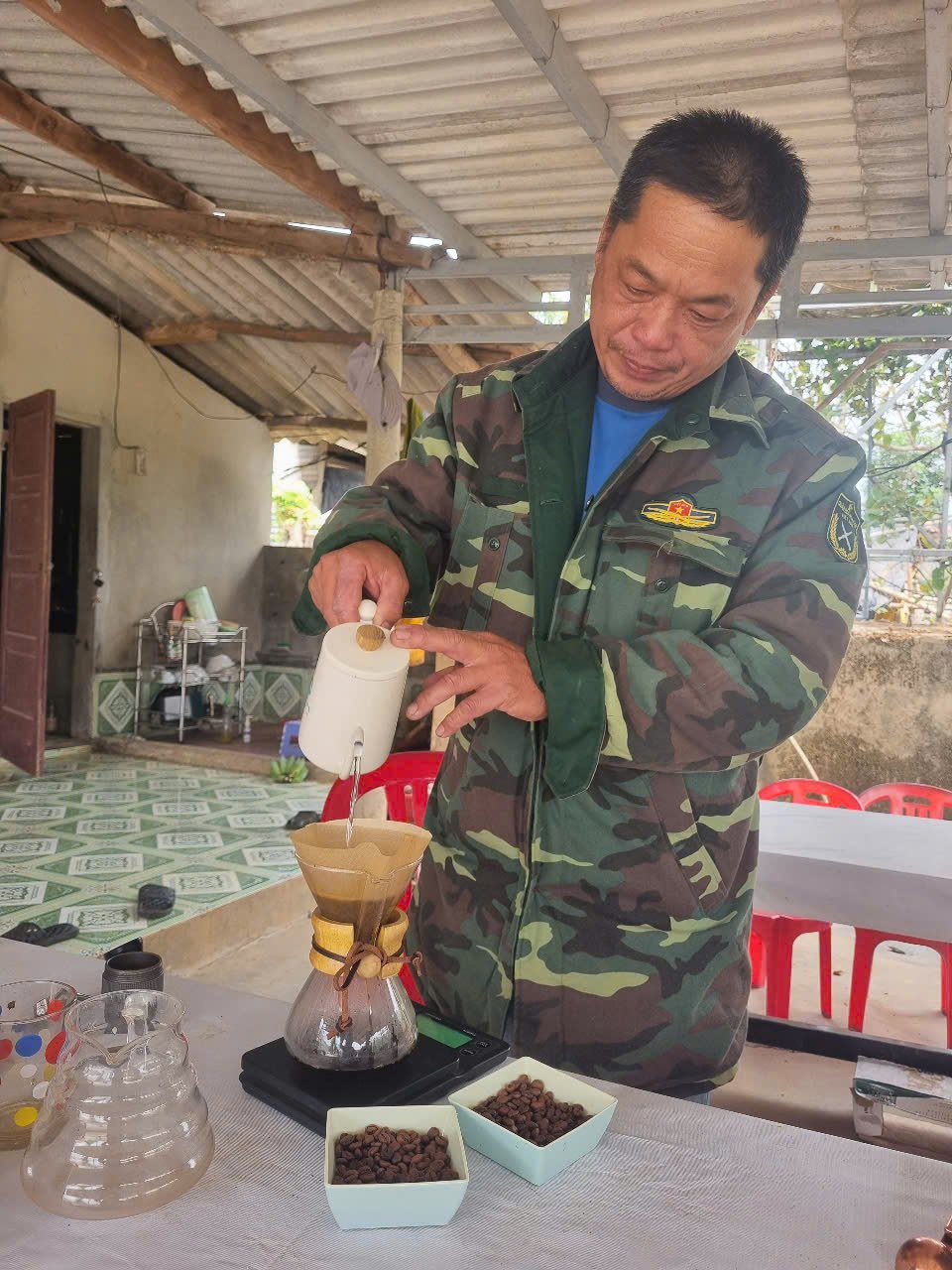
Mr. Le Duc Binh, Director of Sary Specialty Coffee Cooperative, introduces the cooperative's products - Photo: LT
According to officials from the Provincial Agricultural Extension Center, technically, integrated coffee and forestry cultivation allows for the replanning of orchards, removing old, diseased trees, etc. However, allowing people to plant spontaneously will result in some planting densely and others sparsely, without proper rows, and without knowing which forestry or fruit trees are suitable.
Since the province introduced technical procedures and the impact of several support projects, more and more people have registered to participate. For example, in 2024, Huong Phung commune had 374 households registered to intercrop fruit trees and forestry trees in coffee gardens; in 2025, approximately 200 households are expected to register.
In particular, in 2024, the center opened 11 training courses on agroforestry coffee cultivation, including one course for core staff, outstanding farmers, and representatives of cooperatives to transfer technology to local people. Currently, the department has established a team of 7 technical support staff for the agroforestry coffee cultivation project, through which they continue to survey, train, and transfer technology to the people.
Building a brand through competitions.
According to compiled data from the People's Committee of Huong Phung commune, the local coffee growing area is 2,000 hectares, with more than 1,200 households directly involved in production, averaging over 1.5 hectares per household. Yields range from approximately 8.5 to 9 tons of fresh coffee cherries per hectare per year. Coffee plants are widely distributed across all 13 villages in the commune.
Besides Chênh Vênh village, which was selected by the Ministry of Agriculture and Rural Development (now the Ministry of Agriculture and Environment) as a coffee-growing area capable of producing specialty coffee, actual production shows that most villages in the commune meet the conditions for planning the development of high-quality coffee. Currently, there are more than 30 companies, enterprises, cooperatives, and agents involved in collecting, processing, and producing coffee in the area (including several companies, cooperatives, and households producing and processing specialty and organic coffee).
According to Ha Ngoc Duong, Vice Chairman of the People's Committee of Huong Phung commune, people have gradually shifted from traditional coffee cultivation to organic and specialty coffee farming. A positive aspect is that the central and local governments have recently issued several mechanisms and policies for the development of specialty coffee. Several businesses and organizations in the area have also implemented policies to encourage people to cultivate coffee.
Furthermore, rising coffee prices and the fact that some businesses have signed contracts to purchase the entire crop right from the start of the season have reassured farmers. In particular, recently some local coffee products have participated in and won high awards at domestic and international specialty coffee competitions, creating a buzz and attracting consumer attention, thus gradually building a brand for this product line.
For example, in 2020, the Sary Specialty Coffee Cooperative in Xa Ry village, Huong Phung commune, was established with Mr. Le Duc Binh as its director. The cooperative currently has 20 members (including 17 ethnic minority members) cultivating over 40 hectares of coffee. In 2024, the cooperative collaborated with Tong Phuc Lam Company (in Ho Chi Minh City) to participate in the Vietnam Specialty Coffee Competition in Buon Ma Thuot, Dak Lak province, where its product was voted the most popular coffee product.
Since then, more customers have become aware of the cooperative's products. Mr. Binh has 3 hectares of organically grown coffee. In recent years, he has been fermenting ripe bananas with manure and bio-fertilizers to fertilize his coffee plants. Each year, his plantation yields about 36 tons of fresh coffee beans, of which he selects about 10 tons (approximately 2.5 tons) that meet the standards for processing into specialty coffee, and sells the rest as bulk coffee on the market.
“Making specialty coffee requires meticulous attention to detail, from selecting the beans for harvesting, washing, drying, and natural fermentation… it’s very laborious, but in return, specialty coffee fetches three times the price of regular coffee, so everyone is enthusiastic. My wish when establishing the cooperative was to work together to produce a large quantity of high-quality coffee for the market,” Mr. Binh shared.
Lam Thanh
Source: https://baoquangtri.vn/doi-thay-tu-nhung-ray-ca-phe-o-huong-phung-192882.htm
![[Photo] General Secretary To Lam attends the meeting between voters and candidates for the 16th National Assembly.](https://vphoto.vietnam.vn/thumb/1200x675/vietnam/resource/IMAGE/2026/02/26/1772088196117_a1-bnd-7412-5887-jpg.webp)




































![[Photo] Prime Minister Pham Minh Chinh presides over the meeting of the Central Steering Committee on Housing Policy.](https://vphoto.vietnam.vn/thumb/402x226/vietnam/resource/IMAGE/2026/02/26/1772088860610_anh-man-hinh-2026-02-26-luc-13-54-08.png)



















Comment (0)