


..."Necessity is the mother of invention."
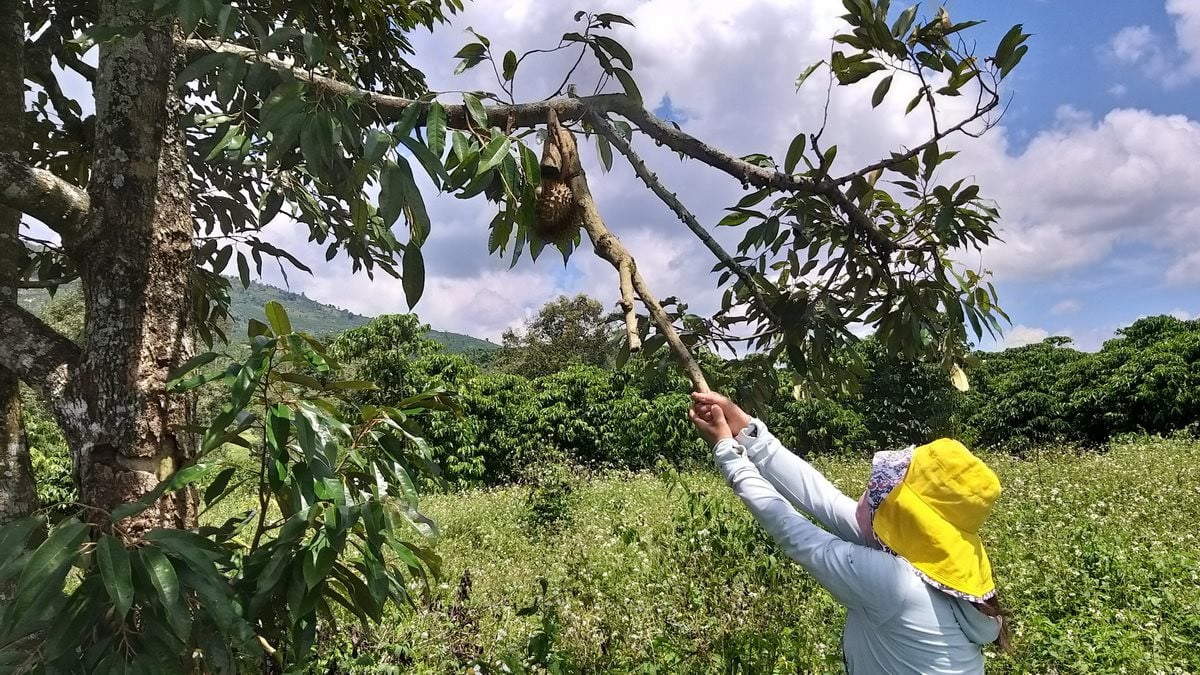
Looking at the lush green rows of dragon fruit trees and the bustling road leading into the district, filled with people and vehicles carrying ripe durians, I couldn't help but excitedly seek out the families who had successfully switched to this new crop. Meeting Mr. Dieu Hon (Thanh Son commune, Tan Phu district, Dong Nai province) in his orchard laden with durians, Mr. Hon's face was weathered, still saddened when he spoke about cashew trees. A few years ago, not just Mr. Dieu Hon, but many farmers in Thanh Son and Tan Phu districts had to cut down their cashew trees due to unstable prices and erratic weather, which repeatedly led to price drops and crop failures, leaving cashew growers frequently facing the prospect of losing everything at the end of the season.
Mr. Dieu Hon explained: “It’s not that we don’t work hard, but partly because cashew trees are sensitive to weather. In recent years, climate change has made the weather no longer follow the usual patterns, affecting cashew yields and resulting in crop failures. Therefore, my income and that of other cashew growers are lower compared to those growing other agricultural products. Not only cashews, but pepper, which used to be among the top crops in terms of profit, is also losing its competitive advantage due to crop failures caused by unpredictable weather fluctuations.”
Previously, Mr. Dieu Hon's family cultivated over 5 sao (approximately 0.5 hectares) of pepper. At that time, one hectare of pepper yielded billions of dong, and after deducting expenses, farmers pocketed several hundred million dong. With over 5 sao of pepper, his family earned over a hundred million dong annually, enough to cover living expenses and their children's education. However, in recent years, erratic weather has caused a sharp decline in pepper yields. Along with that, the price of pepper has continuously fallen, leading to losses for his family. Like many other pepper farmers, Mr. Dieu Hon cut down his pepper plantation because he couldn't survive.
Then, Mr. Dieu Hon learned durian cultivation techniques. Learning proved beneficial; he learned how to apply science and technology to farming and care, resulting in a thriving durian orchard. Through the rainy and dry seasons, the orchard has now yielded its first harvest. Thanks to the stable price of durian, Mr. Dieu Hon's family income has also stabilized, and their lives have become less impoverished.
Similar to Mr. Dieu Hon's family, Mr. Nguyen Quang Minh's family (Phu Son commune) has 2 hectares of durian trees over 4 years old. Thanks to careful investment and effective application of technical measures during the flowering stage, especially during pollination, Mr. Minh's durian orchard yields quite high productivity. On average, each tree produces 80-100 kg. After deducting investment costs, his family has a significant income, helping them increase their earnings compared to before.
Mr. Minh said: “In the place where the durian orchard is now bringing economic benefits to my family, there used to be a cashew orchard, but the weather wasn't favorable, so the yield wasn't high. Then I switched to growing mangoes, and after 3-4 years, the mango orchard yielded a harvest. However, the price of mangoes was unstable, constantly changing, sometimes dropping to 2,000-3,000 VND/kg. It wasn't worth the effort to take care of the trees, and not only did the price drop, but the mango crop also failed due to the weather. So, I reluctantly abandoned the mango trees and switched to growing durian.”
“It’s not that I lacked perseverance, nor was I looking for greener pastures. But the reality of poverty was so persistent that I couldn’t sit still. Breaking away from the old and starting something new, like changing crops, required careful planning, investment of effort, and money. Fortunately, the local government always supported me, and social policy funds were readily available to assist farmers in starting their businesses, so I was able to firmly overcome this difficult transition period,” Minh said.
So, those who abandoned their mango and cashew orchards were fortunate to have policy support to restart their businesses. This wasn't just about money; it was also about the encouragement and emotional support from village and commune officials during those times when they were feeling uncertain and hesitant.
“It’s been six years since I learned about cultivation techniques and applied them to my durian orchard. The initial cost of caring for durian trees is quite high compared to other crops. But at harvest time, each tree yields about 100 kg of fruit. After deducting expenses, each tree brings in a profit of nearly 4 million VND, proving that my shift in crop cultivation was the right decision,” Minh shared.
Not only Mr. Dieu Hon and Mr. Minh, but many farmers in Dong Nai have also boldly applied science and technology in agricultural production, as well as chosen crops suitable for the soil and weather, thus escaping poverty and rising to prosperity.
Among them is the family of Mrs. Sau A Tah (Xuan Hung commune, Xuan Loc district), a purely agricultural family whose economy mainly depends on farming. Despite working hard, poverty and hunger still plagued her family. After much thought and deliberation, Mrs. Sau A Tah decided she had to do something to change her family's life and she succeeded with a dragon fruit farming model that brought her economic income.
Some people still liken Mrs. Sau A Tah's case to "fighting a battle empty-handed." However, whenever someone says that, she expresses her displeasure. Mrs. Sau A Tah says, "If it weren't for the Social Policy providing loan support, and the help and support from my family and neighbors, I couldn't have done it all by myself."
Indeed, to secure initial capital, Ms. Sau A Tah boldly borrowed from the Social Policy Bank and also mobilized funds from her family and relatives in the commune to invest in planting 7 hectares of dragon fruit. Thanks to selecting new, high-yield varieties and receiving guidance from agricultural officials on applying advanced scientific methods to cultivation, her family's dragon fruit orchard now provides a stable income, harvesting 30-40 tons per hectare annually. After deducting expenses, she earns a profit of approximately 300-400 million VND per hectare.
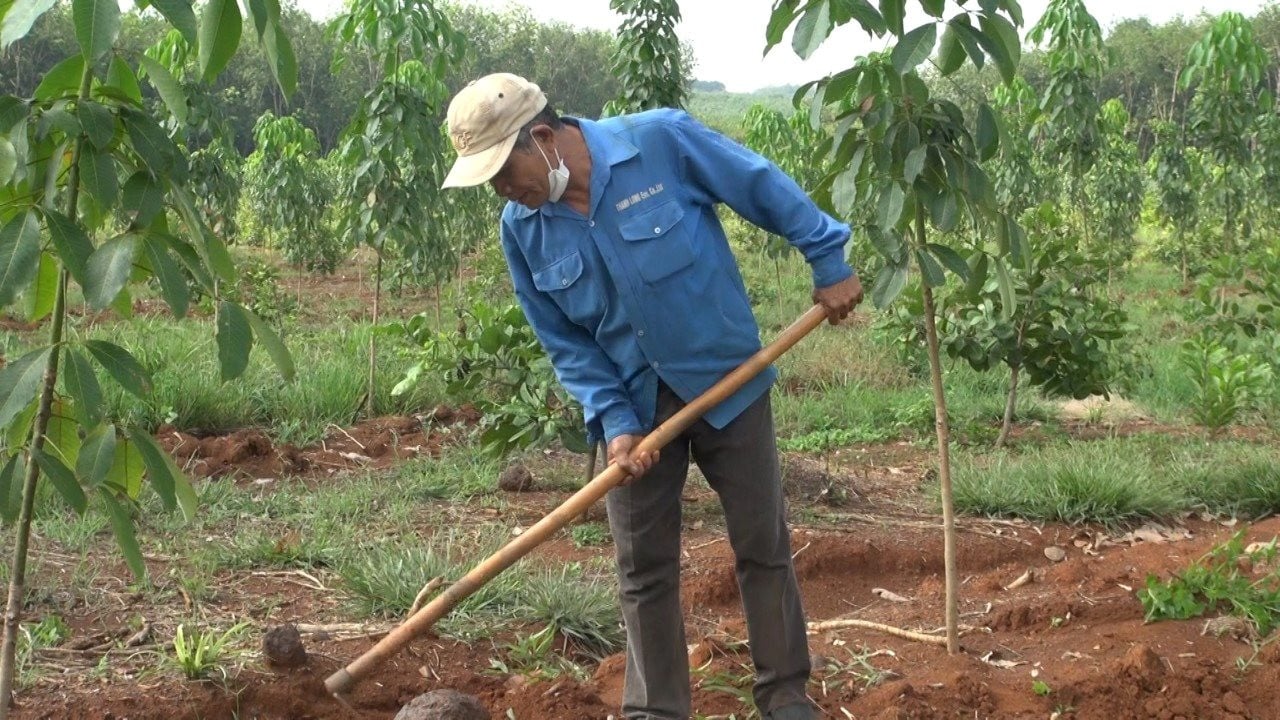
Technology is a companion in wealth creation.
Escaping poverty alone is not enough; many people currently living in Tan Phu district have become wealthy by switching crops, starting with the goal of adapting plants to the local climate and making them more resistant to the impacts of climate change. Take the case of Mr. Nguyen Van Thieu (Hamlet 4, Phu An commune, Tan Phu district). In Phu An, everyone knows Mr. Thieu as "Thieu the durian farmer" because he enjoys a comfortable life thanks to durian cultivation. His 10 hectares of yellow-fleshed, seedless durian, cultivated entirely according to VietGAP standards, is a remarkable asset for his family in this region with its challenging climate.
Therefore, following the directions of the locals, we easily found Mr. Thieu's durian orchard. The durian trees were in the fruit-bearing stage at this time, with the durians hanging like hedgehogs on the trees. Because of his many years of experience in durian cultivation and his adherence to VietGAP standards, every durian in his orchard was perfectly ripe, uniform in size, and, as his neighbors described it, "sweet, creamy, and so soft you forget your worries." This season, Mr. Thieu's durian yield is estimated at nearly 20 tons per hectare.
Sharing his thoughts on the effectiveness of applying technology in production, as well as the economic benefits of durian cultivation, Mr. Thieu said: “I started growing durian in 2000, initially converting only a few hectares of sugarcane land to durian cultivation. After many years of experience, I realized that this crop yields high economic value, so I gradually switched to growing durian. In recent years, the price of durian has been much higher than other fruit crops. In some years, traders bought durian at prices ranging from 55,000 to 60,000 VND/kg, while the lowest price was 35,000 VND/kg.”
When we asked, "Is it possible for a bumper harvest to lead to a drop in prices?", the farm owner honestly replied, "It's the way things are; a bumper harvest often leads to a drop in prices. The most important thing is that even at the lowest prices, durian growers still make a profit. This year, the durian trees have set fruit exceptionally well, and even with the higher fertilizer prices compared to previous years, durian growers are still doing well. I think in Phu An, no other crop yields as much economic value as durian."
In reality, durian trees have high economic value, not only because their market price is higher than other agricultural products, but also because durian trees can withstand the sun, wind, and unpredictable weather of this region, even the more extreme conditions attributed to climate change; durian trees still thrive, flower, and bear fruit.
But that's only part of the story; the crucial part is that local farmers have learned to "train" their crops to adapt to climate change. In an exchange, a representative from the Department of Agriculture and Rural Development of Dong Nai province stated that, in practice, more and more farmers are interested in solutions to adapt to climate change. The most important solution currently is to plan agricultural production areas and transform the crop structure accordingly, such as: increasing the proportion of short-day varieties; using restored native varieties; using native varieties as rootstocks, hybrid varieties with pest and disease resistance, and resistance to unfavorable conditions; and applying biotechnology to improve quality and select varieties that meet requirements.
Furthermore, it is also necessary to implement synchronized solutions regarding irrigation water use, fertilizers, crop rotation, intercropping, soil cover, runoff mitigation, pest management, and the application of high technology. To achieve this, departments, agencies, and localities must work alongside the people, actively disseminate information, raise awareness and responsibility for protecting the rural environment, and use resources economically; and replicate successful models of Farmers' Associations at all levels participating in environmental protection and climate change adaptation...
It is known that in recent years, many localities in Dong Nai province have boldly switched to new crops and applied technology to production to improve productivity, quality, and efficiency. The principle of conversion must be flexible, rational, and widely applied to scientific and technical advancements in production, resulting in a shift in productivity and a trend from low-economic-efficiency crops to high-economic-efficiency crops. This is also why the area planted with some perennial industrial crops such as cashew, pepper, rubber, and coffee has decreased, making way for the cultivation of fruit trees with higher economic value.
The rural areas of Dong Nai are undergoing a transformation, and new landscapes are gradually emerging. This is the culmination of understanding weather patterns, soil conditions, plant growth, and mastering climate change. It's also a result of shifting old mindsets, changing crop purposes, and adopting green and sustainable agriculture based on the strong application of science and technology to innovate, increase labor productivity, achieve harmonious economic and social development, protect the environment, and adapt to climate change. As long as farmers believe in their own strength, poverty caused by climate change will become a thing of the past.
Source

![[Photo] Prime Minister Pham Minh Chinh presides over the meeting of the Steering Committee for the Development of Science, Technology, Innovation, Digital Transformation and Project 06.](https://vphoto.vietnam.vn/thumb/1200x675/vietnam/resource/IMAGE/2026/02/25/1772024613089_1772024091685-jpg.webp)

![[Photo] Prime Minister Pham Minh Chinh receives the Director General of TASS News Agency (Russian Federation)](https://vphoto.vietnam.vn/thumb/1200x675/vietnam/resource/IMAGE/2026/02/25/1772024599891_dsc-8041-jpg.webp)












































![[Photo] Lung Phinh is covered in white plum blossoms.](https://vphoto.vietnam.vn/thumb/402x226/vietnam/resource/IMAGE/2026/02/25/1772036291497_tl-z7563533595318-d0f6815e01d4b292632a5f65d005af7d-8745-jpg.webp)







Comment (0)