

The number of businesses withdrawing from the market in the past 10 months remains high. A series of difficulties faced by businesses are still awaiting resolution. The need to remove bottlenecks for businesses is not only urgent in terms of time, but also in terms of mindset.
Removing bottlenecks for businesses: Requires a growth-driven mindset.
The number of businesses withdrawing from the market in the past 10 months remains high. A series of difficulties faced by businesses are still awaiting resolution. The need to remove bottlenecks for businesses is not only urgent in terms of time, but also in terms of mindset.
The number contains many bottlenecks.
Over 173,000 businesses have withdrawn from the market in the past 10 months, causing concern for Dr. Nguyen Dinh Cung, former Director of the Central Institute for Economic Management Research. His table showing the ratio of businesses entering the market to those withdrawing shows a downward trend (see table).
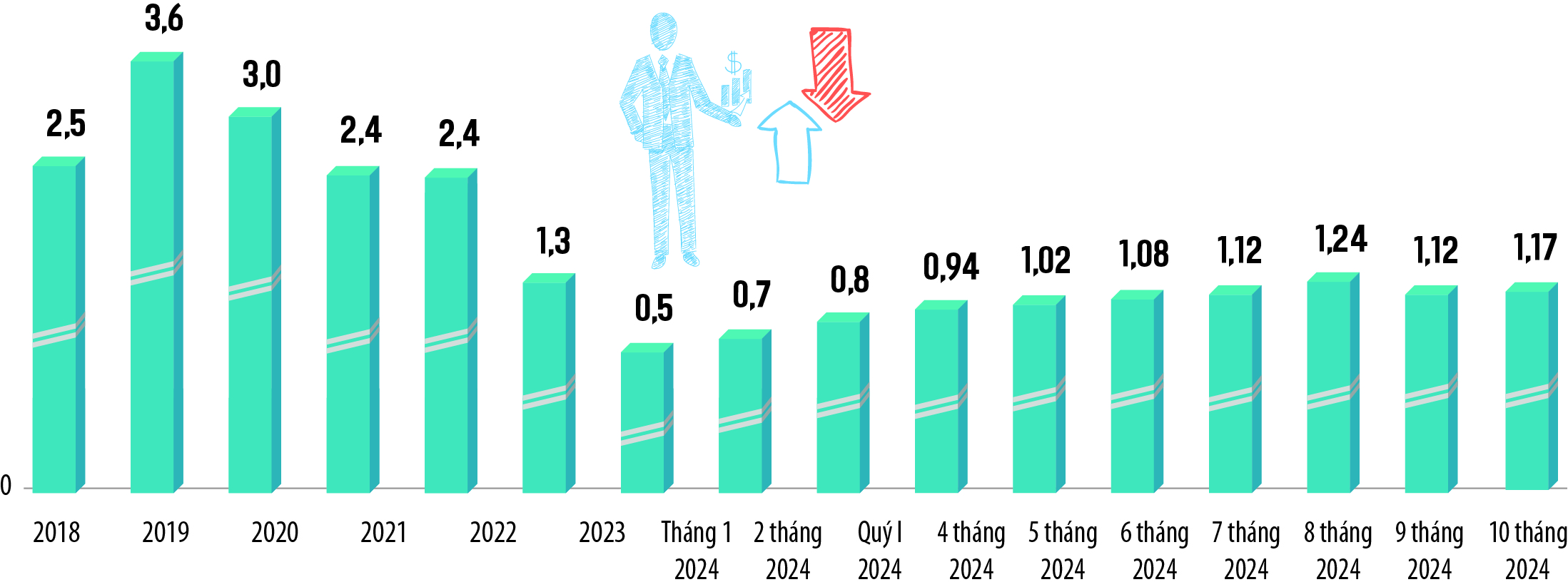 |
| The ratio of businesses entering the market to businesses exiting the market. Source: Dr. Nguyen Dinh Cung |
"Private sector investment growth is also low, at around 7.1%, and although it has recovered quarter by quarter, it is still too low compared to the growth needs of the economy, as well as compared to the capacity of this sector," Mr. Cung added, highlighting the issues of concern from the statistics.
Compared to the pre-pandemic period, specifically 2014-2019, the growth of this sector has consistently been above 10%. 2017 recorded a record growth rate of 17%. “The consistently high growth rate over those five years contributed significantly to Vietnam’s GDP growth rate in 2017-2019. Without promoting private investment and creating a new atmosphere for investment and development, GDP could not have achieved such a breakthrough in the next period,” Dr. Cung affirmed.
However, what worries Mr. Cung most is that the difficulties faced by businesses seem to remain too numerous and take too long to be resolved. “I don’t understand why the businesses’ recommendations are so slow to be addressed. Looking back, it’s still the same issues: tax refunds, access to credit, land, removal of inappropriate business conditions… Many problems already have solutions, but they still haven’t been resolved completely,” Mr. Cung questioned, after continuously receiving recommendations from business associations.
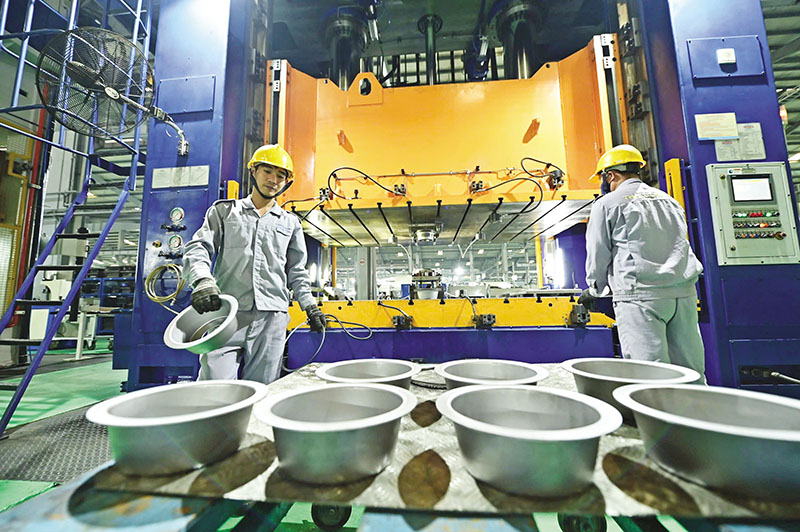 |
| Aluminum businesses are facing significant difficulties in exporting, yet their requests for action remain unresolved for years. (Photo: Duc Thanh) |
Business community anxiety
Ms. Ly Thi Ngan, Chief of the Office of the Vietnam Aluminum Profile Association (VAA), expressed her frustration at the difficulties faced by businesses in the industry. “Exporting businesses are facing significant challenges, yet our recommendations have remained unresolved for years. We continue to petition for adjustments to the tax framework and a reduction in export taxes on aluminum products in the form of bars, rods, and profiles (HS code 7604) from 5% to 0%…,” Ms. Ngan stated.
The VAA has repeatedly submitted this proposal to the Ministry of Finance , requesting that it be reported to the Government and the National Assembly, starting in 2018, when inadequacies were discovered in the implementation of the 2016 Export and Import Tax Law. Since then, the VAA and its members have reiterated this issue many times, but have yet to receive a response.
The reason is that aluminum profiles – under HS code 7604 – are processed products requiring hundreds of billions of VND in investment per factory and research and development to transform raw aluminum into profiles, and are subject to an export tax rate of 5%. Meanwhile, products under HS code 7610, which are simply processed such as cutting, shaping, and punching, with low investment costs from aluminum profiles, are subject to a 0% tax rate. "This is unfair to Vietnamese aluminum profile manufacturers," Ms. Ngan shared the VAA's viewpoint.
In particular, she stated that this product group is subject to export taxes ranging from 5% to 40%, making it very difficult for businesses to penetrate foreign markets, especially the US market - currently the largest partner of the aluminum industry.
VAA is not the most persistent association with its years of petitioning.
On November 5th, five associations and industry groups jointly signed a letter addressed to Deputy Minister of Health Do Xuan Tuyen and the Drafting Committee for the amendment of Decree 09/2016/ND-CP on fortifying food with micronutrients. These five associations are the Vietnam Association of Seafood Processing and Export (Vasep), the Ho Chi Minh City Food and Beverage Association, the Transparent Food Association, the Phu Quoc Fish Sauce Producers Association, and the Association of High-Quality Vietnamese Goods Businesses. This proposal was submitted following the Ministry of Health's meeting on October 30th to gather feedback on the draft Decree.
"We believe that the meeting's results did not fully and accurately reflect our concerns about the difficulties and obstacles in implementing regulations on the need for iodine-fortified salt used in food processing and iron and zinc-fortified wheat flour used in food processing," Mr. Nguyen Hoai Nam, Deputy General Secretary of Vasep, clarified the reason for the above document.
According to Mr. Nam, businesses wholeheartedly support the policy of supplementing micronutrients to improve people's health, including the mandatory iodine requirement for salt and solid seasonings used in households and food service establishments.
"The only point of concern and recommendation we have is the regulation on the use of iodized salt and iron and zinc-fortified flour in food processing, because many of Vietnam's export markets, such as Japan and Australia, require the non-use of iodized salt and demand a certificate confirming that the product does not use this type of salt. This puts significant pressure on Vietnamese export businesses," Mr. Nam explained in detail.
In the aforementioned document, the associations proposed excluding exported food products from the scope of the Decree amending Decree 09/2016/ND-CP. The addition of micronutrients to salt and flour in food processing was suggested as encouraged. Furthermore, the associations proposed allowing the production and import of non-iodized salt to meet specific needs.
It requires a mindset that promotes development, rather than management.
The recommendations from the five associations regarding Decree 09/2016/ND-CP are not new; in fact, the Government has already included them in Resolution 19/2018/NQ-CP on continuing to implement key tasks and solutions to improve the business environment and enhance national competitiveness.
Specifically, the Government has assigned the Ministry of Health to research, amend, and supplement Decree No. 09/2016/ND-CP in the following direction: abolishing the regulation that "salt used in food processing must be fortified with iodine" at point a, clause 1, Article 6; and abolishing the regulation that "wheat flour used in food processing must be fortified with iron and zinc" at point b, clause 1, Article 6. Instead, food processing businesses should only be encouraged to use them.
“These solutions all stem from the reasonable demands of businesses. Perhaps the success of the business environment reform period from 2014-2019 was due to policymakers adopting the mindset of facilitators of development, rather than state administrators,” Dr. Cung observed.
It's no coincidence that Mr. Cung mentioned this period. Looking back, the years 2014-2019 marked a breakthrough in Vietnam's investment and business environment. Since 2014, the first year the Government issued Resolution 19/2014/NQ-CP on key tasks and solutions to improve the business environment and enhance national competitiveness, Vietnam's efforts to improve its business environment officially began to be measured by its ranking compared to other economies in the region, as well as global competitiveness rankings.
Significantly, reforms are not just about improving rankings on global charts, but more importantly, about fundamentally removing obstacles and barriers to business operations, creating a truly open and favorable business environment.
The abolition and simplification of business regulations is a continuation of previous reforms, but the scale, scope, and decisiveness of this reform are much greater than before. As a result, thousands of business conditions have been abolished; thousands more have been added or amended to be more favorable to business operations.
“I believe that the mood of the business environment and the policy environment at that time created a turning point, leading to a leap in growth. This time also requires such a leap, and there is a basis to achieve it, as General Secretary To Lam has stated that we must definitively abandon the mindset of prohibiting what we cannot manage, and we must remove institutional bottlenecks…,” Mr. Cung emphasized.
However, these shifts in mindset are not limited to civil servants in general, but need to begin in many leadership positions...
Source: https://baodautu.vn/go-diem-nghen-cho-doanh-nghiep-doi-hoi-tu-duy-thuc-day-phat-trien-d229450.html


![OCOP during Tet season: [Part 3] Ultra-thin rice paper takes off.](/_next/image?url=https%3A%2F%2Fvphoto.vietnam.vn%2Fthumb%2F402x226%2Fvietnam%2Fresource%2FIMAGE%2F2026%2F01%2F28%2F1769562783429_004-194121_651-081010.jpeg&w=3840&q=75)


Comment (0)