

 |
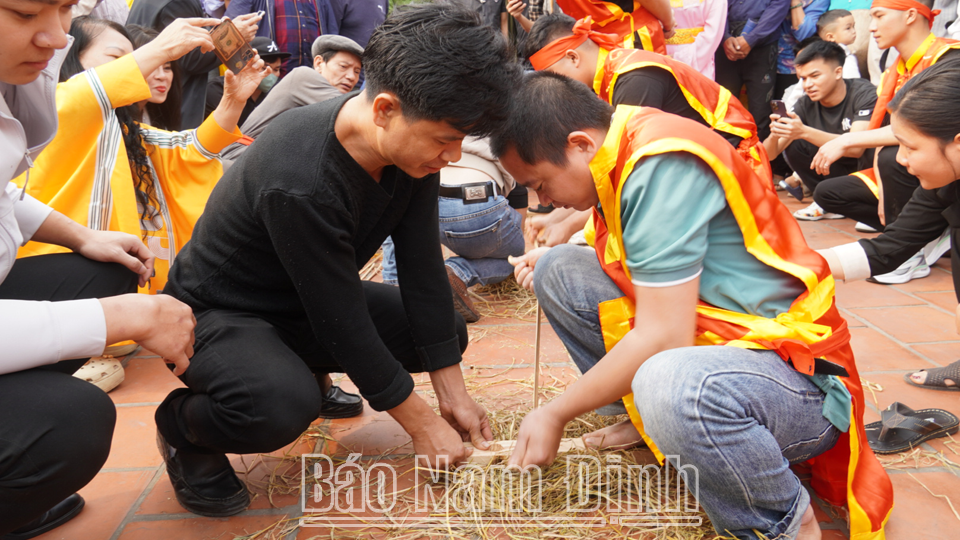
| Performing the ritual of lighting the ceremonial fire to officially open the festival at the traditional Ninh Xá temple and shrine festival. |
Ninh Xa Temple is dedicated to Luong Binh Vuong and An Nhu Vuong. According to legend, these were sons of King Hung who came to govern the Dai An region, helping the people of Ninh Xa to reclaim land, cultivate rice, grow mulberry trees, raise silkworms, and weave cloth. During the Ly Dynasty, the temple also housed the shrine of Lao La Dai Than Ninh Huu Hung, a skilled woodcarver. Ninh Huu Hung was from Chi Phong village, Truong Yen commune, Hoa Lu district ( Ninh Binh province). He was appointed by King Dinh Tien Hoang as the Chief Inspector of the Six Prefectures (General in charge of woodworking in the six prefectures). During the Early Le Dynasty, he continued to be highly regarded for overseeing the construction of many large projects, including the Hoa Lu capital.
According to historical records, during a trip to accompany King Le Dai Hanh on a plowing ceremony, on the way back across the Sat River, the king ordered his dragon boat to stop and visit the temples of Luong Binh Vuong and An Nhu Vuong. Seeing the dilapidated state of the temples, Ninh Huu Hung asked the king for permission to stay and repair the temples and Phuc Le Pagoda (Ninh Xa Pagoda). Furthermore, seeing that the land was fertile and the population sparse, he brought his relatives from Ninh Binh to cultivate and develop the area, teaching the people carpentry and carving skills to earn a living; he encouraged farming and the development of local handicrafts. Later, the people who settled here all changed their surname to Ninh, so the area became known as Ninh Xa (village of the Ninh family). Next to the temple is the shrine of Dai Lan Princess (a general of the Trung Sisters). To this day, the Ninh Xa temple and shrine still preserve 28 royal decrees and many valuable religious artifacts. In 1991, Ninh Xa temple and shrine was classified as a "National Historical and Cultural Monument" by the Ministry of Culture, Sports and Tourism .
Currently, the carpentry craft in Ninh Xa continues to thrive. The village has nearly 600 households, mostly engaged in traditional carpentry, producing statues and various wooden religious and decorative items such as thrones, chairs, palanquins, incense burners, ceremonial bowls, arched doorways, scrolls, imperial plaques, couplets, and cabinets. Many ancient architectural structures still bear the mark of the skilled hands of the village's craftsmen with elaborate carvings and vivid themes such as dragons playing, dragons bowing to the moon, dragon nests, mother dragons teaching their offspring, and immortals riding dragons. These works are durable, aesthetically pleasing, and crafted with refined and detailed techniques, becoming a renowned brand of Ninh Xa. Many skilled craftsmen skillfully combine tradition and creativity in their carving, mother-of-pearl inlay, and embellishment, adding exquisite details that have made them well-known to both domestic and international customers. Traditional crafts passed down through generations have brought stable and prosperous lives to the people, contributing to building a strong, thriving, and renowned Ninh Xa countryside.
To express gratitude to those who contributed to the founding of the village and the defense of the country, every year, at the beginning of spring, the people of Ninh Xa organize a festival. The Ninh Xa Temple Festival is divided into two periods: the 6th day of the first lunar month and the 5th to 7th day of the third lunar month. The 6th day of the first lunar month commemorates the founding of the craft village, so the festival is held on this day as an opportunity for descendants from near and far, and craftsmen who work far from home, to return to their hometown to visit their ancestors. The festival includes a procession and, especially, the "offering of skillful crafts" ceremony. Craftsmen with beautiful products can display them next to the altar or in the courtyard. After the festival in the first lunar month, the main festival of the year takes place from the 5th to 7th day of the third lunar month, usually held every three years. The most unique feature of the festival is the "Fire-pulling ceremony" held on the main festival day, the 6th day of the third lunar month.
To perform the "Fire-Pulling Ceremony," villagers prepare items including dried, flammable bamboo strips from the kitchen hearth, three pieces of dry mahogany wood for pulling the fire, and bundles of dry straw that easily ignite. Those chosen to participate in pulling the fire are strong, skillful, and agile young men from the village. From early morning on the 6th, people gather in large numbers at the temple courtyard. After the traditional ceremony, the young men take their positions to prepare for pulling the fire. This custom is reenacted according to the principle of "wood generates fire," a concept used by the founder of the craft, Ninh Huu Hung, to create fire. When the flame flares up, the person pulling the fire must quickly use the straw bundle to ignite it. An elder in the village will then use that flame to light incense for the entire village to perform the incense offering ceremony. Afterward, the incense burner is placed on a palanquin and carried to Le Pagoda, symbolizing the sincere remembrance of the ingenious invention of fire by the founder of the craft, Ninh Huu Hung, who, in ancient times, helped King Dinh and King Le feed their troops, fight invaders, quell rebellions, and rebuild their homeland. People follow the palanquin procession, accompanied by lively drums and trumpets, creating a vibrant atmosphere throughout the region. Along with the custom of lighting the fire and offering incense to inaugurate the festival, the festival also includes rituals, palanquin processions, cultural performances (traditional opera, Quan Ho folk singing, etc.), folk games, volleyball and football competitions, attracting a large number of people to participate, enjoy, and enthusiastically cheer. During these days, descendants from near and far, and the villagers, temporarily stop working and producing, focusing on the affairs of the hamlet and village.
For the people of Ninh Xa, the traditional festival at Ninh Xa temple and shrine is an opportunity to express the principle of "drinking water, remembering the source," to show gratitude to the founders of the craft and those who contributed to "pioneering and developing the land," and to participate in unique cultural exchange activities, creating a spirit of enthusiasm and inspiration to continue working, creating, preserving, and developing the traditional crafts of their homeland.
Text and photos: Dieu Linh
Source: https://baonamdinh.vn/van-hoa-nghe-thuat/202504/doc-dao-le-hoi-den-phuninh-xa-34b6d05/


![[Photo] General Secretary To Lam receives the Special Envoy of General Secretary and President of China Xi Jinping](/_next/image?url=https%3A%2F%2Fvphoto.vietnam.vn%2Fthumb%2F1200x675%2Fvietnam%2Fresource%2FIMAGE%2F2026%2F01%2F30%2F1769759383835_a1-bnd-5347-7855-jpg.webp&w=3840&q=75)


![OCOP during Tet season: [Part 3] Ultra-thin rice paper takes off.](/_next/image?url=https%3A%2F%2Fvphoto.vietnam.vn%2Fthumb%2F402x226%2Fvietnam%2Fresource%2FIMAGE%2F2026%2F01%2F28%2F1769562783429_004-194121_651-081010.jpeg&w=3840&q=75)

![OCOP during Tet season: [Part 2] Hoa Thanh incense village glows red.](/_next/image?url=https%3A%2F%2Fvphoto.vietnam.vn%2Fthumb%2F402x226%2Fvietnam%2Fresource%2FIMAGE%2F2026%2F01%2F27%2F1769480573807_505139049_683408031333867_2820052735775418136_n-180643_808-092229.jpeg&w=3840&q=75)



Comment (0)