


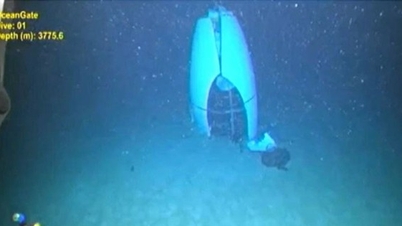
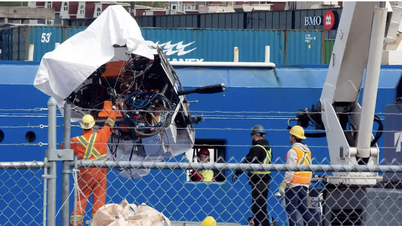
The debris included part of a pressure chamber, the bow of the ship, and two parts of an engine, according to an announcement from the U.S. Coast Guard at a press conference in Boston. Rear Admiral John Mauger said the debris "is consistent with the hypothesis that the ship exploded."
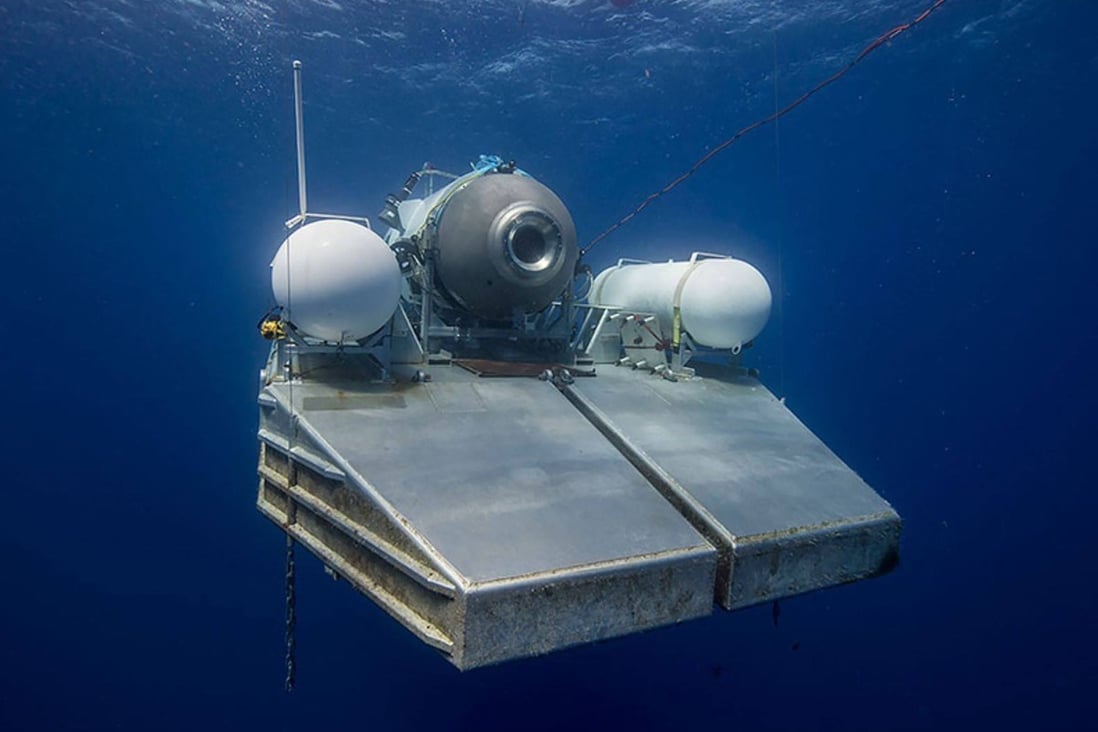
A Titan submarine is shown waiting for a signal to dive. Photo: AFP
One expert said it's difficult to determine the sequence or exactly what happened. But a catastrophic explosion would have occurred with incredible force and speed due to being crushed by water pressure at the bottom of the ocean.
The wreck of the Titanic lies at the bottom of the North Atlantic Ocean at a depth of approximately 3,800 meters.
At sea level, atmospheric pressure is 14.7 psi. Water pressure at a depth of 3,800 meters is approximately 400 atm, equivalent to nearly 6,000 psi.
In the event of a hull defect or some other reason leading to an explosion, the submersible would be crushed in a fraction of a second by the immense water pressure. Those inside the pressurized chamber would almost certainly die instantly.
"We found five different large pieces of debris that told us it was the remains of Titan," said seabed expert Paul Hankins. "Among those large pieces, we found the forward bell of a pressure vessel. That's the first indication of a catastrophic event."
"Shortly after that, we found a second, smaller piece of debris. It was the rear bell section, and we basically found the entire pressurized chamber," he said.
Professor Roderick Smith, an engineering professor at Imperial College London, said the accident was likely caused by a "failure in the pressurization section of the hull," but debris would need to be recovered for a full investigation.
Hoang Nam (according to AFP, SCMP)
Source



































































































Comment (0)