

Corporate profits continue to erode.
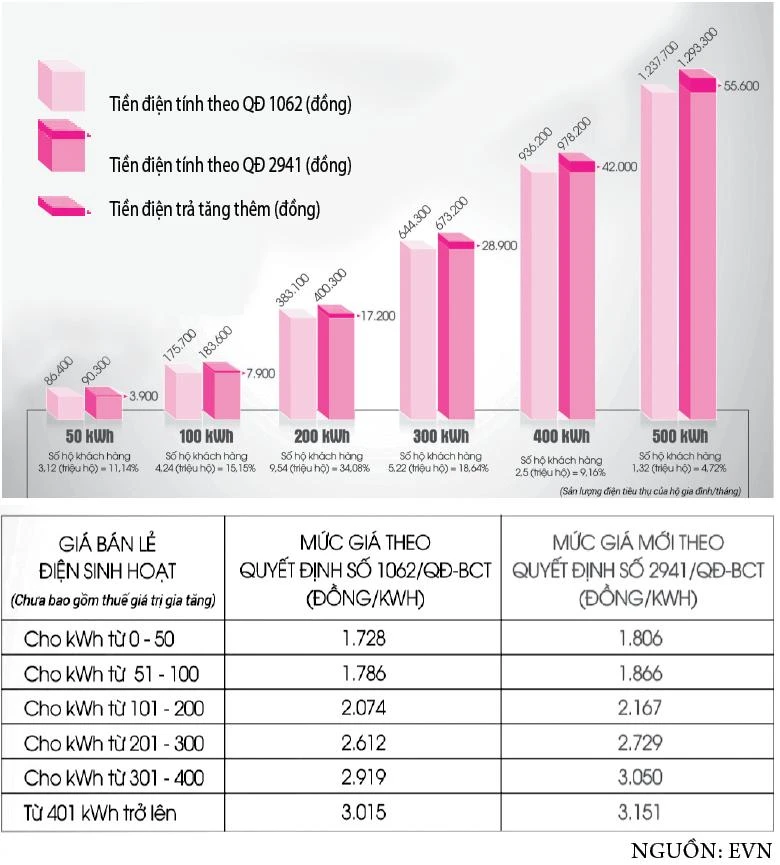
On November 9th, Vietnam Electricity Group (EVN) announced a 4.5% increase in the average electricity price, equivalent to 86.4 VND/kWh, from 1,920.3732 VND/kWh to 2,006.79 VND/kWh, excluding value-added tax. This is the second electricity price increase this year, following a 3% increase in early May. According to EVN's calculations, after the price adjustment, the monthly electricity bill will increase by 3,900 VND for customers using tier 1 (0 - 50 kWh); 7,900 VND for tier 2 (51 - 100 kWh); 17,200 VND for tier 3 (101 - 200 kWh); and 28,900 VND for tier 4 (201 - 300 kWh). Tier 5 (301 - 400 kWh) increased by 42,000 VND and Tier 6 (401 kWh and above) increased by 55,600 VND.

Rising electricity prices could impact consumer prices at the end of the year.
For manufacturing, business, and service sectors, the increase in electricity costs depends on usage and consumption rates during peak and off-peak hours. Specifically, the service sector (547,000 customers) will see an increase of approximately 230,000 VND per month; the manufacturing sector (over 1.9 million customers) will pay an additional 423,000 VND per month; and administrative and public service customers (681,000 customers) will pay an additional 90,000 VND per month. EVN assesses that this electricity price adjustment will ensure that poor households and families receiving social welfare benefits are minimally affected.
Although poor households are not significantly affected, middle-income and high-income households, and especially businesses, have to pay considerably higher electricity bills. Mr. Do Phuoc Tong, Chairman of Duy Khanh Mechanical Company and Chairman of the Ho Chi Minh City Mechanical and Electrical Association, expressed concern about the second electricity price increase this year, especially since it occurred in the last quarter of the year.
According to him, manufacturing businesses, especially those in energy-intensive industries like mechanical engineering and steel, will face even more challenges in calculating and balancing costs in the coming period. For existing orders with agreed-upon prices, they will accept increased costs, but they will also hesitate to raise prices for new orders due to intense competition. According to Mr. Tong's calculations, an average increase of 4.5% in electricity prices is equivalent to a more than 1% increase in input costs for mechanical engineering businesses in the near future.
"We manufacture for export and sell to foreign businesses in Vietnam. If we increase prices, they will buy from neighboring countries like China immediately. With significant investment in machinery improvements, Ho Chi Minh City's mechanical engineering industry has become more involved in the global supply chain. However, customers have many choices, so the biggest headache for businesses is price competition. That's why, even though costs have increased, we certainly wouldn't dare raise prices, because we have to follow world prices and market price levels. Raising prices would mean losing customers. Therefore, in the short term, the modest profits of businesses will continue to shrink," Mr. Tong said.
Mr. Tong's sentiment reflects that of most businesses in the current period, even micro-enterprises. Ms. Nguyen Thai Trang, from D&T Fashion Company, which specializes in designing and manufacturing clothing for middle-aged women, admitted that in the current difficult period, acquiring even a few wholesale customers is already challenging. Since the beginning of October, the company has launched additional discount policies to stimulate demand during the shopping season. With a 4.5% increase, the company's accountant estimates that next month's electricity bill could increase by more than 6 million VND.
Ms. Thai Trang expressed her concern: "We don't know exactly how much the electricity company will increase prices in the near future, but the additional increase we estimate will almost cover the cost of paying an extra worker's salary, while the company is already planning to reduce staff in various departments to cut costs. Regardless, the company cannot simply pass this cost on to consumers. Therefore, the increase in electricity prices could significantly erode our profits."
Controlling electricity price gouging
Although businesses say they are hesitant to raise prices, experts believe that the prices of some goods will be slightly affected by the end-of-year period, when production and consumption demand increases, leading to increased electricity demand.
Dr. Nguyen Quoc Viet, Deputy Director of the Institute for Economic and Policy Research, commented that the manufacturing sector, especially fast-moving consumer goods, will be significantly affected by the increase in electricity prices in the last quarter of the year, impacting both production costs and selling prices. Furthermore, industries with high electricity consumption will face significant pressure. Citing data from Mirae Asset's calculations in May, when the average electricity price increased by 3%, Dr. Nguyen Quoc Viet stated that at that time, electricity costs accounted for approximately 9-10% of the cost of goods sold for steel manufacturers, a similar figure for chemical companies. The cement industry saw increases of up to 14%, and the paper industry 5%. Now, with an additional 4.5% increase in the average electricity price, industries with high electricity consumption will likely continue to be affected.
This expert commented: "This situation will certainly put pressure on inflation at the end of the year, as the consumer price index is heavily dependent on production and business activities. In particular, consumer goods and food services for the Lunar New Year will be affected as the year draws to a close and production increases. Besides that, the acceleration of disbursement, the rush of public investment, and the slight increase in exports will lead to increased electricity consumption. Therefore, no matter what, businesses will have to be very careful to make a profit in the last months of the year, otherwise, they will end another year of even greater difficulties."
Sharing the same view, Associate Professor Dr. Dinh Trong Thinh, an expert in economics and finance, affirmed that production and consumption costs will certainly be affected to some extent by electricity prices, impacting all goods and services, but the impact will not be significant. He analyzed that with a 4.5% increase in the average electricity price, the increase in production costs will be less than 0.2% of the total electricity consumption. This increase is negligible and unlikely to affect prices.
However, Mr. Thinh noted that prices must be well controlled to avoid a situation where prices "increase in line with electricity prices." Prices of goods usually increase at the end of the year due to preparations for the Lunar New Year, when businesses often stockpile goods for production. If not strictly controlled, this could lead to people taking advantage of the electricity price increase to raise the prices of goods, resulting in a chain reaction of price increases.
"Price and market management agencies must monitor more closely and frequently in the coming period. On a macroeconomic level, inflation until the beginning of November was still well under control, around 3.2%, and the value of the Vietnamese Dong was also appreciating well against the US Dollar. Meanwhile, there is only a month and a half left until the end of the year, too short a time to say how electricity prices will affect the consumer price index (CPI). It is predicted that this year, the CPI will be below the threshold of 4.5% allowed by the National Assembly," Associate Professor Dr. Dinh Trong Thinh emphasized.
Enhance "shock-resistant" solutions.
Citing the General Statistics Office's assessment of the impact of the electricity price increase on the consumer price index (CPI), Mr. Tran Viet Hoa, Director of the Electricity Regulatory Authority (Ministry of Industry and Trade), said that the CPI could increase by 0.035% after the electricity price hike. According to Mr. Hoa, even with this latest price increase, the electricity price is still below the 2023 electricity production cost. This price increase has not yet offset the electricity production and business costs, and the exchange rate difference of over 14,000 billion VND from the previous year was not factored into the electricity price calculation.
Everyone understands the negative cash flow problem in the electricity sector, but raising prices at the end of the year, when the economy is struggling, exports are declining, the number of businesses leaving the market is increasing, purchasing power is weak, and incomes are decreasing, will create considerable pressure on both people and businesses.
However, Dr. Nguyen Quoc Viet commented that the electricity sector was quite "clever" in choosing the timing of the price increase right at the beginning of winter, when the demand for electricity for cooling in the northern and central regions may decrease. Accordingly, electricity bills for each household during this period will increase, but the increase will not feel significant due to reduced electricity consumption. He believes that in the context of an economy still facing many difficulties and challenges, it is essential to reasonably calculate the increase to ensure that EVN can maintain its production and business operations, reinvest, and restore and develop the production and business of enterprises and the lives of the people, ensuring a harmonious balance of interests between the state, the people, and enterprises.
However, Mr. Viet also acknowledged that most businesses are facing difficulties, incurring significant losses, and experiencing production stagnation due to reduced domestic and global purchasing power. Therefore, increasing electricity prices at this time would indirectly create an additional burden. He suggested that solutions are needed to "cushion the shock" for businesses by facilitating access to loans and reducing administrative procedures. Regarding EVN, the expert advised that expenses such as operating costs, investment costs, and labor costs should be carefully considered to balance financial resources. In the long run, the losses of businesses cannot and should not be passed on to electricity prices.
In the future, the upward trend in production input prices will remain very high due to unfavorable developments from geopolitical tensions around the world, which will continue to affect exchange rate stability. At that time, the pressure to ensure the inflation target of below 4.5%, which the National Assembly recently approved for 2024, may be challenged. This is without considering the wage reform implemented from the middle of next year. "In reality, the prices of basic services have been under pressure to increase but have been suppressed to ensure macroeconomic stability in 2023 at 3.2-3.3%. With this price increase, inflationary pressure will persist into next year," Dr. Nguyen Quoc Viet noted.
Dr. Nguyen Duc Do, Deputy Director of the Institute of Economics and Finance (Academy of Finance), commented that the target of controlling the average annual CPI increase rate at around 4.5% is still within reach. Therefore, the impact of electricity price increases on the CPI is not a cause for concern. However, the increase in input costs for manufacturing businesses due to rising electricity prices has fueled anxiety at the end of the year. This is something that regulatory agencies should have anticipated.
"In reality, splitting the electricity price increase into two phases also reflects that intention. The audit results show that electricity production costs increased sharply last year and this year will also increase, although not as much as last year. Therefore, an increase in electricity prices is unavoidable. Macroeconomic management involves dividing the increase into smaller increments to avoid shocks, but it's impossible to 'absorb' all the shocks. Fortunately, world oil prices are trending downwards at this time, and the special consumption tax on these items has been proposed to be further reduced by 50%... These factors hopefully will help balance the costs for businesses and consumers," Mr. Do analyzed.
Raising electricity prices will help EVN collect an additional approximately 3,200 billion VND.
EVN representatives stated that this electricity price increase will help the corporation increase revenue by approximately 3,200 billion VND from now until the end of the year, helping to alleviate some of the difficulties of 2023. Previously, with the electricity price increase in early May, EVN collected an additional 8,000 billion VND this year. However, these two price increases have not yet fully offset the losses from last year to date. By the end of August, EVN's estimated losses are expected to reach over 28,700 billion VND. If we include the 26,500 billion VND loss of 2022 (excluding exchange rate differences) and the first eight months of 2023, EVN's total losses exceed 55,000 billion VND.
According to EVN, in 2023, several input parameters affected costs, including a 17 billion kWh decrease in hydropower production – a source of cheap electricity. The prices of input fuels remained high, such as imported coal increasing by 186% compared to 2020; domestic coal prices increased by nearly 30-46% compared to 2021. Oil prices also increased by 18% compared to 2021, and especially the foreign exchange rate increased by nearly 4%, directly impacting EVN's electricity purchase costs and electricity prices.
EVN is developing a pricing framework for electricity generation from wind and solar energy sources.
EVN has recently issued a document requesting the Electricity Trading Company (EPTC) to calculate and develop a framework for electricity generation prices for wind and solar power plants, following the method used by the Ministry of Industry and Trade in establishing electricity generation price frameworks. Previously, EVN received Document No. 7695 dated November 2nd from the Ministry of Industry and Trade regarding the development of an electricity generation price framework applicable to various types of power plants.
EVN requires EPTC to calculate and develop a framework for electricity generation prices (consultants may be hired if necessary) for solar power plants (ground-mounted solar power, floating solar power) and wind power plants (onshore, offshore, and offshore wind power) in accordance with Circular No. 19/2023 dated November 1, 2023, of the Ministry of Industry and Trade, which stipulates the method for developing the electricity generation price framework for wind and solar power plants. The method and formula for calculating the price are based on relevant parameters (investment costs, operating costs, fixed maintenance costs, interest rates, electricity delivery and acceptance, etc.).
Regarding the methodology for constructing the electricity generation price framework based on parameters such as installed capacity, project economic viability, repayment period, equity/loan ratio, profit margin, and the corresponding normal distribution coefficient for expected wind power; the investment cost parameters, foreign currency loan ratio, operating and maintenance cost ratio, and parameters for calculating the average annual electricity output of standard wind and solar power plants are selected based on data from consulting organizations to ensure universality and up-to-date global data, instead of using historical data from power plants; domestic and foreign currency loan interest rates are determined based on statistical data from credit institutions.
Source link

![[Photo] Admire the coral "masterpiece" amidst the million-year-old heritage of Dak Lak province.](https://vphoto.vietnam.vn/thumb/1200x675/vietnam/resource/IMAGE/2026/05/30/1780107638639_y25-jpg.webp)





































































































Comment (0)